

How to Start an HVAC Business
In a $159 billion market, HVAC customers come onto your calendar twice a year by agreement, and the equipment fails on the hottest day of the year whether anyone budgeted for it or not. Here is what an HVAC business costs, what it pays after you replace yourself, and why the maintenance agreement is the best recurring-revenue mechanism in the trades.
Chris Scott — former CDFI director and SBA management
As the director of a Community Development Financial Institution (CDFI), and as management at the U.S. Small Business Administration (SBA), I saw thousands of business plans and loan applications cross my desk. That work is where I learned what a durable business looks like on paper, and what a business that only looks durable looks like on paper.
It is not, however, where the list of fifty came from. That came from years of research, running category after category through the same four questions: Is it profitable? Does it have recurring revenue? Is it recession resistant? Is it AI resistant? Those four questions are the framework behind the book, The Microbusiness Millionaire, and they are what separated the categories that built real wealth from the ones that quietly built a job with a P&L attached. Fifty survived the screen. Far more never made it through.
HVAC is one of the fifty, and it carries one structural advantage most trades do not — the maintenance agreement, which turns customers into a calendar. It is also one of only nine that carry no structural condition at all. What follows is the market, the four questions, the three ways in and what each costs, how people fund it, and where the money actually ends up.
The industry: big, essential, and quietly consolidating
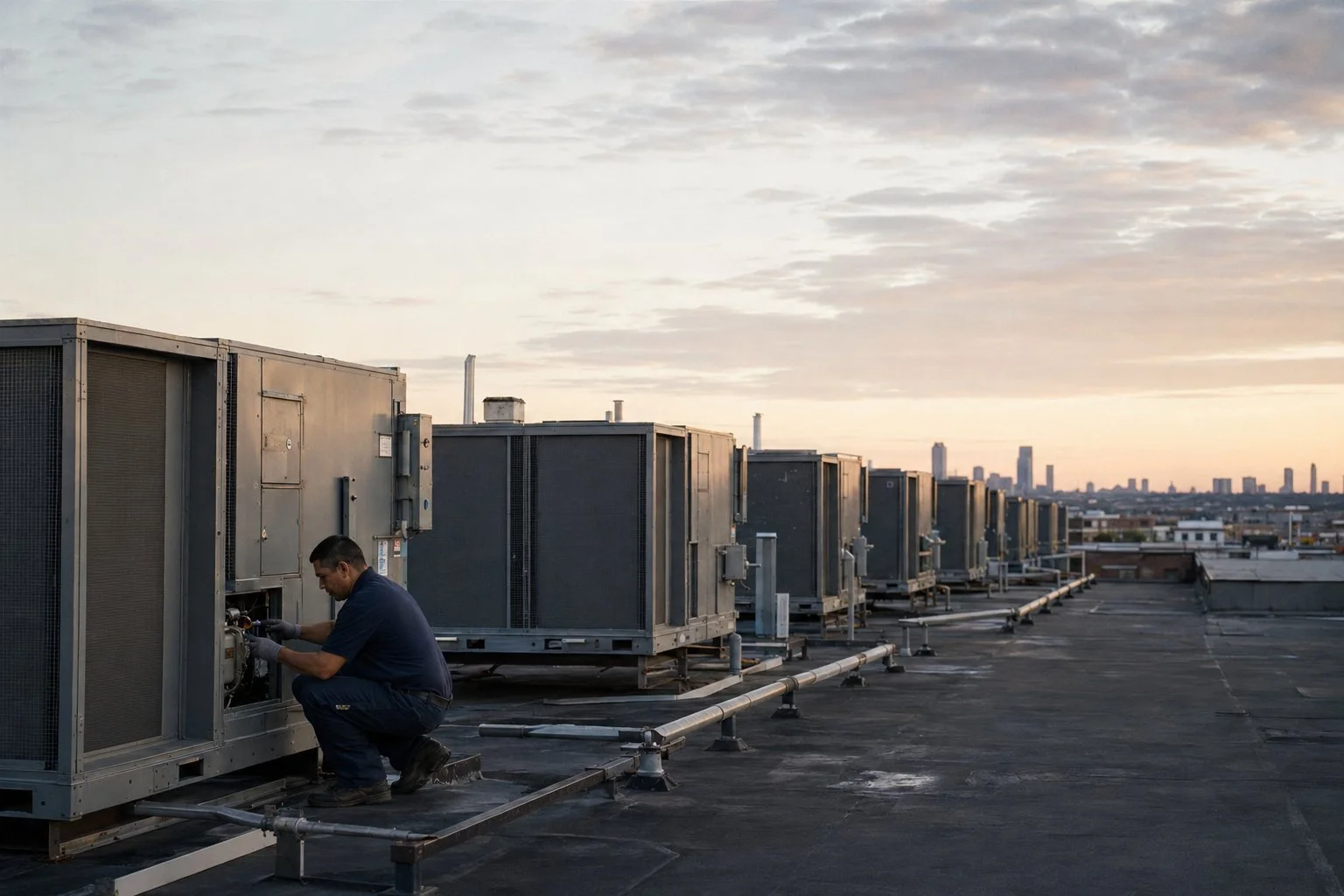
The U.S. heating and air-conditioning contractors industry is about $159.4 billion in 2026, growing at a 2.6% compound rate over the past five years. [S1] This is essential infrastructure: the work is steady precisely because the services are necessary and the repair and maintenance demand never stops. [S1]
The labor picture is the interesting part. There were 425,200 HVAC technicians in 2024. Employment is projected to grow 8% from 2024 to 2034 — much faster than average — with about 40,100 openings a year. [S2] What those technicians are paid depends on where you are hiring. The wage worth planning on is the local one, and the Resource Directory in the free tools shows where to find it. The price of replacing yourself is a supervisor's wage — the pay that shows up the day you come off the trucks. Every profit number later in this article has to survive it, and the real cost runs higher once payroll taxes and insurance go on top.
Read that as an owner rather than as a job-seeker. Demand for the work is outrunning the supply of people who can do it, which gives you pricing power. It is also the thing you will manage every week for as long as you own the business.
Why HVAC made the list
Every category in the research had to clear four tests. Clear three and you usually have a self-employed job in disguise.
Does it pay after you replace yourself? It does, at scale, after paying technicians and after paying someone to do the job you have been doing for free.
Does the revenue recur? Yes, and this is HVAC's structural edge over every other trade: the maintenance agreement. Spring and fall service contracts put customers on your calendar twice a year, by agreement, before the season starts. That is not repeat business you hope for. It is contracted revenue you can forecast, and it is the thing a buyer pays a premium for.
Does it survive a recession? Heat and cooling are not optional. New-construction HVAC moves with the builders, but replacement and service demand is driven by equipment failure, and equipment fails on its own schedule regardless of the economy.
Will it still need humans in ten years? Someone has to be on the roof, in the attic, with a gauge set on the unit. Software can dispatch the truck. It cannot braze a joint. Very low AI exposure.
Four for four, with the best recurring-revenue mechanism in the trades.
The research on this category kept separating operators on a single line item that never appears in a marketing brochure: how many maintenance agreements they hold. Two companies in the same city can post similar revenue and run completely different businesses. One carries several hundred agreements and its phone rings all winter, because several hundred households have already paid for a visit. The other sells installs and emergency calls, often deliberately, on the view that service work is cheap work — and then goes looking to restructure in February. From the lending side of the desk the agreement count is the first thing worth asking for, because it is the closest thing this trade has to contracted revenue. The agreements were never the cheap work. They were the reason one of those businesses had a floor under it.
What it takes to make this one work
A note on the tags. Every category in the fifty cleared the same four tests; far more never made it through. The tags do not grade a business — they tell you what has to line up for it to work in your hands. HVAC carries the Works anywhere tag: one of only nine categories with no structural condition, no season to cover and no geography that decides it. Every market has heating or cooling, and most have both.
What does matter is inside your control, and it is what the rest of this article is about: the certifications, the agreement count, and whether you can recruit technicians in a trade that is short of them.
What it costs to get in — the three paths
| Path | Best for | Typical cost range |
|---|---|---|
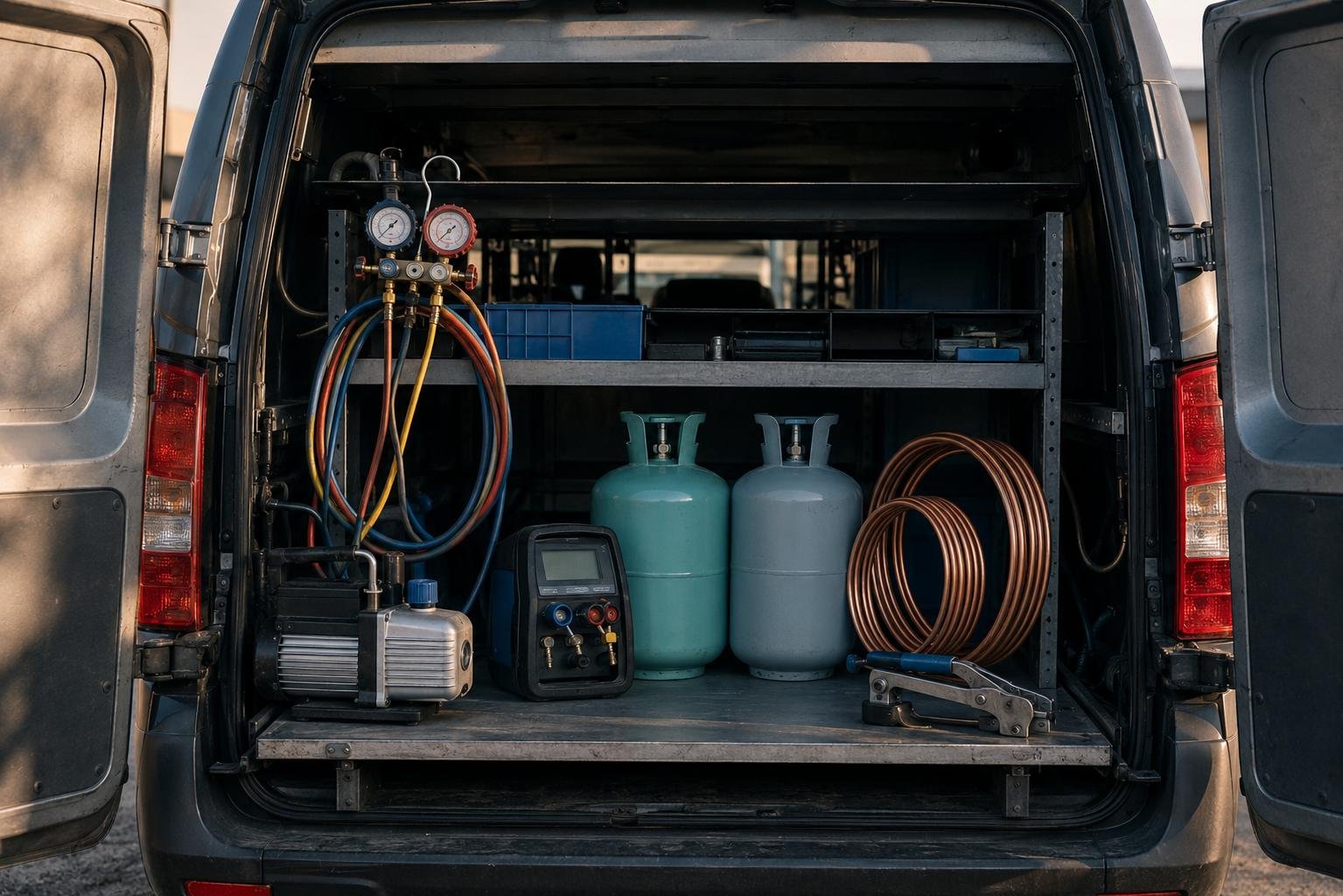
| Startup | EPA cert + state license + truck | $30,000 – $75,000 |
| Acquisition | Established service contracts + customer list | $280,000 – $350,000 |
| Franchise | Brand + lead generation + territory. Examples: Aire Serv, One Hour Heating & Air. | $85,000 – $290,000 |
Franchise brands are named as examples, not endorsements, and the range shown is a category estimate rather than any single brand's published figure. Franchise investment figures reflect a franchisor's most recent Franchise Disclosure Document (FDD) and change annually — verify each brand's current FDD (Item 7 for the initial-investment range; Item 19 for any financial-performance representation) before pursuing one. [S3]
Both brands in that row disclose 2026 ranges reaching well past a quarter of a million dollars — Aire Serv at roughly $113,800 to $271,700 and One Hour Heating & Air at roughly $143,300 to $286,700, with lower readings around $85,000 to $88,000 for the smallest territories. [S6]
Note how One Hour prices its fee, because it is the second category in the fifty to work this way: a base of about $43,000 plus a small amount for every person in the territory above 100,000. As with garage doors, the headline number is not really a price. It is a function of how many households you are being given, which means a bigger fee and a bigger market arrive together and the comparison only makes sense territory by territory.
Read the acquisition line carefully: established service contracts. You are not paying $280,000 to $350,000 for trucks and gauges. You are paying for a customer list of maintenance agreements, which is the thing that puts a floor under a winter.
When you evaluate an HVAC acquisition, the agreement count and the renewal rate matter more than the equipment list. Ask for both before you ask for anything else.
How people actually fund it

An acquisition at $280,000 to $350,000 sits in CDFI direct lending and SBA Community Advantage territory — the community-lender tiers most first-time buyers have never heard of. Community Advantage carries up to $350,000, so this range fits inside the framework's lane almost exactly; deals priced above that line are a different conversation, and the framework's advice is to start below it and grow into larger deals using retained earnings and the lender relationship.
One pattern I watched from the lending chair, across every industry that came through: a qualified buyer walks into a big national bank, gets declined, and concludes he cannot be funded. He never learns that a CDFI across town, or a Community Advantage lender, specializes in exactly this size of deal. Two free national directories will show you the ones near you — the Opportunity Finance Network CDFI locator and SBA Lender Match. [S4]
A $30,000–$75,000 startup is a different tier altogether — SBA Microloan territory, or savings if you already hold the certifications.
Finding the lender is the easy half. An HVAC company also has a specific tell an underwriter looks for: the maintenance-agreement count and its renewal rate. Several hundred agreements renewing reliably reads very differently from a run of installs and emergency calls, because one of those is forecastable and the other is not. Start recording both before anyone asks for them.
The profit reality: owner-replacement cash flow

Here is the calculation that separates a business from a job.
An HVAC company looks profitable because the owner is running calls, quoting installs, dispatching, and doing the books — none of it priced. The honest test: after you pay the technicians, and after you pay a field supervisor a market wage to run the day-to-day the way you run it, is there anything left for you as the owner?
Real numbers. Technician pay and first-line supervisor pay both move by market. In a trade growing 8% with 40,100 openings a year, you will not be paying below the going rate for anyone good. Pull both figures for your own area before you model anything. [S2] [S5] Whatever the company shows as profit has to survive paying both.
If it survives, you own a business. If it only works because you are the supervisor for free, you own a job with a P&L attached — and you find that out the first summer you try to run two crews at once.
The category-level math is easy — you just did it. Running it on a specific company, where the seller's profit quietly includes his own labor and the agreement count might be six hundred or might be sixty, is where people freeze. That is the job of the course, Microbusiness Millionaire: Operating System — the four tests turned into a repeatable screen you run on a real deal.
The benefits of owning an HVAC business
Contracted recurring revenue. Spring and fall maintenance agreements put customers on your calendar before the season starts.
Essential demand. Heat and cooling are not discretionary, and equipment fails on its own schedule.
A labor market that supports your pricing. Growth of 8% and 40,100 annual openings means technicians are the constraint, and constrained supply holds rates up.
AI resistance. On the roof, in the attic, gauges on the unit — work that needs a person standing there.
A natural pairing with plumbing. The multi-trade home-services platform is the standard roll-up for a reason.
A liquid exit. A documented agreement list sells well, and consolidators are actively acquiring in this space.
What separates the strong operators from the struggling ones
Agreements sold from day one. The most consequential decision in this category. Every agreement is a scheduled visit and a floor under your winter, and the count is what a buyer eventually pays a premium for.
The owner-replacement math, done first. Put a supervisor's wage into the numbers before counting anything as profit, and the day you hire one changes nothing about your cash flow.
Service alongside installs. Installs arrive unevenly and move with the cycle; service is steady. A company weighted toward both rides out the years when building slows.
Peak-season emergency work priced properly. The hundred-degree Saturday call is worth a premium, and charging it is what funds the rest of the year.
Systems before technicians. In a labor market this tight, put training and process on paper first — then every hire lands on something rather than learning from your elbow.
Refrigerant compliance kept current. EPA Section 608 is federal law with real penalties attached. Diary the certifications the way you diary the service calendar.
Licenses, permits, and regulations
Two gates. First, EPA Section 608 certification is federally required for anyone who maintains, services, repairs, or disposes of equipment that could release refrigerants — with certification types by equipment class (Type I small appliances, Type II high-pressure, Type III low-pressure, Universal). That is federal law, not a nice-to-have. [S6] Second, most states require an HVAC contractor license, with requirements, exams, and experience hours that vary by state. Add a registered entity, general liability, workers' comp, bonding for commercial work, and local permits on installs. Start with the EPA's 608 program page, your state licensing board, and the free SBA "Apply for licenses and permits" tool. [S7] (General information, not legal advice — confirm your local requirements.)
Build a portfolio, not a job
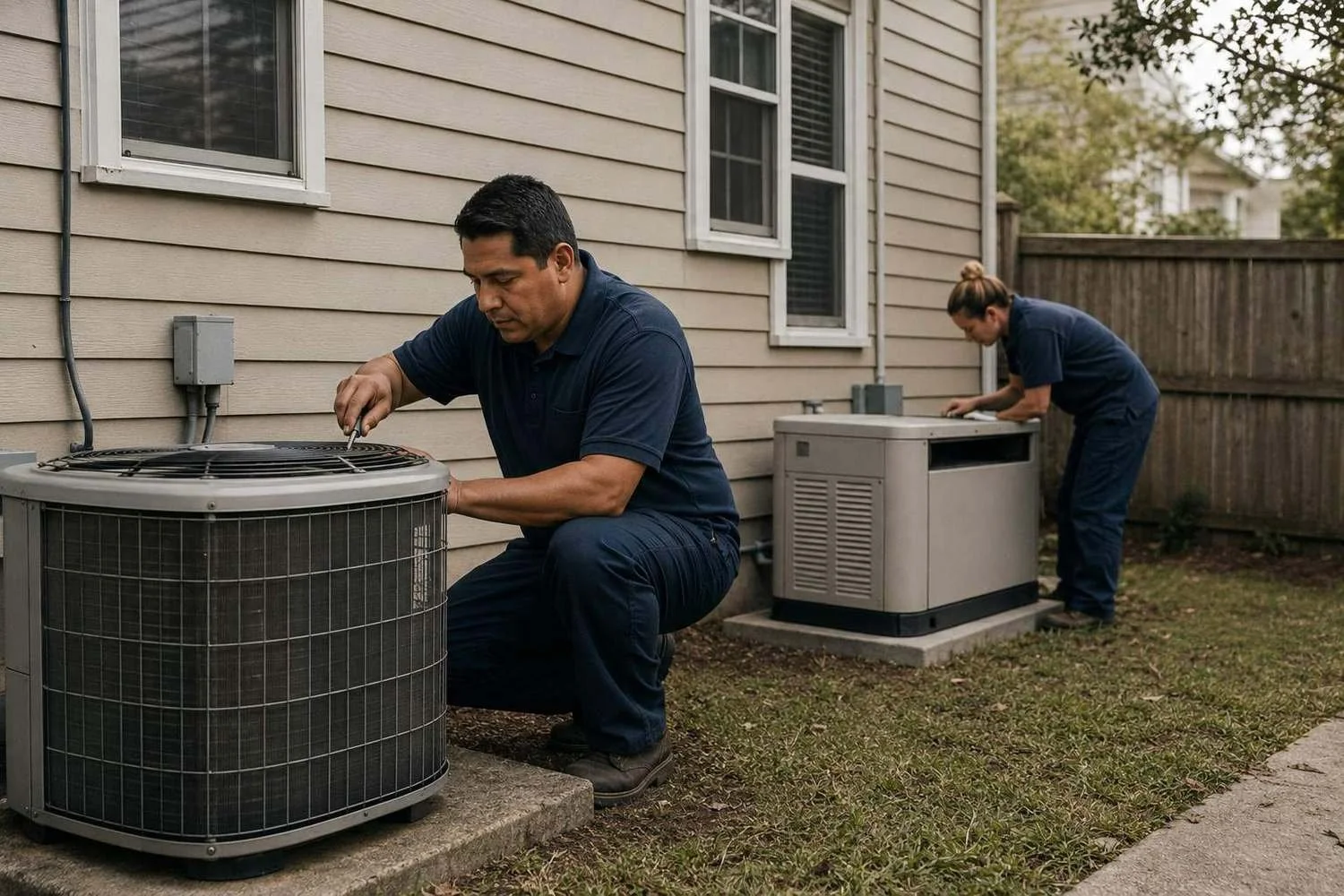
HVAC is a route business: it stacks along a territory, on customers and dispatch you are already paying for, rather than at a single location. It pairs naturally with plumbing, electrical, indoor air quality, and generator service — same customers, same dispatch, same trucks.
HVAC plus plumbing is the classic multi-trade home-services platform, and it works because the expensive part of both businesses is identical: getting a trusted technician through someone's front door. Once that is done, selling the second trade costs almost nothing. Indoor air quality and generator service are premium additions to a customer list you already own. Start with the agreement holders, then sell the next service to the people already on that list.
That is the difference between owning a crew and owning a portfolio. You are not building an HVAC company. You are building the trades vendor a few hundred households call first, anchored by agreements that put them on your calendar before the season starts. A portfolio like that, with a documented customer list and a renewal rate behind it, sells to a buyer as one asset — which is how it ends up worth over a million dollars at sale, instead of a van and a gauge set.
Frequently asked questions
Is an HVAC business profitable? At scale, yes, measured honestly — after paying technicians and after paying a supervisor to replace the owner's labor. That is the test, not the percentage on the way there. The agreement count is what decides whether the answer holds through a slow winter.
How much does it cost to start an HVAC business? Roughly $30,000 to $75,000 to start with certifications in hand, about $280,000 to $350,000 to buy an established company with service contracts, or roughly $85,000 to $290,000 for a franchise.
What certification do I need for HVAC? EPA Section 608 certification is federally required for handling refrigerants, and most states also require an HVAC contractor license. Verify both. [S6][S7]
Can I start an HVAC business part-time? If you are already a certified technician working for someone else, evenings and weekends are a workable on-ramp. The one thing to plan for is that peak-season emergency demand does not respect a part-time schedule.
Where to go from here
Download the free guide.50 Boring Businesses That Make Millionaires is the full result of the research: fifty categories run against the four tests, what each one costs to enter by all three paths, what has to line up for it to work, and how they pair into a portfolio. Free at microbusinessmillionaire.com.
Read the book.The Microbusiness Millionaire: How Ordinary People Build Extraordinary Wealth One Microbusiness at a Time follows four people who each reached a portfolio worth more than a million dollars by a different path. One keeps a hospital job and uses CDFI financing to acquire one stable service business, then another, then a third. One saves on a single income for three years, leaves a master plumber's wage, and stacks trade service lines starting with an SBA microloan. One uses an SBA Community Advantage loan to open a franchise, then opens three more. One starts with about $5,000 on the side and keeps a W-2 for years, building the slowest and most patient version of the same result. Four starting points, four amounts of money, four portfolios worth over a million dollars at sale. The book is coming soon — join the email list at microbusinessmillionaire.com to hear when it lands.
Join the next cohort — Microbusiness Millionaire: Operating System. The book gives you clear examples of how it's done. The course is the step-by-step system for doing it yourself: screening a real company against the four tests, running the owner-replacement cash-flow math on a seller's actual numbers, knowing when to walk, knowing which lenders fund deals this size, and installing the operator who runs the business without you. Eight weeks online, five seats a cohort, waitlist first — at microbusinessmillionaire.com.
About the author
Chris Scott has spent more than twenty-five years in the small-business arena. As the director of a Community Development Financial Institution (CDFI) and as management at the U.S. Small Business Administration (SBA), he saw thousands of business plans and loan applications cross his desk. His research into which microbusinesses build wealth — and which quietly build a job — became The Microbusiness Millionaire and the free companion guide, 50 Boring Businesses That Make Millionaires.
Sources & references
[S1] IBISWorld, Heating & Air-Conditioning Contractors in the US — Industry Analysis / Market Size, 2026 ($159.4bn; 2.6% CAGR 2021–2026). ibisworld.com
[S2] U.S. Bureau of Labor Statistics, Occupational Outlook Handbook: Heating, Air Conditioning, and Refrigeration Mechanics and Installers (425,200 jobs in 2024; 8% projected growth 2024–34; ~40,100 annual openings). bls.gov/ooh
[S3] U.S. Federal Trade Commission, Franchise Rule / FDD Items 7 and 19. ftc.gov
[S4] Opportunity Finance Network CDFI Locator (ofn.org); SBA Lender Match (sba.gov).
[S5] U.S. Bureau of Labor Statistics, OEWS, First-Line Supervisors of Construction Trades and Extraction Workers (SOC 47-1011). bls.gov/oes
[S6] U.S. Environmental Protection Agency, Section 608 Technician Certification. epa.gov
[S7] U.S. Small Business Administration, Apply for licenses and permits (sba.gov); state HVAC contractor licensing boards.
[S6] HVAC franchise disclosure data: One Hour Heating & Air Conditioning's 2026 FDD states an estimated initial investment of $143,273–$286,702, on a base initial franchise fee of $43,000 plus an additional population fee of $0.43 for each person above 100,000 in the territory; other readings report $84,570–$286,702. Aire Serv's 2026 FDD is reported at $113,809–$271,709, with other readings at $87,600–$216,400 on a $40,000 fee. Reported figures vary between aggregators and filing years; verify the current FDD directly for any brand.
[Internal]50 Boring Businesses That Make Millionaires — HVAC entry (tag, three-path entry-cost table, portfolio pairings, framework note), drawn from the author's research and filtered through the underwriting criteria he applied as a CDFI lender.
This article is for general information only and is not legal, financial, tax, or investment advice. Category-level figures are reference points, not a specific-deal projection; individual businesses vary. Consult a CPA, attorney, business broker, franchise consultant, or CDFI loan officer before acting.
Last updated: 8/21/2026.