

How to Start a Window & Gutter Cleaning Business
The thing everyone treats as this category's limitation — a customer who only calls twice a year — is the reason nobody ever leaves. Here is what a window and gutter cleaning business costs, what it pays after you replace yourself, and the one move that turns two visits a year into four on the same address.
Chris Scott — former CDFI director, SBA manager

As the director of a Community Development Financial Institution (CDFI), I reviewed loan applications and made the approve-or-decline decisions. Later, at the U.S. Small Business Administration (SBA), I monitored lending programs and saw which loans were approved and which were denied. Across those two roles, thousands of business plans and loan applications crossed my desk. I still work at the SBA, now in its venture capital division. That work is where I learned what a durable business looks like on paper, and what a business that only looks durable looks like on paper.
It is not, however, where the list of fifty came from. That came from years of research, running category after category through the same four questions: Is it profitable? Does it have recurring revenue? Is it recession resistant? Is it AI resistant? Those four questions are the framework behind the book, The Microbusiness Millionaire, and they are what separated the categories that built real wealth from the ones that quietly built a job with a P&L attached. Fifty survived the screen. Far more never made it through.
Window and gutter cleaning is one of the fifty, and it is a category an owner can buy into and then stack other services on top of.
It looks almost too simple to be a real business. That simplicity is exactly why it works, and there is one condition you have to design around from the first day rather than discover in year two.
A word on the neighbor.Solar panel cleaning is also one of the fifty, and the two run together so naturally that they are easy to confuse — same ladder, same exterior, often the same house. They are different businesses. Window and gutter cleaning is a standalone route: the customer knows they need it, calls for it, and buys it on its own. Solar cleaning is an attachment: the same visit, the same customer, but somebody has to show them the array is quietly costing them output. Window cleaning is a route you can build. Solar cleaning is a service you attach to one. That is why solar appears further down this article as one of the four services you bolt onto this route, and not the other way around.
The industry: small owners, sticky customers
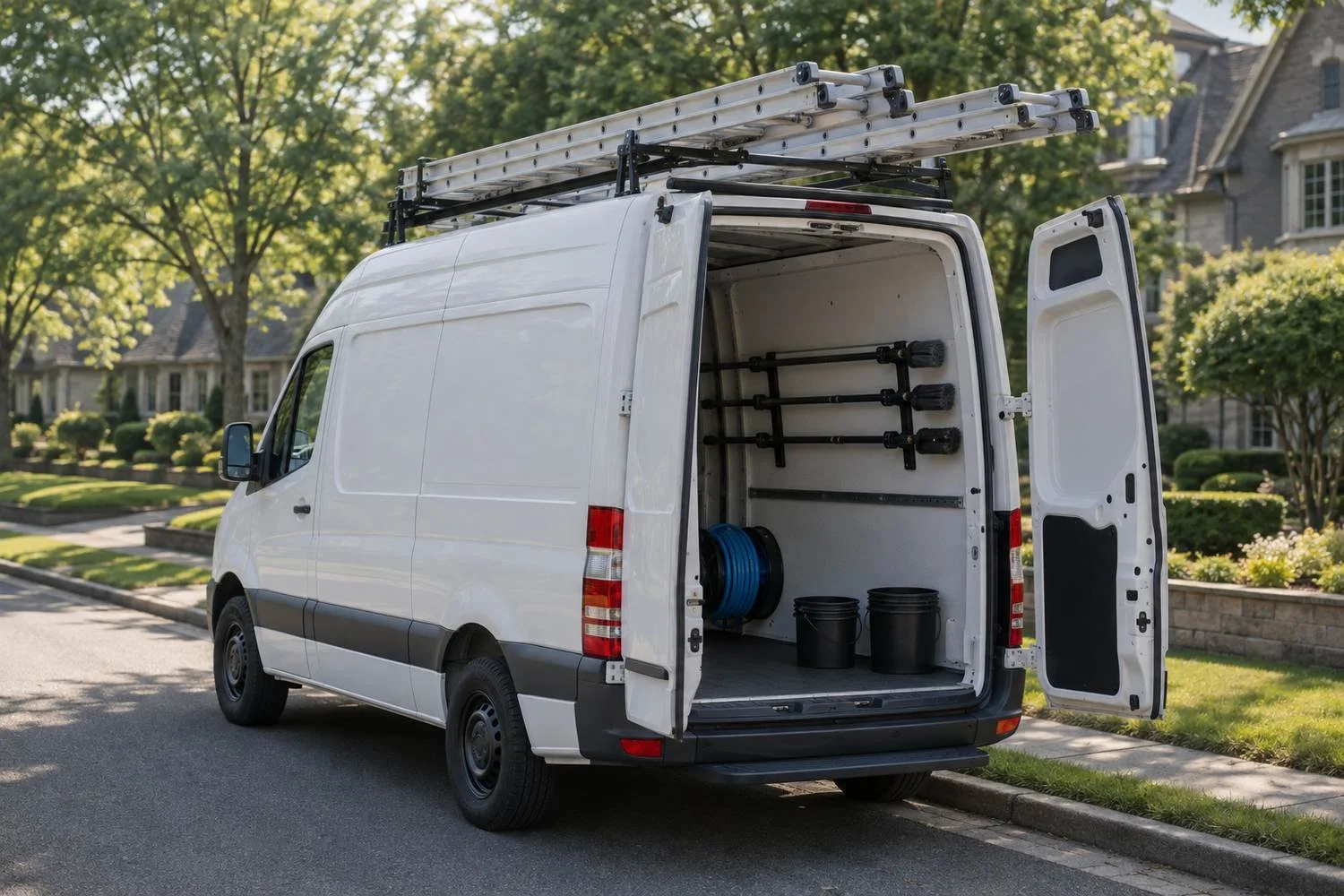
U.S. window washing is about $2.9 billion in 2026, spread across roughly 35,300 businesses. [S1] Pressure washing, the service that pairs with it most naturally, adds about $1.2 billion across another 32,000-plus businesses, so fragmented that no single company holds even a 5% share. [S2]
Do the arithmetic on the first figure and the average window washing business turns over about $82,000 a year. That tells you the category is full of one-van owners who have not yet built a second service, which is precisely the gap the rest of this article is about. The owners doing well are the ones running two or three related exterior services off the same truck.
The labor benchmark comes from grounds and building maintenance work. [S3] What it pays is a local number, reported by area, and it varies more from one metro to the next than it does across trades. Plan against your own. That wage is the price of replacing yourself — what a manager would have to be paid to do the work you would otherwise be doing. Every profit number later in this article has to survive it, and the real cost runs higher once payroll taxes and insurance go on top.
This is a hire-and-train business rather than a licensed-credential one, which cuts both ways. You can start almost immediately and staff up without waiting on anybody's certification — and so can the person down the street. The defensibility comes from the route and the retention rather than the skill.
Why window & gutter cleaning made the list
Every category in the research had to clear four tests. Clear three and you usually have a self-employed job in disguise.
Does it pay after you replace yourself? It does, on one condition about frequency that the tag section below handles head-on, because it is the single thing this category asks of you. The short version: it pays once the route is dense and the address is buying more than one service.
Does the revenue recur? Predictably, once or twice a year, and far more reliably than that number sounds. Windows get dirty on a schedule. Gutters fill every autumn without exception. The customer who had you out last spring has you back this spring, because the need returns like clockwork and finding somebody new is a small chore nobody gets around to.
Does it survive a recession? Reasonably well on the commercial side, where a storefront still needs clean glass to sell, and better still on the gutter side. A clogged gutter becomes a roof and foundation repair rather than a cosmetic one, and the homeowner who defers it pays for it later at considerably higher rates. That is maintenance, not luxury, and it is the half of this business that holds when money is tight.
Will it still need humans in ten years? Someone has to reach the glass and clear the downspout by hand. Software can route the day and send the reminder. It cannot get up to the gutter.
Four for four, on an entry of $2,000 and a ladder.
The research found people underestimating this category again and again, and the reason is a piece of intuition that turns out to be backwards. An account that generates revenue once or twice a year looks slight next to a weekly service, and the first instinct is that a customer you see twice a year cannot be sticky. Then you look at tenure and find average accounts running nine years and longer. The low frequency is not the limitation. It is the reason nobody leaves. A customer who thinks about you twice a year, and finds you turned up both times, never develops the habit of shopping around — whereas a weekly service is one poor visit away from being replaced, every single week. From the lending side of the desk that reframes what the file is showing. Customer count is the number people bring; tenure is the number that predicts whether the revenue survives the sale. A route of two hundred accounts averaging nine years is a different asset from four hundred averaging eighteen months, and should be priced as one. Ask for the tenure distribution before the revenue figure.
What it takes to make this one work
A note on the tags. The tags do not grade a business — they tell you what has to line up for it to work in your hands. Window & gutter cleaning carries one: Best paired. On this category the tag is less a condition than an instruction manual.
Best paired: sell exterior maintenance, not window cleaning
The condition: customers come around only once or twice a year. A single service run on its own builds a route slowly, because filling a calendar takes a great many addresses when each one calls twice — and reaching a full week takes materially longer here than in a weekly-service business.
The move that meets it: bundle from the first day rather than from the first slow winter. Sell exterior maintenance instead of window cleaning, and lead with whichever service the customer happens to need today.
Add power washing, gutter guard installation, holiday light installation and solar panel cleaning to the same route and one address becomes four visits a year instead of two. Same ladder, same truck, same trust — you are giving the customer more reasons to see your face, not finding more customers. That distinction is the entire economics of this category. What you are building is not a window company but an exterior-services customer list anchored on windows.
The upside: retention runs high and acquisition cost spreads over years rather than months. Bundle that stickiness across four services on one address and you have built the thing a buyer pays a real multiple for — not revenue, but revenue that will still be there the year after the sale.
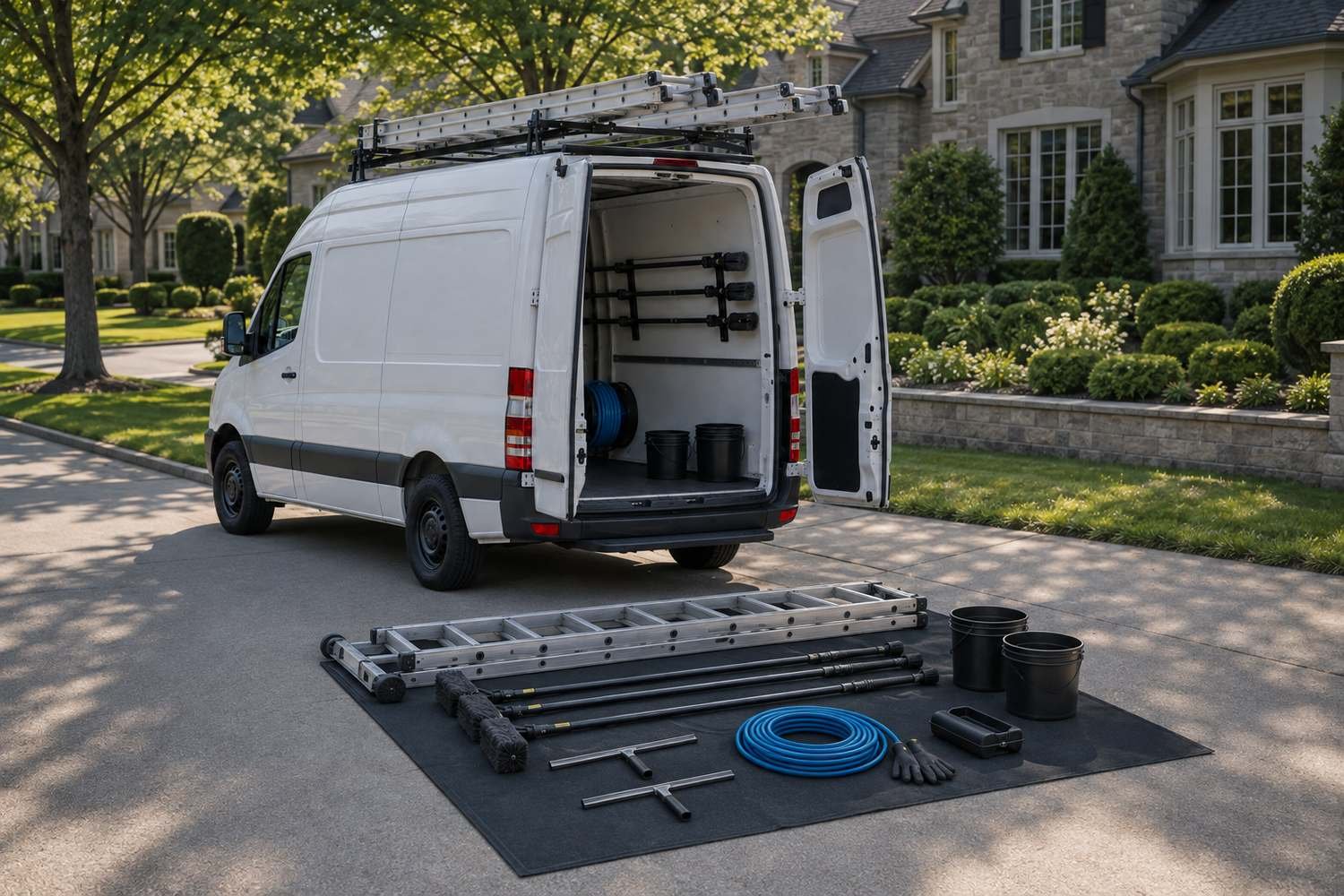
What it costs to get in — the three paths
| Path | Typical cost range | Best for |
|---|---|---|
| Startup | $2,000 – $10,000 | Ladders + supplies + insurance |
| Acquisition | $134,000 – $211,500 | Route + equipment |
| Franchise | $125,000 – $300,000 | Brand + bundled service model. Examples: Shine, Window Genie. |
Brands are named as real examples so you can check them yourself, not as endorsements, and their actual investment ranges may differ from the range above. Each franchisor's Franchise Disclosure Document (FDD) is the authoritative source and refiles annually: check Item 7 for the initial-investment range and Item 19 for any financial-performance representation before pursuing one. [S4]
The franchise row spans a wider band than it looks, and both named brands start higher than a category number suggests. Shine's own figure for a single territory is $141,570 to $203,095; Window Genie's 2025 Item 7 runs $125,600 to $300,000. [S7] The difference is territory size and how much fleet is included. Read Item 7 on the specific territory being offered rather than assuming a category figure covers it.
Notice what the franchise row is really selling. Every system that franchises this for a living sells windows plus gutters plus power washing plus lights. Not one of them sells window cleaning on its own.
They reached that conclusion the same way your own route math will. You can build the identical bundle for $2,000 and a ladder — what the franchise sells is the playbook and the territory, not the buckets.
How people actually fund it

At the low end this barely needs a lender at all. A $2,000 to $10,000 startup comes out of savings — the tier where a business gets built on weekends around a W-2 rather than launched all at once.
A lender enters at the $134,000 to $211,500 route acquisition — buying an established customer list with the equipment that serves it. That is the rung the book follows most closely for acquisitions, funded through CDFI direct lending.
One pattern I watched from the lending chair: a qualified borrower walks into a national bank, gets declined, and concludes they cannot be funded. They never learn that a CDFI across town, or a Community Advantage lender, exists precisely for deals this size. Two free national directories will show you the ones near you — the Opportunity Finance Network CDFI locator and SBA Lender Match. [S5]
Finding the lender is the easy half. Window and gutter cleaning has a specific tell an underwriter looks for, and almost nobody brings it: account tenure, alongside the number of services sold per address. Accounts averaging nine years behave like an annuity and get priced like one; the same revenue from customers averaging eighteen months does not. Bring the tenure distribution rather than the customer count, before anyone asks.
The profit reality: owner-replacement cash flow

Here is the calculation that decides more of these deals than anything else in them. A window and gutter business looks profitable because the owner is on the ladder, quoting the jobs, scheduling the route and doing the books — none of it priced. The honest test: after you pay the crew, and after you pay someone a market wage to run the route the way you run it, is there enough left over for you to own the thing?
Real numbers, and the one that matters is not the crew wage. Crew is the cheaper of the two lines, and easy enough to price where you are. [S3] But the person who replaces you is the manager who runs the route. Pull that role's wage for your own market, load it with payroll taxes, insurance and workers' compensation, and build the model on what comes out. [S3] That is the number the business has to clear before you have been paid anything at all.
Two things carry the category past that number. Route density: the tighter the addresses cluster, the more stops fit into a day, and a customer list scattered across a metro loses to one concentrated in three neighborhoods at the same revenue and headcount. Then the bundle: four services on one address means four billable visits a year from a customer you acquired once, on a street the truck was already going to. Density decides how many addresses a day the crew reaches; the bundle decides what each one is worth. Get both and the manager’s wage stops being the constraint.
The category-level math is easy — you just did it. Running it on a specific route, where the seller's "profit" quietly contains his own unpriced ladder time and the bundle mix is buried in three years of invoices, is where people freeze. That is the job of the course, Microbusiness Millionaire: Operating System — the four tests turned into a repeatable screen you run on a real deal.
The benefits of owning a window & gutter cleaning business
Ladders, supplies and a policy, and you are working. No premises, no inventory, no certification to wait on.
Customers who never learn to shop. Twice-a-year contact and nine-year average tenure are the point, not the limitation.
Gutter cleaning is maintenance, not luxury. A clogged gutter becomes a roof and foundation repair, which holds demand through downturns.
A bundling anchor. Power washing, gutter guards, holiday lights and solar panel cleaning all bolt onto the same route.
The ladder and the downspout are not things software reaches.
What separates the strong owners from the struggling ones
The bundle sold from the first visit. The defining decision in this category. Every visit is an opening to add the next service to an address you are already standing at, and the owners who work that way turn two visits a year into four without acquiring a single extra customer. The ones who sell only windows are running the same route for half the revenue.
Bid by the route, not by the pane. The money here is in stops per day rather than the price of any one window, so the strong owners price to fill a tight day and let the per-job rate follow. A dense route at a fair rate beats a scattered one at a premium rate, reliably.
Both feet properly accounted for. Work at height is where the claims in this category come from, so the strong owners carry coverage before they climb for a paying customer, foot and secure every ladder, and reach from the ground with a water-fed pole whenever the job allows — which on single-storey residential is more often than most people assume.
The gutter half taken seriously. Windows get you the appointment; gutters are the non-deferrable, twice-a-year revenue that holds through a downturn, because a clogged gutter becomes a roof repair. Owners who own both halves of the visit own the relationship.
Density built before reach. A customer twenty minutes out costs a stop that could have been made in the same hour, so the strong owners saturate a neighborhood before opening the next one. It is slower on a map and considerably faster on a bank statement.
Licenses, permits, and regulations
Window and gutter cleaning carries no federal occupational license, which means the real exposure here is insurance and safety rather than paperwork. Expect a registered entity, general liability at the limits your commercial contracts demand, commercial auto, and workers' compensation once you hire.
The genuine risk is work at height. Ladder and fall-protection practice is where the claims come from, and it is worth treating as a standard rather than a preference from the first job onward. High-rise and commercial rope-access work is a separate discipline with its own certification and rules, and it should be entered deliberately rather than drifted into because a customer asked.
Some municipalities also regulate water discharge and where wash water may drain. Start with your state and municipal offices and the free SBA "Apply for licenses and permits" tool. [S6] (General information, not legal advice — confirm your local requirements.)
Build a portfolio, not a job
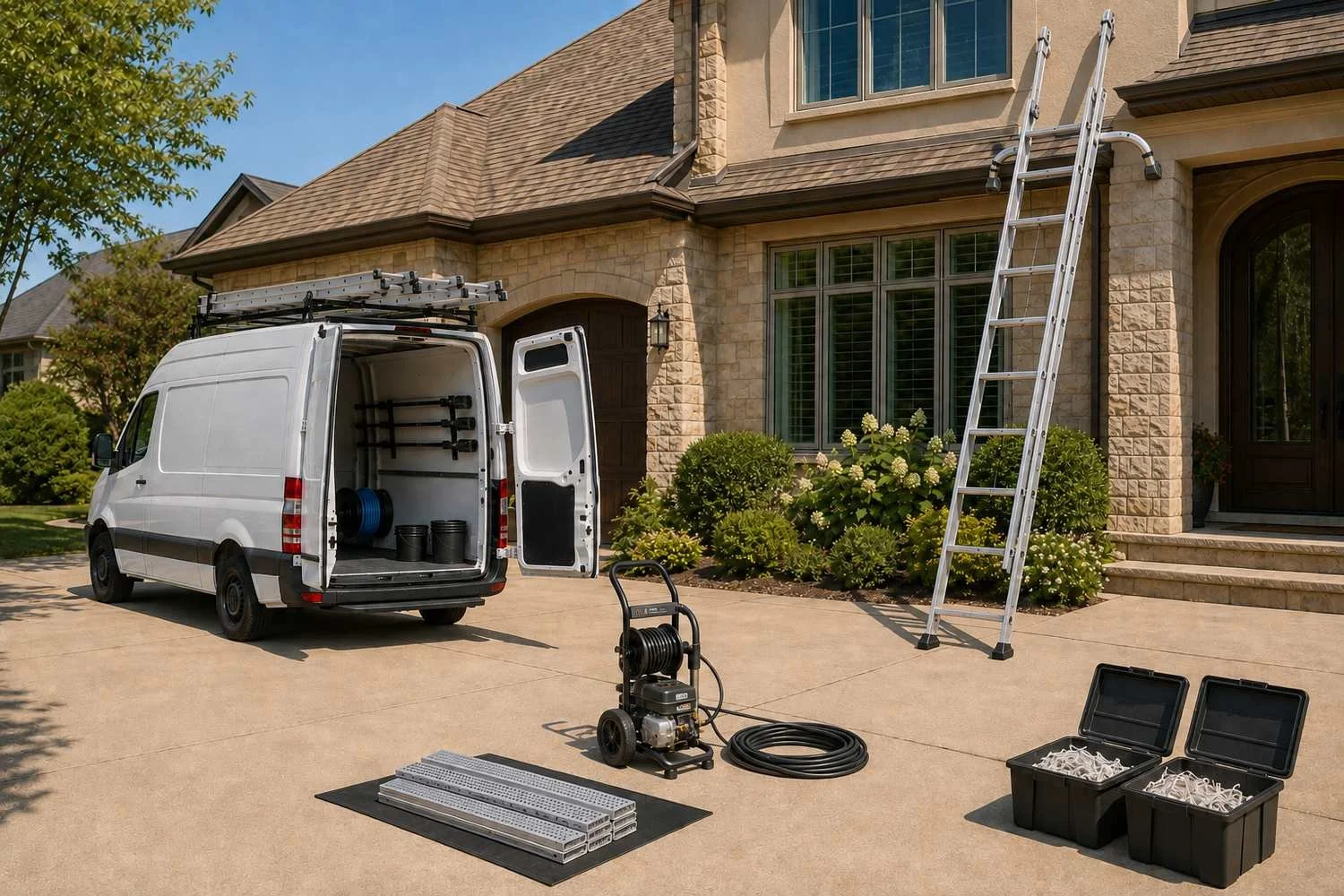
Window and gutter cleaning is a route business, and it is the natural anchor of an exterior-services portfolio. What makes it a clean anchor is that every service that attaches to it is sold at the same address, off the same truck, to a customer who already trusts you with the outside of the house. There is nothing to reconcile here.
Power washing is the same customer wanting the driveway and the siding done while you are there. Gutter guard installation is an upsell on a job already booked, sold at the moment the customer is looking at their own gutters. Holiday light installation is November-to-January revenue on the same roofline you cleaned in October, which is how a seasonal business stops having a dead quarter. Solar panel cleaning attaches on the same ladder to the growing share of houses with an array.
Four services, one route, one brand, one customer list, and a calendar that fills itself.
That is the difference between owning a van and owning a portfolio. The thing being built is not a window-cleaning company — it is the exterior-maintenance vendor for a few hundred properties, with four services on each address and a tenure record a buyer can verify. It sells as one asset rather than a ladder you happen to climb.
Frequently asked questions
Is a window cleaning business profitable? At scale it is, measured honestly — after paying the crew and the loaded cost of the manager who replaces the owner's labor. It wins on route density and retention rather than on rate: tight, sticky routes carrying several bundled services per address are what make the cash flow predictable enough to lend against.
How much does it cost to start a window cleaning business? Roughly $2,000 to $10,000 for ladders, supplies and insurance, — no premises and no inventory. About $134,000 to $211,500 to buy an established route with its equipment. Franchising runs roughly $125,000 to $300,000 depending on the brand, the territory and how much fleet is included. [S7]
Do I need a license to clean windows? Generally no occupational license for ground-level residential and commercial window and gutter work — the real requirements are insurance and safety, and high-rise rope-access work carries its own certification. Confirm your local rules on water discharge and any municipal requirements. [S6]
How do you make money if customers only call twice a year? You bundle. Add power washing, gutter guards, holiday lights and solar panel cleaning to the same route and one address becomes four visits a year, from a customer you acquired once. The twice-a-year contact is also exactly why retention runs so high — customers never get into the habit of shopping.
Where to go from here
Download the free guide.50 Boring Businesses That Make Millionaires is the full result of the research: fifty categories run against the four tests, what each one costs to enter by all three paths, what has to line up for it to work, and how they pair into a portfolio. Free at microbusinessmillionaire.com.
Read the book.The Microbusiness Millionaire: How Ordinary People Build Extraordinary Wealth One Microbusiness at a Time follows four people who each reached a portfolio worth more than a million dollars by a different path. One keeps a hospital job and uses CDFI financing to acquire one stable service business, then another, then a third. One saves on a single income for three years, leaves a master plumber's wage, and stacks trade service lines starting with an SBA microloan. One uses an SBA Community Advantage loan to open a franchise, then opens three more. One starts with about $5,000 on the side and keeps a W-2 for years, building the slowest and most patient version of the same result. Four starting points, four amounts of money, four portfolios worth over a million dollars at sale. The book is coming soon — join the email list at microbusinessmillionaire.com to hear when it lands.
Join the next cohort — Microbusiness Millionaire: Operating System. The book gives you clear examples of how it's done. The course is the step-by-step system for doing it yourself: screening a real company against the four tests, running the owner-replacement cash-flow math on a seller's actual numbers, knowing when to walk, knowing which lenders fund deals this size, and installing the manager who runs the business without you. Eight weeks online, five seats a cohort, waitlist first — at microbusinessmillionaire.com.
About the author
Chris Scott has spent more than twenty-five years in the small-business arena. As the director of a Community Development Financial Institution (CDFI), he reviewed loan applications and made the approve-or-decline decisions. Later, at the U.S. Small Business Administration (SBA), he monitored lending programs. Across those two roles, thousands of business plans and loan applications crossed his desk. He still works at the SBA, now in its venture capital division. His research into which microbusinesses build wealth — and which quietly build a job — became The Microbusiness Millionaire and the free companion guide, 50 Boring Businesses That Make Millionaires.
Sources & references
[S1] IBISWorld, Window Washing in the US (NAICS OD6458), 2026 — market size $2.9bn; ~35,344 businesses. ibisworld.com
[S2] IBISWorld, Pressure Washing Services in the US (2026 market size $1.2bn; ~32,000+ businesses; highly fragmented, no company above 5% share). ibisworld.com
[S3] U.S. Bureau of Labor Statistics, Occupational Employment and Wage Statistics, May 2025 — Grounds Maintenance Workers, used as the crew proxy; First-Line Supervisors of Landscaping, Lawn Service, and Groundskeeping Workers (SOC 37-1012), used as the owner-replacement proxy and loaded at roughly +20% for payroll taxes, insurance and workers' compensation. bls.gov/oes
[S4] U.S. Federal Trade Commission, Franchise Rule / FDD Items 7 and 19. ftc.gov
[S5] Opportunity Finance Network CDFI Locator (ofn.org); SBA Lender Match (sba.gov).
[S6] U.S. Small Business Administration, Apply for licenses and permits (sba.gov); state and municipal water-discharge and high-rise access requirements.
[S7] Shine Window Care and Holiday Lighting: total single-territory investment $141,570–$203,095 per the franchisor's own published figure, and $141,570–$189,295 in the 2025 FDD for a protected area of 75,000–125,000 households; initial franchise fee $49,900. Window Genie: 2025 FDD Item 7, $125,600–$300,000, initial franchise fee $40,000–$47,500. Verify the current FDD directly with each franchisor.
[Internal]50 Boring Businesses That Make Millionaires — Window & Gutter Cleaning entry (tag, three-path entry-cost table, portfolio pairings, framework note, "what it takes to make this one work") and Solar Panel Cleaning entry (pairings). Drawn from the author's research and filtered through the underwriting criteria he applied as a CDFI lender.
This article is for general information only and is not legal, financial, tax, or investment advice. Category-level figures are reference points, not a specific-deal projection; individual businesses vary. Consult a CPA, attorney, business broker, franchise consultant, or CDFI loan officer before acting.
Last updated: 8/25/2026