
How to Start a Trash Bin Cleaning Business
Every household in an $86 billion industry has a bin, and almost none of them are being cleaned. Here is what a trash bin cleaning business costs, what it pays after you replace yourself, and why the number that decides the whole thing is stops per hour rather than customer count.
Chris Scott — former CDFI director, SBA manager
As the director of a Community Development Financial Institution (CDFI), I reviewed loan applications and made the approve-or-decline decisions. Later, at the U.S. Small Business Administration (SBA), I monitored lending programs and saw which loans were approved and which were denied. Across those two roles, thousands of business plans and loan applications crossed my desk. I still work at the SBA, now in its venture capital division. That work is where I learned what a durable business looks like on paper, and what a business that only looks durable looks like on paper.
It is not, however, where the list of fifty came from. That came from years of research, running category after category through the same four questions: Is it profitable? Does it have recurring revenue? Is it recession resistant? Is it AI resistant? Those four questions are the framework behind the book, The Microbusiness Millionaire, and they are what separated the categories that built real wealth from the ones that quietly built a job with a P&L attached. Fifty survived the screen. Far more never made it through.
Trash bin cleaning is one of the fifty, and it is a young category.
That is the whole story in one sentence. Young means part of every early sale is explaining what the service is. Young also means almost nobody is competing with you for the street you are standing on. Work through the explaining and you reach the other side holding monthly subscription revenue on a route that runs itself — and it goes faster than most people expect, because the explaining gets shorter every house.
The industry: a young service inside a very large one
The parent industry is enormous and stable: waste collection services in the United States total about $86.1 billion in 2025, grown at roughly a 3.7% compound rate over five years. [S1] Every household inside that figure has a bin, and virtually none are being cleaned.
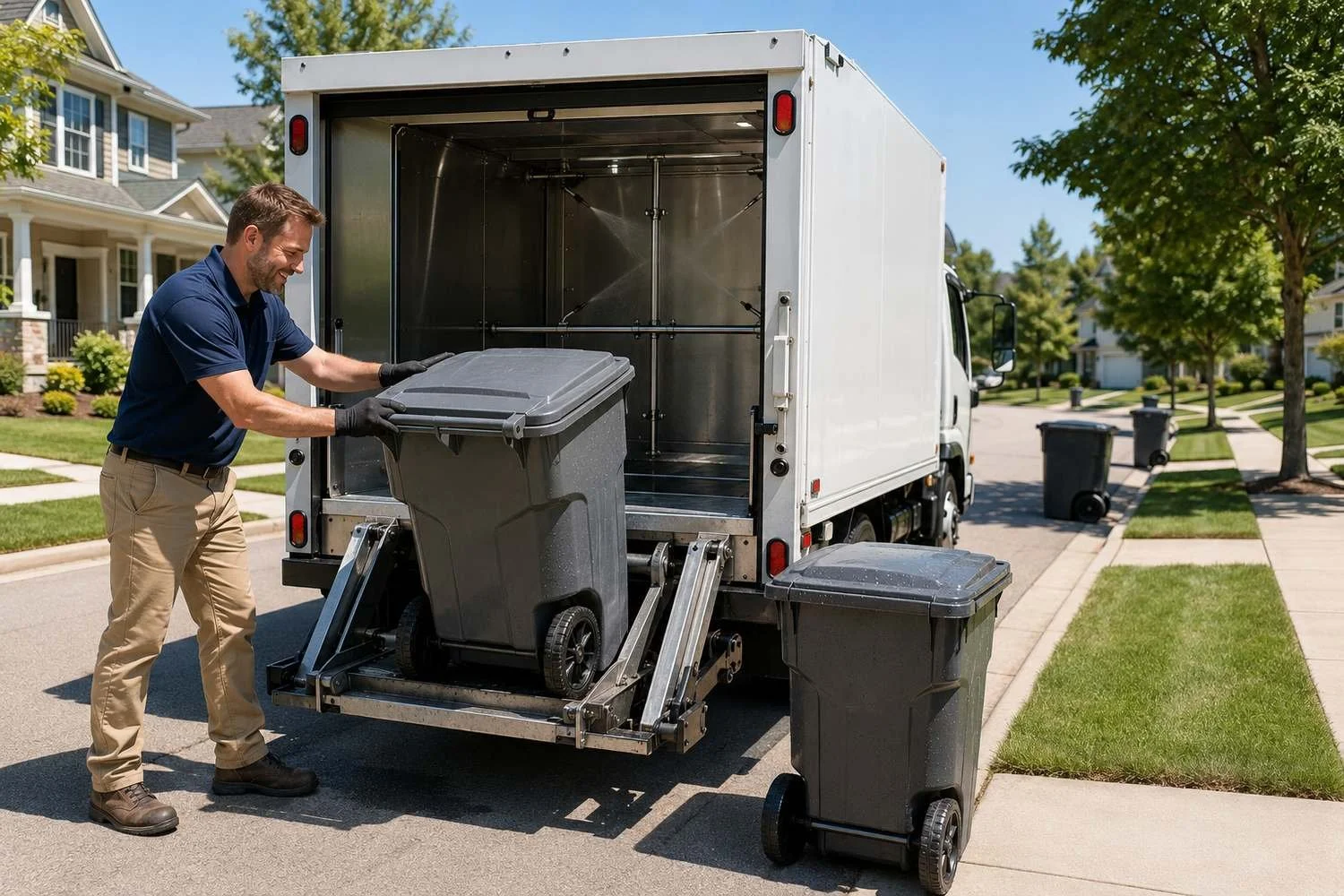
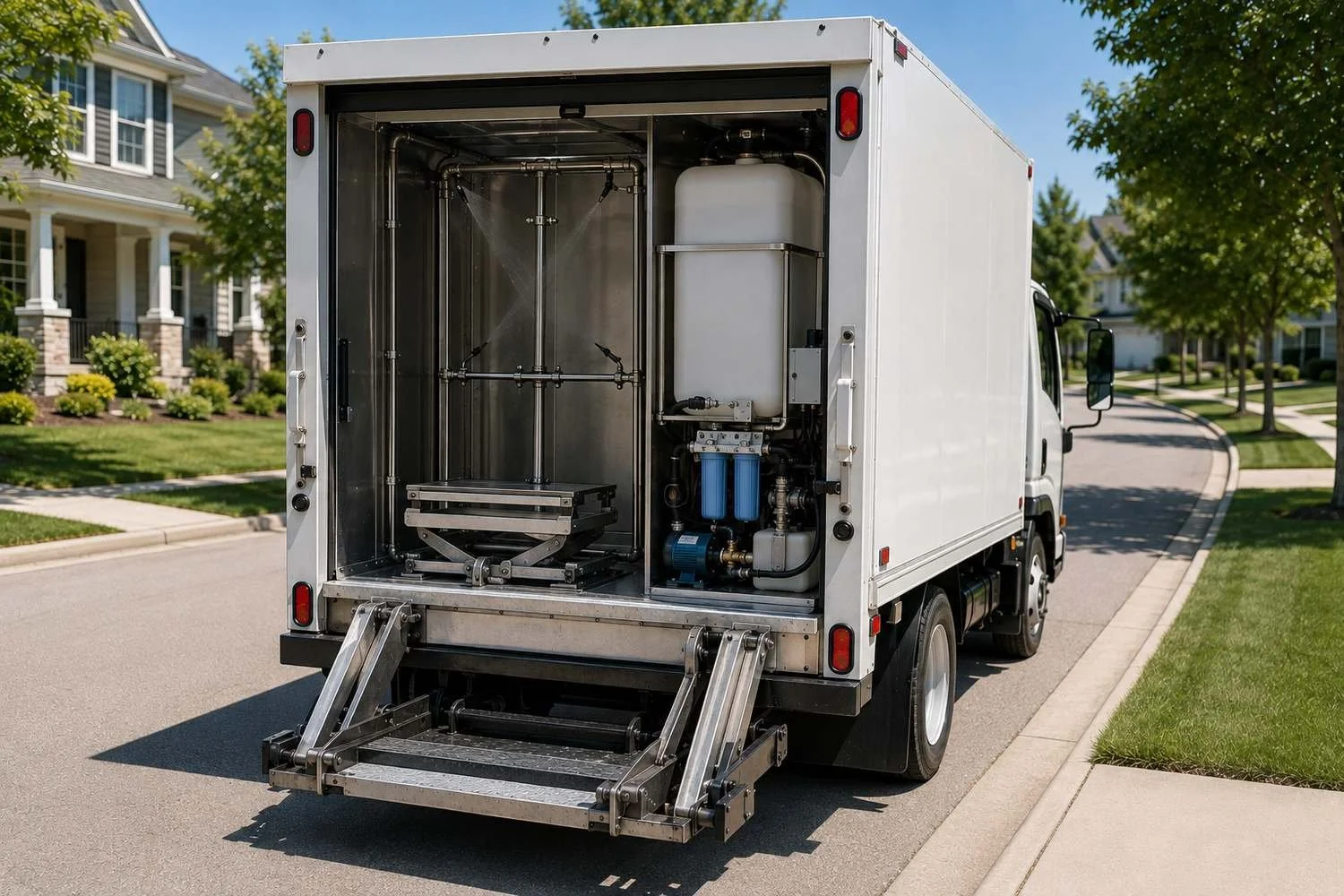
That is the opening, and it is a genuinely new one. Bin cleaning is a small, fast-growing segment carved out of a very old industry: mobile units with onboard water reclamation, servicing bins at the curb on collection day.
There is no established national chain in most markets, and in a great many neighborhoods the category has simply not arrived yet. In an established service, the question is how to win a street from somebody. Here it is how to be the first person to knock on it.
The labor benchmark comes from the collection side of the trade. Roughly 135,430 workers collect refuse and recyclable material. [S2] What that job pays is published area by area, and it moves further between cities than it does between trades. Take the figure for your own market. That wage is the price of replacing yourself — what you would have to pay a driver to take the round off you. Every profit number later in this article has to survive it, and the real cost runs higher once payroll taxes and insurance go on top.
That is the wage market you will hire into, and the number the whole business has to clear. This is route work with trainable labor and no scarce credential, so replacing your own hours is a solvable exercise — the only question is whether the route is dense enough to pay for it yet.
Why trash bin cleaning made the list
Every category in the research had to clear four tests. Clear three and you usually have a self-employed job in disguise.
Does it pay after you replace yourself? It can, and the equipment picture is why. One specialized truck serves the whole route, so there is no per-customer capital and no inventory. Once the stops per hour are high enough, a driver's wage comes out of a revenue line that does not have to be re-sold every month.
Does the revenue recur? Monthly or quarterly, by subscription. Customers sign up for scheduled service and stay signed up; nobody phones to book a bin cleaning the way they would a one-time haul. A set date, a set price, and no sale in between.
Does it survive a recession? Reasonably well. The service is inexpensive per household and attaches to a hygiene concern rather than a luxury, and a growing number of municipalities now encourage bin hygiene outright — which moves the pitch from a nicety toward expected maintenance.
Will it still need humans in ten years? Rolling a bin into a wash bay, running the cycle and returning it to the right house on a residential street is physical work performed one address at a time. Software can sequence the route. It cannot move the bin.
Four for four, on one piece of equipment and a monthly invoice.
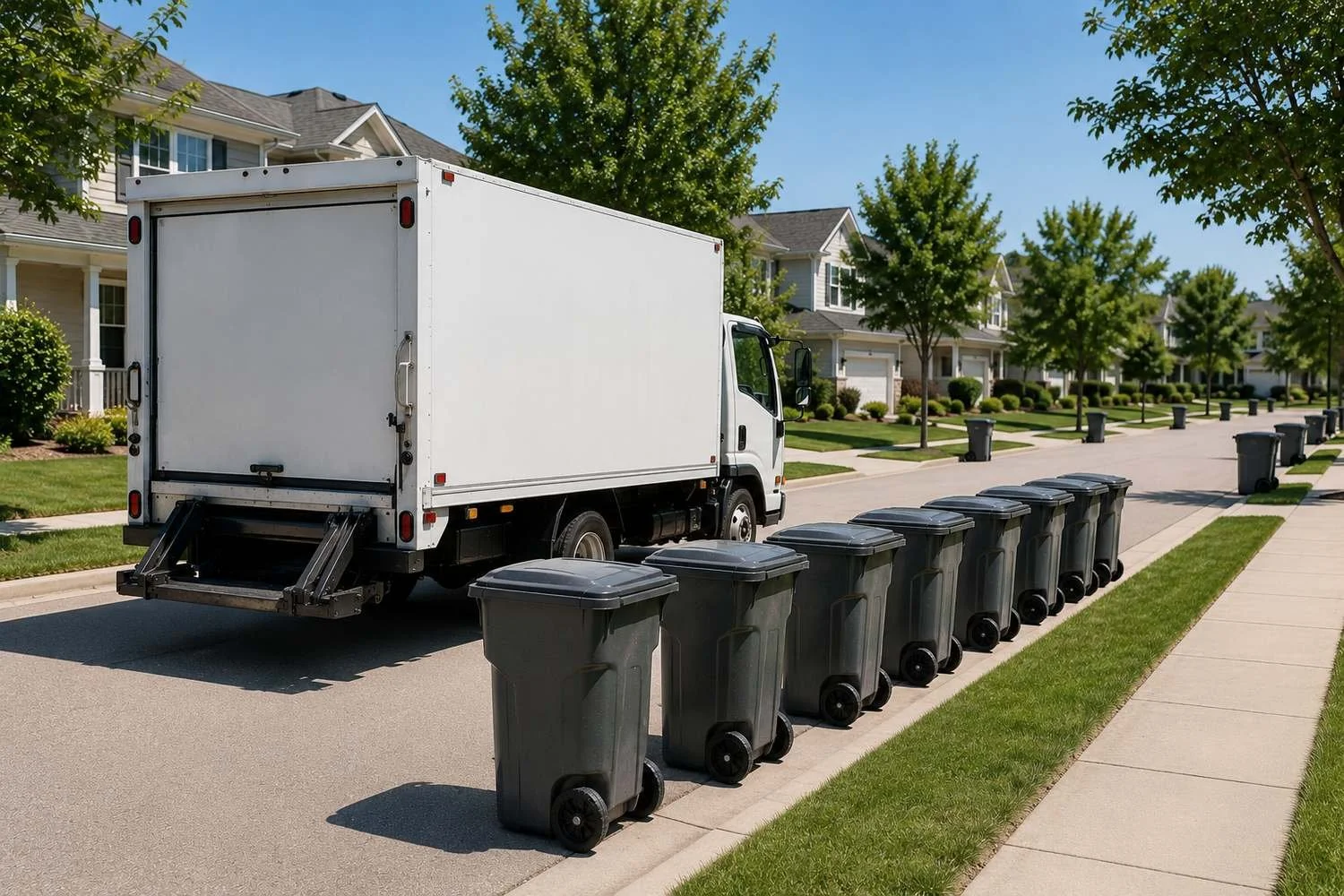
The pattern the research kept finding is that customer count and revenue are almost unrelated. Take two owners. One has ninety subscribers spread across four zip codes and spends most of the day driving between them — impressive on a spreadsheet, and very little left after fuel and hours. The other has sixty inside two subdivisions and earns considerably more, because the truck barely moves between stops. The difference is not the price list or the equipment, which are effectively identical. It is that the second owner knocked the block after every install and offered the neighbors the same day of service. He was not selling a bin cleaning. He was selling a street. From the lending side of the desk that is the entire file: a route with high stops per hour inside a tight boundary services debt a scattered one cannot, at the same revenue and the same subscriber count. The number an underwriter should ask for is not how many customers, but how many minutes between them.
What it takes to make this one work
A note on the tags. Every category in the fifty cleared the same four tests; far more never made it through. The tags do not grade a business — they tell you what has to line up for it to work in your hands. Trash bin cleaning carries two: Works anywhere and Best paired. Read them together, because they point at the same thing from two directions.
Works anywhere: nothing has to line up first
This is one of only nine categories in the fifty with no structural condition attached. No climate requirement, no calendar, no regional market that has to exist first. Every household in the country has a bin, and the collection day it goes out on is already scheduled for you by somebody else.
Which means nothing external is deciding your outcome. The variable that matters is entirely inside your control, and it has a name: route density. Not how many customers. How close together they are.
What the newness costs you is that part of every early sale is explaining what a bin cleaning is and why it is worth paying for. That is not a structural condition — it is a first-year workload, and the move below is what shrinks it.
Best paired: the truck is already on the street
The condition: a single subscriber on a block is an expensive customer. The revenue is modest per household by design, so a route that reaches one house here and another four miles away spends the difference on fuel and windshield time before it ever reaches you.
The move that meets it:sell the street rather than the house. One customer on a block makes the next four straightforward — the truck is already parked there, the neighbors can watch the work, and the explaining gets much shorter the second time. Work a subdivision until it is saturated before opening a new one.
Then point the same dense route at the services that ride it: pet waste removal in the identical subdivisions, junk removal to the same household, power washing to a homeowner who has just shown they care how the property looks. The truck is on the street either way.
The upside: get the density and the economics stop being arguable. Monthly subscription revenue, one piece of equipment, no inventory, three services riding the same streets, and a competitor set that in most markets has not shown up yet — while the municipal hygiene rules spreading through the country do the education for you. The one genuinely hard part of this business gets easier on its own every year you stay in it.
What it costs to get in — the three paths
| Path | Typical cost range | Best for |
|---|---|---|
| Startup | $20,000 – $50,000 | Specialized truck + reclamation system |
| Acquisition (estimate) | $30,000 – $100,000 | Route + equipment |
| Franchise | $83,000 – $159,000 | Brand + equipment + system. Example: Bin Blasters. |
Brands are named as real examples so you can check them yourself, not as endorsements. Each franchisor's Franchise Disclosure Document (FDD) is the authoritative source and refiles annually: check Item 7 for the initial-investment range and Item 19 for any financial-performance representation before pursuing one. [S3]
One quirk of this category is worth knowing before you shop that third column. Some of the best-known names in bin cleaning are not franchises at all — they manufacture the truck and sell a turnkey package of equipment, training and launch support, deliberately without a franchise fee, royalty or protected territory. That is a legitimate and often cheaper route in, but it is a different transaction: no franchise fee also means no FDD, no Item 7 and no Item 19, so there is no filed document to check the claims against. Establish which of the two you are being offered before you compare numbers. [S6]
Notice how much of the startup figure is a single purchase. The specialized truck, with its wash bay and onboard reclamation, is the business — no inventory, no shop, no per-customer equipment. The capital goes in once, and every subscriber added afterward runs on an asset already paid for.
Which makes the acquisition column worth reading carefully. What changes hands at $30,000 to $100,000 is not really the truck. It is the route — subscribers already signed up, already sequenced, already saturating particular streets. Buying density outright is often the most efficient way in, and it skips the entire explaining year.
How people actually fund it

A $20,000 to $50,000 startup sits squarely in the SBA Microloan range, and a $30,000 to $100,000 route acquisition moves into CDFI direct lending territory. A subscription bin route is almost a textbook version of what that rung was built to fund: scheduled stops, monthly billing, a defined territory, and revenue that renews without a sale.
One pattern I watched from the lending chair: a qualified borrower walks into a national bank, gets declined, and concludes they cannot be funded. They never learn that a CDFI across town, or a Community Advantage lender, exists precisely for deals this size. Two free national directories will show you the ones near you — the Opportunity Finance Network CDFI locator and SBA Lender Match. [S4]
Finding the lender is the easy half. A bin route has a specific tell an underwriter looks for: stops per hour and subscribers per route, with monthly churn alongside them. A tight route prices very differently from a scattered one reporting identical revenue, and the second cannot service the same debt. Bring that breakdown by route rather than in total, before anyone asks.
The profit reality: owner-replacement cash flow

Here is the calculation that decides more of these deals than anything else in them. A bin cleaning business looks profitable because the owner is driving the truck, running the stops, knocking doors for new subscribers and keeping the books — none of it priced. The honest test: after you pay your crew, and after you pay a manager a market wage to run the route and the book the way you run them, is there enough left over for you to own the thing?
This category answers with a single number: stops per hour. Subscription pricing is modest per household by design, so what decides the business is how many houses the truck services between one and the next.
Load payroll taxes and insurance onto the collector wage in your own market and you have what the driver who replaces you actually costs. [S2] A saturated subdivision, where he works a block at a time, covers that comfortably and leaves real cash flow behind it. The identical subscriber count spread across a metro spends the same money on fuel and windshield time and leaves nothing. Same truck, same price list, same number of customers — and only one of them is a business you can own without driving it.
The second lever is the one people miss: the door-knocking. Early on the owner is the sales force, and that effort never appears on a profit and loss. Once the route is dense, new subscribers start arriving by neighbor referral — and the largest unpriced cost in a young category quietly retires itself. Density does not just improve the driving. It ends the selling.
The category-level math is easy — you just did it. Running it on a specific company, where the seller's "profit" quietly contains his own unpriced driving and door-knocking hours and the real question is stops per hour inside each individual route, is where people freeze. That is the job of the course, Microbusiness Millionaire: Operating System — the four tests turned into a repeatable screen you run on a real deal.
The benefits of owning a trash bin cleaning business
Monthly subscription revenue. Scheduled service that renews without a sale.
One piece of equipment. The truck is the business — no inventory, no shop, no per-customer capital.
An open field. In most markets the category has not arrived, so the streets are unclaimed.
A tailwind you did not create. Municipal bin hygiene rules do more of the explaining every year.
Three services on one street. Pet waste removal, junk removal and power washing ride the same route.
What separates the strong owners from the struggling ones
Density chased instead of customer count. The defining decision here. Strong owners measure the route in stops per hour rather than subscribers, and take sixty houses on two streets over ninety scattered across a metro every time — the first route pays a driver, the second pays a fuel card.
One subdivision saturated before the next is opened. Working a neighborhood until it is full is slower on a map and faster on a bank statement. Finishing a street compounds; starting a new one resets.
Priced as a subscription, not as a wash. The rate has to be set so a driver's market wage fits underneath it at realistic density — pricing the route you intend to build rather than the one you have in month two. Get it right at the start and you never re-price a customer list later.
The pairings put on the same street. The truck is already parked there and the household trusts you, so pet waste removal, junk removal and power washing sell at close to zero acquisition cost. Add the second service once a subdivision is saturated, not before.
Wash water handled to the local standard from day one. Capture and reclamation is what makes the truck welcome on any street in the jurisdiction, and far easier to build into the equipment purchase than to retrofit after a municipality asks.
Licenses, permits, and regulations
The business licensing here is light; the water rules are the real requirement. Expect a general business license and sales-tax registration, plus commercial auto and general liability insurance, and workers' compensation once you employ drivers.
The compliance that matters is environmental. Under Clean Water Act stormwater rules, wash water generally cannot be discharged to a storm drain, and many municipalities require capture, containment and proper disposal — which is exactly why the onboard water reclamation system is standard equipment in this category rather than an upgrade someone talks you into. Confirm how your jurisdiction expects reclaimed water to be disposed of, since sanitary-sewer discharge often requires an agreement with the local utility.
Some areas add water use or drought restrictions, and servicing bins at the curb raises right-of-way questions in a few municipalities. Start with your city or county and your state environmental agency, plus the free SBA "Apply for licenses and permits" tool. [S5] (General information, not legal advice — confirm your local wash-water discharge and reclamation requirements before you take paid work.)
Build a portfolio, not a job
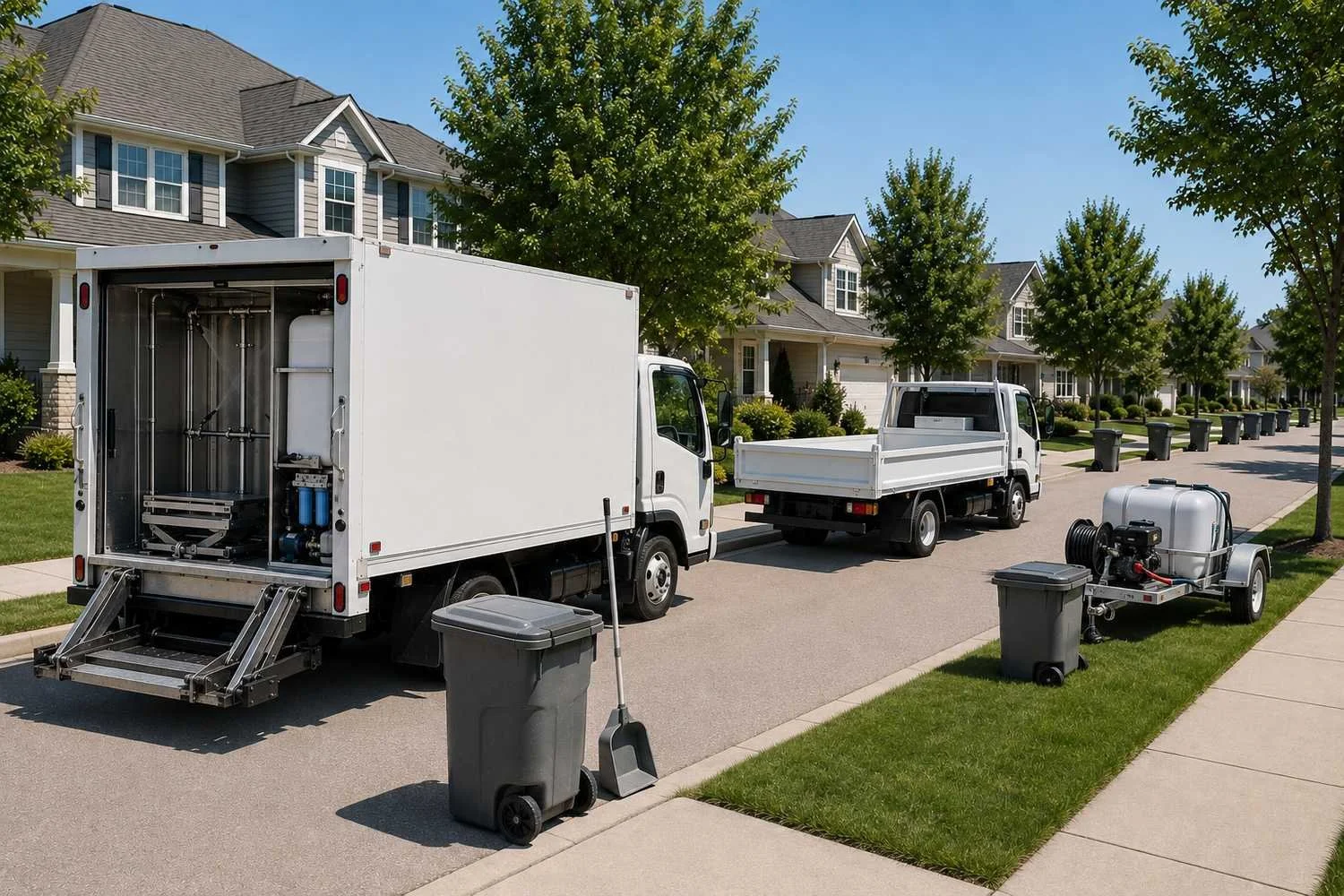
Trash bin cleaning is a route business, and an unusually clean one to build a portfolio around, because everything that pairs with it is a route too — same street, same household, same vehicle.
Pet waste removal runs a weekly route through the identical subdivisions and needs no additional vehicle. Junk removal reaches the same customer at the moment they are clearing a garage. Power washing is the natural next sale to a homeowner who has just shown they care what the outside of the property looks like. One dense neighborhood can carry all four.
That is the difference between owning a truck and owning a portfolio. The thing being built is not a cleaning route — it is the residential service relationship a few hundred households rely on every month, anchored by subscription revenue that renews without a sale. A portfolio like that, with a documented customer list and stops per hour on every route, sells to a buyer as one asset. That is how it ends up worth over a million dollars at sale, rather than a truck and a wash bay.
Frequently asked questions
Is a trash bin cleaning business profitable? It can be, because the revenue is a monthly subscription running off a single piece of equipment. The honest test is stops per hour: a saturated route covers a driver's loaded wage and leaves cash flow behind it, while the same subscriber count scattered across a metro spends it on drive time.
How much does it cost to start a trash bin cleaning business? Roughly $20,000 to $50,000 for a specialized truck with a wash bay and reclamation system, nearly all of it a single purchase. About $30,000 to $100,000 to acquire an existing route, or roughly $83,000 to $159,000 for a franchise. Check whether you are being offered a franchise with a filed FDD or a turnkey equipment package without one, because both are sold here.
How do you get customers in a new category? By selling the street rather than the house. One customer on a block makes the next four straightforward: the truck is visible, the work is visible, and the explanation gets shorter each time you give it.
Do I need a permit for the wash water? Often, yes. Wash water generally cannot enter a storm drain, and many jurisdictions require capture, containment and proper disposal — the reason onboard reclamation is standard equipment here. Confirm your local and state requirements before taking paid work. [S5]
Where to go from here
Download the free guide.50 Boring Businesses That Make Millionaires is the full result of the research: fifty categories run against the four tests, what each one costs to enter by all three paths, what has to line up for it to work, and how they pair into a portfolio. Free at microbusinessmillionaire.com.
Read the book.The Microbusiness Millionaire: How Ordinary People Build Extraordinary Wealth One Microbusiness at a Time follows four people who each reached a portfolio worth more than a million dollars by a different path. One keeps a hospital job and uses CDFI financing to acquire one stable service business, then another, then a third. One saves on a single income for three years, leaves a master plumber's wage, and stacks trade service lines starting with an SBA microloan. One uses an SBA Community Advantage loan to open a franchise, then opens three more. One starts with about $5,000 on the side and keeps a W-2 for years, building the slowest and most patient version of the same result. Four starting points, four amounts of money, four portfolios worth over a million dollars at sale. The book is coming soon — join the email list at microbusinessmillionaire.com to hear when it lands.
Join the next cohort — Microbusiness Millionaire: Operating System. The book gives you clear examples of how it's done. The course is the step-by-step system for doing it yourself: screening a real company against the four tests, running the owner-replacement cash-flow math on a seller's actual numbers, knowing when to walk, knowing which lenders fund deals this size, and installing the manager who runs the business without you. Eight weeks online, five seats a cohort, waitlist first — at microbusinessmillionaire.com.
About the author
Chris Scott has spent more than twenty-five years in the small-business arena. As the director of a Community Development Financial Institution (CDFI), he reviewed loan applications and made the approve-or-decline decisions. Later, at the U.S. Small Business Administration (SBA), he monitored lending programs. Across those two roles, thousands of business plans and loan applications crossed his desk. He still works at the SBA, now in its venture capital division. His research into which microbusinesses build wealth — and which quietly build a job — became The Microbusiness Millionaire and the free companion guide, 50 Boring Businesses That Make Millionaires.
Sources & references
[S1] IBISWorld, Waste Collection Services in the US (NAICS 1506) — market size approximately $86.1bn in 2025, growing at a ~3.7% CAGR between 2020 and 2025. ibisworld.com
[S2] U.S. Bureau of Labor Statistics, Occupational Employment and Wage Statistics, Refuse and Recyclable Material Collectors (SOC 53-7081) — approximately 135,430 employed (May 2023); wages published by area. bls.gov/oes
[S3] U.S. Federal Trade Commission, Franchise Rule / FDD Items 7 and 19. ftc.gov
[S4] Opportunity Finance Network CDFI Locator (ofn.org); SBA Lender Match (sba.gov).
[S5] U.S. Small Business Administration, Apply for licenses and permits (sba.gov); U.S. Environmental Protection Agency Clean Water Act stormwater discharge rules; municipal wash-water capture, containment, and disposal requirements; local sanitary-sewer discharge agreements and water-use restrictions.
[S6] Bin Blasters franchise disclosure data (2026 FDD; estimated initial investment $83,050–$158,900) as reported by franchise-filing aggregators. Sparkling Bins Business (sparklingbinsbusiness.com) markets a turnkey equipment, training and launch package expressly without franchise fees, royalties or a franchise agreement, and therefore without an FDD. Verify the current status and filings of any brand before comparing offers.
[Internal]50 Boring Businesses That Make Millionaires — Trash Bin Cleaning entry (tags, three-path entry-cost table, portfolio pairings, framework note, "what it takes to make this one work"), drawn from the author's lending experience and research.
This article is for general information only and is not legal, financial, tax, or investment advice. Category-level figures are reference points, not a specific-deal projection; individual businesses vary. Consult a CPA, attorney, business broker, franchise consultant, or CDFI loan officer before acting.
Last updated: 8/25/2026.