

How to Start a Pet Boarding and Daycare Business
Pet owners cut their own vacations before they cut the dog's, which keeps demand steady even when household budgets tighten. Here is what a pet boarding and daycare business costs, what it pays after you replace yourself, and why the small-format entry is the one that gets funded.
Chris Scott — former CDFI director, SBA manager

As the director of a Community Development Financial Institution (CDFI), I reviewed loan applications and made the approve-or-decline decisions. Later, at the U.S. Small Business Administration (SBA), I monitored lending programs and saw which loans were approved and which were denied. Across those two roles, thousands of business plans and loan applications crossed my desk. I still work at the SBA, now in its venture capital division. That work is where I learned what a durable business looks like on paper, and what a business that only looks durable looks like on paper.
It is not, however, where the list of fifty came from. That came from years of research, running category after category through the same four questions: Is it profitable? Does it have recurring revenue? Is it recession resistant? Is it AI resistant? Those four questions are the framework behind the book, The Microbusiness Millionaire, and they are what separated the categories that built real wealth from the ones that quietly built a job with a P&L attached. Fifty survived the screen. Far more never made it through.
Pet boarding and daycare is one of the fifty, and here format decides the outcome before anything else does. The same service can be a six-figure lease-and-buildout project that sits outside what a community lender will finance for a first-time owner, or a modest in-home operation started for a fraction of that — and the second version is the one that gets funded and compounds. Getting that choice right is most of the work.
The industry: fragmented, growing, and full of small owners
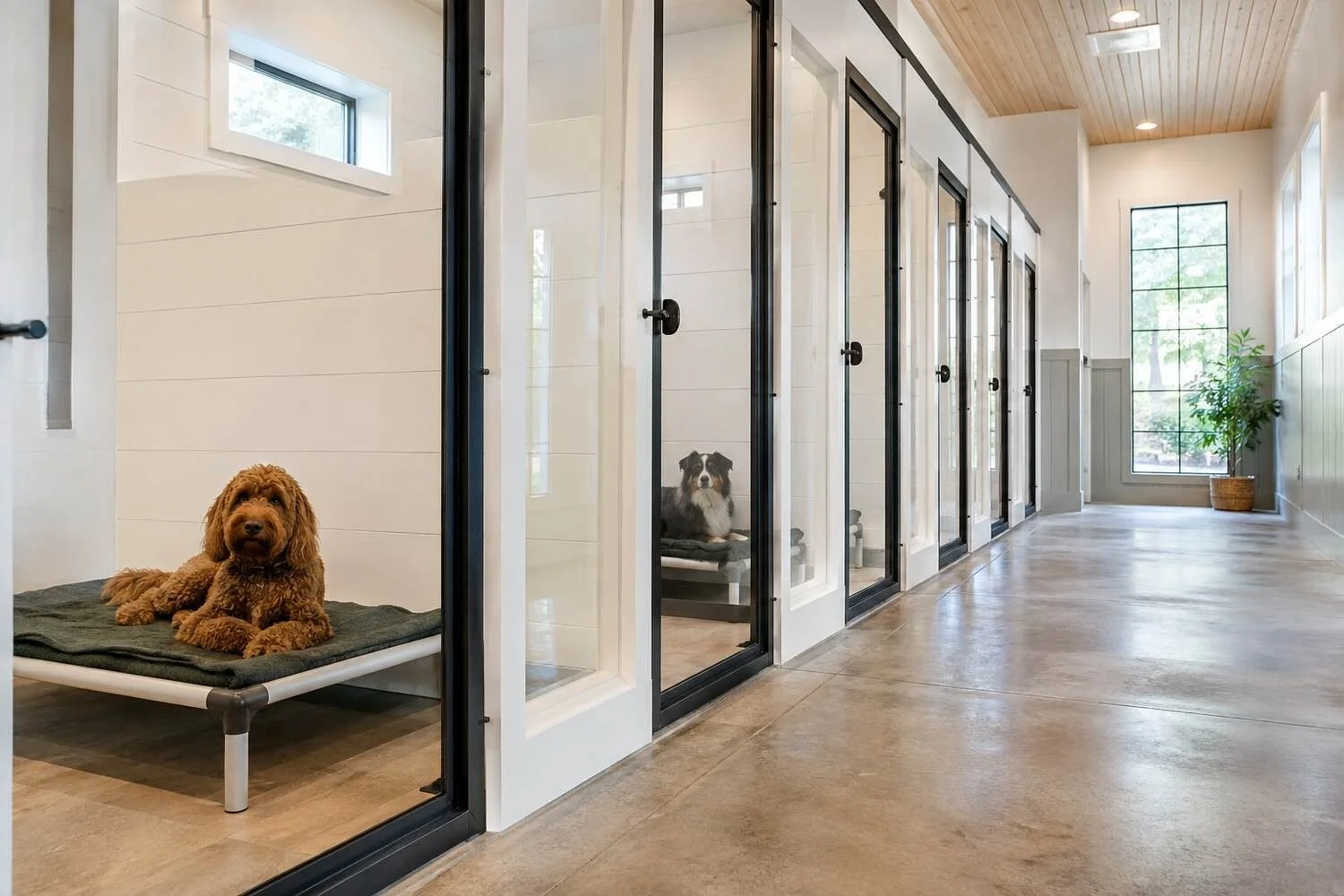
Pet grooming and boarding in the United States is roughly a $15.4 billion industry in 2026, growing at about a 3.9% compound rate over five years, and it is remarkably fragmented — approximately 169,481 businesses as of 2025, a count growing about 7.3% a year over the previous five. [S1] That is not a market controlled by chains. It is a market made almost entirely of small owners, which is exactly the structure that rewards a good one.
The spending behind it is substantial. The American Pet Products Association put U.S. pet care spending above $150.6 billion in 2024, with roughly $12.6 billion of that going specifically to services — grooming, daycare, boarding, training, and sitting. [S2] About 66% of U.S. households owned a pet as of 2023. [S3]
On the labor side, animal caretakers — the BLS category covering boarding and daycare staff — set the wage you will be paying. What they earn shifts from one market to the next, so look up the figure for your own. [S4] That is your main operating cost, and this work calls for trainable skill rather than a scarce credential, which puts the staffing math in your favor. That wage is the price of replacing yourself — what it takes to hire someone to run the floor in your place. Every profit number later in this article has to survive it, and the real cost runs higher once payroll taxes and insurance go on top.
Why pet boarding made the list
Every category in the research had to clear four tests. Clear three and you usually have a self-employed job in disguise.
Does it pay after you replace yourself? It can, and the staffing picture helps: caretaker roles are trainable rather than credentialed, so replacing your own hours is genuinely solvable here. The constraint sits on the other side of the ledger — whether occupancy is high enough, and the format light enough, that staff wages plus rent still leave owner-replacement cash flow.
Does the revenue recur? Steadily. Daycare in particular is a standing weekly commitment — the same dogs, the same days, every week — and boarding returns on a predictable holiday and vacation rhythm. A regular daycare client behaves like a subscription, which is why filling those weekday slots matters more than chasing one-off boarding bookings.
Does it survive a recession? Unusually well, and the reason is behavioral rather than economic: people cut their own vacations before they cut the dog's, so the spending survives a squeeze that removes other discretionary services entirely. Daycare tied to a work schedule holds even more firmly — if the owner is going to the office, the dog needs somewhere to be.
Will it still need humans in ten years? Entirely. Supervising a play group, reading dog body language before a scuffle starts, and settling an anxious animal at two in the morning is hands-on work with real judgment in it. Booking software fills the calendar. It does not walk the floor.
Four for four — with customers who protect this line item in their budget.
In this category, two owners can sell the identical service and end up with two completely different businesses, because the format decides the finances. The research kept landing on the same split. On one side, owners who opened with a long lease and a full buildout — turf, drainage, sound treatment — and a break-even that required high occupancy from month one, in a building nobody had used yet. On the other, owners who started with a handful of dogs at their own property, added weekday daycare as the regulars accumulated, and moved into a small facility once the occupancy history existed on paper. From the lending side of the desk I can tell you which of those two is the straightforward conversation with a community lender: the one financing a business that already works, rather than a building that might.
What it takes to make this one work
A note on the tags. Every category in the fifty cleared the same four tests; far more never made it through. The tags do not grade a business — they tell you what has to line up for it to work in your hands. Pet boarding carries two: Best paired and Solo first. Together they are the instruction manual.
The condition: scale and format. Large-format daycare carries a lease and a buildout that push the project past the framework's financing lane. That is a different kind of money, and a first-time owner asking a community lender to fund an unopened facility is a hard conversation.
The move that meets it: enter at the in-home or small-facility end, where the buildout is modest and the money fits comfortably inside what a CDFI or SBA microloan will carry. Then let occupancy, rather than square footage, do the compounding — fill your weekday daycare slots with regulars, build a documented occupancy history, and expand when the demand is on paper rather than in the projection. And because the tag is "Best paired," attach the services that stack inside the same walls: daycare, in-facility grooming, and, if you want a third, on-site training.
The upside: entered this way, you are in a fragmented market of small owners, with weekly recurring daycare revenue, staff you can actually hire and train, and customers who protect this line in their budget when they are cutting elsewhere. Add the on-site pairings and one household relationship carries boarding, daycare, and grooming — which is the compounding the guide is pointing at.
What it costs to get in — the three paths
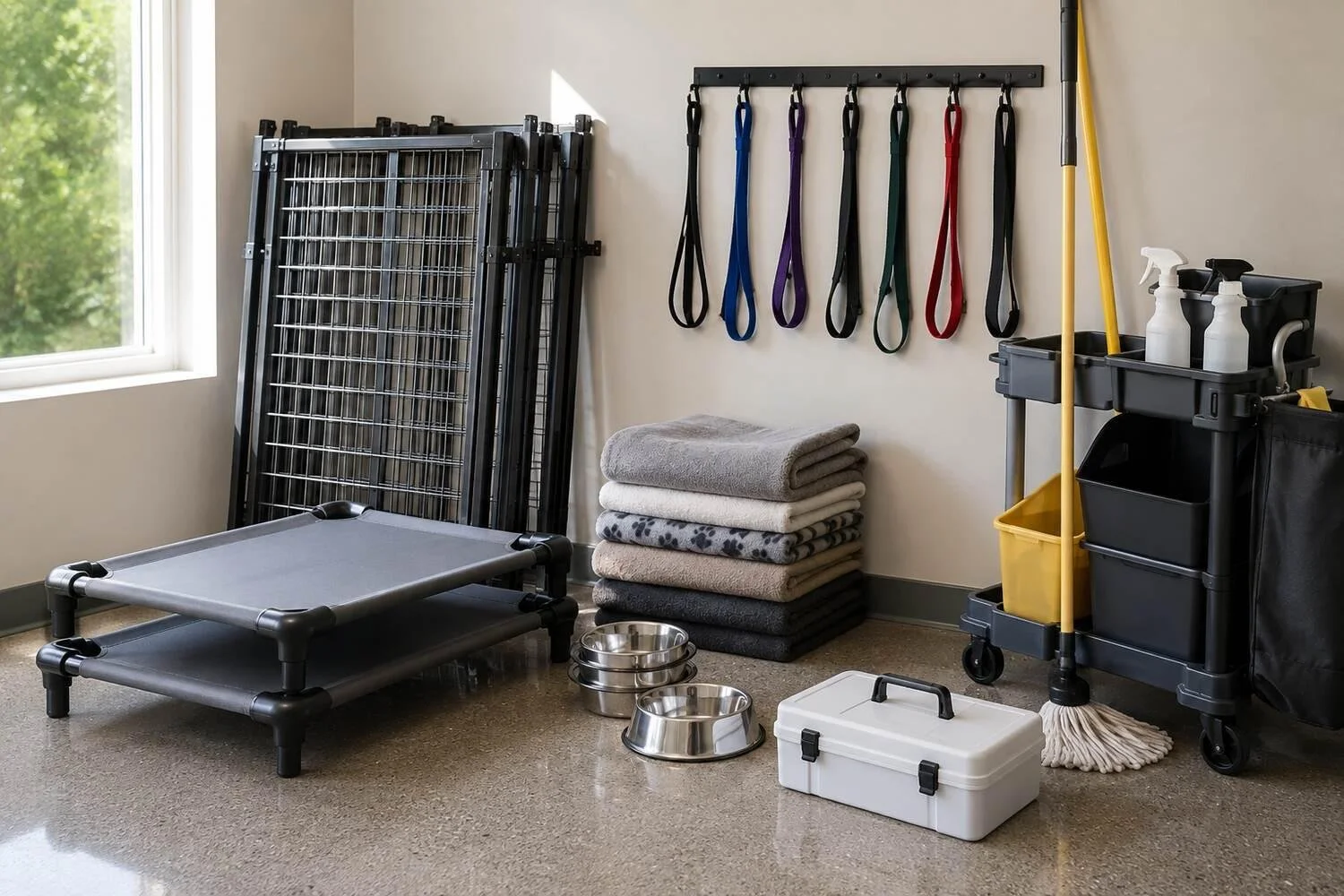
| Path | Typical cost range | Best for |
|---|---|---|
| Startup | $50,000 – $150,000 | Lease + buildout + insurance |
| Acquisition | $142,500 – $265,000 | Facility + customer list |
| Franchise | $543,000 – $2,037,000 | Brand + facility systems (examples: Dogtopia, Camp Bow Wow) |
Franchise brands are named as examples, not endorsements. Franchise investment figures reflect a franchisor's most recent Franchise Disclosure Document (FDD) and change annually — verify each brand's current FDD (Item 7 for the initial-investment range; Item 19 for any financial-performance representation) before pursuing one. [S5]
Look hard at the franchise row, because it is the most important number on this page and it is not a typing error. A national dog daycare franchise is a seven-figure project. The brands above publish initial investments running from roughly half a million dollars to just over two million, because each one is a purpose-built facility with play floors, drainage, sound treatment and outdoor yards, on a long commercial lease.
Put that next to the $350,000 ceiling on an SBA Community Advantage loan and the arithmetic answers itself. The franchise path in this category is not a stretch for a first-time owner working with a community lender — it is several times outside the lane entirely. It is a real business and people do build it, but they build it with investor capital or conventional commercial finance, which is a different book from this one.
That is exactly why the format decision comes first. Every figure in that table describes a facility business. The in-home and small-facility entry the guide recommends sits well below even the startup range shown — it is the version of this category that fits a first-time owner's financing lane, and it is how most successful independents begin. Treat the table as the map of where this business can go once it is proven, not as the price of admission.
How people actually fund it

A small-format or in-home start fits comfortably in the SBA Microloan range, and the step up into a modest facility moves into CDFI direct lending. An acquisition of an existing facility with an established customer list reaches into SBA Community Advantage territory, which carries up to $350,000 — so the typical acquisition in this category fits inside the ceiling. That is the rung the book follows most closely for acquisitions: CDFI financing used to buy recurring, key-holding service businesses one at a time. A daycare customer list is that idea in another form — standing weekly commitments, repeat households, and revenue that renews itself.
One pattern I watched from the lending chair: a qualified buyer walks into a national bank, gets declined, and concludes they cannot be funded. They never learn that a CDFI across town, or a Community Advantage lender, exists precisely for deals this size. Two free national directories will show you the ones near you — the Opportunity Finance Network CDFI locator and SBA Lender Match. [S6]
Finding the lender is the easy half. The harder half is walking in with a package that earns a yes, and a boarding business has a specific tell an underwriter looks for: occupancy rate and the daycare-to-boarding revenue mix — what share of capacity is filled on an average weekday, and how much revenue comes from recurring daycare regulars versus seasonal boarding peaks. Steady weekday occupancy is far more bankable than a business that lives on holidays. Start tracking it before anyone asks for it.
The profit reality: owner-replacement cash flow

Here is the calculation that decides more of these deals than anything else in them. A boarding business looks profitable because the owner is doing the overnights, running the play groups, cleaning the kennels, taking the bookings, and keeping the books — none of it priced. The honest test: after you pay your staff, and after you pay a facility manager a market wage to run the operation the way you run it, is there enough left for you to own the thing?
Two numbers decide it. The first is occupancy, and specifically weekday occupancy: rent and staffing are close to fixed whether the kennels are full or half empty, so every unfilled weekday slot comes straight out of the cash flow that manager's wage is paid from. This is why recurring daycare regulars matter more than boarding peaks — they fill the slow days that otherwise carry cost without revenue. The second is format. A modest facility running at high occupancy clears a manager's wage comfortably; a large facility running at partial occupancy struggles to, because the fixed costs scaled ahead of the customer list. Same service, same staff wages, very different ability to replace the owner.
The category-level math is easy — you just did it. Running it on a specific facility, where the seller's "profit" hides his own unpriced overnights and cleaning hours, and where the real question is average weekday occupancy across a full year rather than the holiday weeks, is the part that stops people. That is the job of the course, Microbusiness Millionaire: Operating System — the four tests turned into a repeatable screen you run on a real deal.
The benefits of owning a pet boarding business
Weekly recurring daycare. Regulars book the same days every week — close to a subscription.
Recession-durable customers. People cut their own vacations before they cut the dog's.
Trainable staff. Caretaker roles call for no scarce credential, which makes replacing your hours realistic.
A fragmented market. Approximately 169,481 businesses and growing — a field of small owners.
Three services, one address. Boarding, daycare, and in-facility grooming all run inside the same building, off one customer relationship.
What separates the strong owners from the struggling ones
Format before ambition. A lease and buildout ahead of a proven customer list is the hardest version of this to finance; the in-home start is the one lenders can say yes to.
Weekday regulars before holiday peaks. Daycare regulars fill the slow days that carry the fixed cost. Holiday boarding is the bonus, not the base.
Documented occupancy before expansion. Let a year of real occupancy history pull the next step, rather than a projection of it.
The on-site pairings, taken. Grooming and daycare serve the household you already have, inside walls you are already heating.
Licenses, permits, and regulations
This category is more regulated than the other pet businesses on the list, and the requirements are worth confirming rather than assuming.
Start with zoning, because it is the item that surprises people most and the only one that can stop you outright. Animal boarding is frequently restricted by district and by noise ordinance, and in-home operations often face hard limits on the number of animals kept. Confirm this before you commit to a location — or to your own property, which people forget is also a location.
Then the licensing itself. Expect a general business license and sales-tax registration, plus a state or local kennel, boarding, or animal-care facility license, which commonly carries inspection, capacity limits and recordkeeping obligations.
Then the operating requirements: vaccination records, sanitation and waste disposal, staff-to-animal ratios, and emergency and fire safety planning. Facilities with outdoor runs may face additional runoff rules.
On insurance, general liability plus animal bailee coverage for the animals in your care is the practical baseline, along with workers' compensation if you employ staff. Standard liability does not cover an animal that is in your custody, which is the gap most new owners do not know they have.
Start with your city or county zoning office and your state department of agriculture or animal-control authority, plus the free SBA "Apply for licenses and permits" tool. [S7] (General information, not legal advice — confirm your local zoning, kennel licensing, and animal-care requirements before you board a single animal for a fee.)
Build a portfolio, not a job
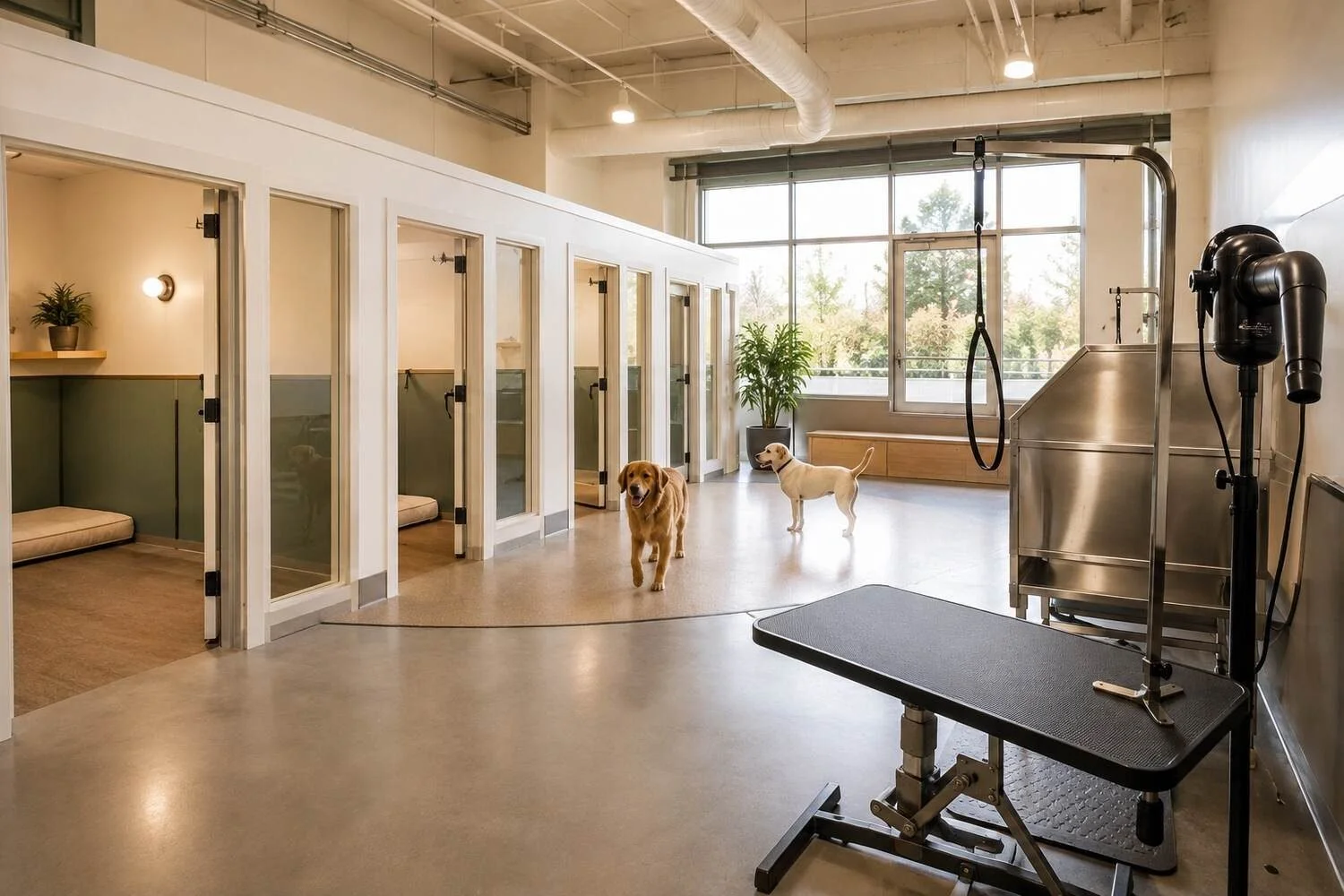
Pet boarding anchors a cluster of pet services, and the first thing to get right is which cluster. Facility businesses stack at one location. Route businesses stack along a route. Boarding is a facility, so the services that belong with it are the ones that run inside the same walls, on animals already in your care.
Daycare is the recurring backbone, and it is why the category is on the list at all — the same dogs, the same weekdays, revenue that renews without a sale. In-facility grooming is the strongest income addition of the group: a dog boarding for four nights can go home clean, which is an easy sale, and it needs a tub, a table, a dryer, and a groomer on the schedule rather than a second location. Both of them monetize a relationship you have already paid to acquire, which is where the real return lives. On-site training — evening group classes, board-and-train packages — is a reasonable third addition that uses space you are already heating, though per hour of staff time it typically earns less than grooming does. Sequence accordingly: daycare, then grooming, then training if you want it.
Stacked that way, the business stops being a kennel and starts being a portfolio. You are not building a boarding facility. You are building the pet-care relationship that a few hundred households rely on for the whole life of the animal, anchored by weekday daycare that recurs like a subscription and deepened by grooming they were going to buy from somebody anyway. A portfolio like that, with documented occupancy and multi-service households, sells to a buyer as one asset — which is how it ends up worth over a million dollars at sale, instead of a building full of kennels.
Frequently asked questions
Is a pet boarding business profitable? It can be, and the customers are unusually durable. The honest test is weekday occupancy: rent and staffing are close to fixed, so a facility with recurring daycare regulars filling the slow days clears a manager's wage far more comfortably than one relying on holiday boarding peaks.
How much does it cost to start a pet boarding business? The facility figures run $50,000–$150,000 for a lease, buildout, and insurance, with acquisitions at $142,500–$265,000 and franchises at $200,000–$500,000. The in-home or small-facility entry sits well below all of those, and it is the version that fits a first-time owner's financing lane.
Should I start in-home or open a facility? Start small. An in-home or small-facility operation builds occupancy history and repeat clients on modest capital, which is both easier to finance and stronger evidence when you do expand. Let documented demand pull the facility, rather than the reverse.
What pairs best with a boarding business? Daycare first, then grooming performed in your own facility. Both serve households already on your customer list and both use the building you are already paying for. On-site training works as a third. Mobile services belong to a route business, which is a different structure with a different anchor.
Do I need a license for pet boarding? Usually. Most areas require a kennel or animal-care facility license with inspections and recordkeeping, and zoning is often the binding constraint — animal boarding is restricted by district and noise ordinance in many places, including for in-home operations. Confirm both before committing to a location. [S7]
Where to go from here
Download the free guide.50 Boring Businesses That Make Millionaires is the full result of the research: fifty categories run against the four tests, what each one costs to enter by all three paths, what has to line up for it to work, and how they pair into a portfolio. Free at microbusinessmillionaire.com.
Read the book.The Microbusiness Millionaire: How Ordinary People Build Extraordinary Wealth One Microbusiness at a Time follows four people who each reached a portfolio worth more than a million dollars by a different path. One keeps a hospital job and uses CDFI financing to acquire one stable service business, then another, then a third. One saves on a single income for three years, leaves a master plumber's wage, and stacks trade service lines starting with an SBA microloan. One uses an SBA Community Advantage loan to open a franchise, then opens three more. One starts with about $5,000 on the side and keeps a W-2 for years, building the slowest and most patient version of the same result. Four starting points, four amounts of money, four portfolios worth over a million dollars at sale. The book is coming soon — join the email list at microbusinessmillionaire.com to hear when it lands.
Join the next cohort — Microbusiness Millionaire: Operating System. The book gives you clear examples of how it's done. The course is the step-by-step system for doing it yourself: screening a real company against the four tests, running the owner-replacement cash-flow math on a seller's actual numbers, knowing when to walk, knowing which lenders fund deals this size, and installing the manager who runs the business without you. Eight weeks online, five seats a cohort, waitlist first — at microbusinessmillionaire.com.
About the author
Chris Scott has spent more than twenty-five years in the small-business arena. As the director of a Community Development Financial Institution (CDFI), he reviewed loan applications and made the approve-or-decline decisions. Later, at the U.S. Small Business Administration (SBA), he monitored lending programs. Across those two roles, thousands of business plans and loan applications crossed his desk. He still works at the SBA, now in its venture capital division. He has also owned, operated, and sold several pet care businesses. His research into which microbusinesses build wealth — and which quietly build a job — became The Microbusiness Millionaire and the free companion guide, 50 Boring Businesses That Make Millionaires.
Sources & references
[S1] IBISWorld, Pet Grooming & Boarding in the US — market size approximately $15.4bn in 2026 after a ~3.9% five-year CAGR; approximately 169,481 businesses as of 2025, a count growing about 7.3% per year over the prior five years. ibisworld.com
[S2] American Pet Products Association (APPA) — U.S. pet care spending projected above $150.6bn in 2024, including approximately $12.6bn on services such as grooming, daycare, boarding, training, and sitting/walking.
[S3] Pet ownership data — approximately 66% of U.S. households owned a pet as of 2023.
[S4] U.S. Bureau of Labor Statistics, Occupational Employment and Wage Statistics, Animal Caretakers (SOC 39-2021). bls.gov/oes
[S5] U.S. Federal Trade Commission, Franchise Rule / FDD Items 7 and 19. ftc.gov. Franchise ranges shown reflect published Item 7 estimated initial investment for Dogtopia (approximately $543,095–$1,399,180) and Camp Bow Wow (approximately $1,216,577–$2,037,471, 2025 FDD; the franchisor's own published 2024 range was $943,606–$1,199,536). Verify the current FDD before relying on either.
[S6] Opportunity Finance Network CDFI Locator (ofn.org); SBA Lender Match (sba.gov).
[S7] U.S. Small Business Administration, Apply for licenses and permits (sba.gov); state and local kennel/boarding facility licensing and inspection requirements; municipal zoning and noise ordinances governing animal boarding, including in-home limits; vaccination, sanitation, staffing-ratio and emergency-planning requirements; animal bailee insurance considerations.
[Internal]50 Boring Businesses That Make Millionaires — Pet Boarding & Daycare entry (tags, three-path entry-cost table, portfolio pairings, framework note, "what it takes to make this one work"), drawn from the author's research and filtered through the underwriting criteria he applied as a CDFI lender.
This article is for general information only and is not legal, financial, tax, or investment advice. Category-level figures are reference points, not a specific-deal projection; individual businesses vary. Consult a CPA, attorney, business broker, franchise consultant, or CDFI loan officer before acting.
Last updated: 8/24/2026