

How to Start a Pet Waste Removal Business
The dog does not stop producing work and the owner does not want the job, which makes this a service a household almost never gets around to canceling. Here is what a pet waste removal business costs, what it pays after you replace yourself, and why turning customers away is the discipline that builds it.
Chris Scott — former CDFI director, SBA manager
As the director of a Community Development Financial Institution (CDFI), I reviewed loan applications and made the approve-or-decline decisions. Later, at the U.S. Small Business Administration (SBA), I monitored lending programs and saw which loans were approved and which were denied. Across those two roles, thousands of business plans and loan applications crossed my desk. I still work at the SBA, now in its venture capital division. That work is where I learned what a durable business looks like on paper, and what a business that only looks durable looks like on paper.
It is not, however, where the list of fifty came from. That came from years of research, running category after category through the same four questions: Is it profitable? Does it have recurring revenue? Is it recession resistant? Is it AI resistant? Those four questions are the framework behind the book, The Microbusiness Millionaire, and they are what separated the categories that built real wealth from the ones that quietly built a job with a P&L attached. Fifty survived the screen. Far more never made it through.
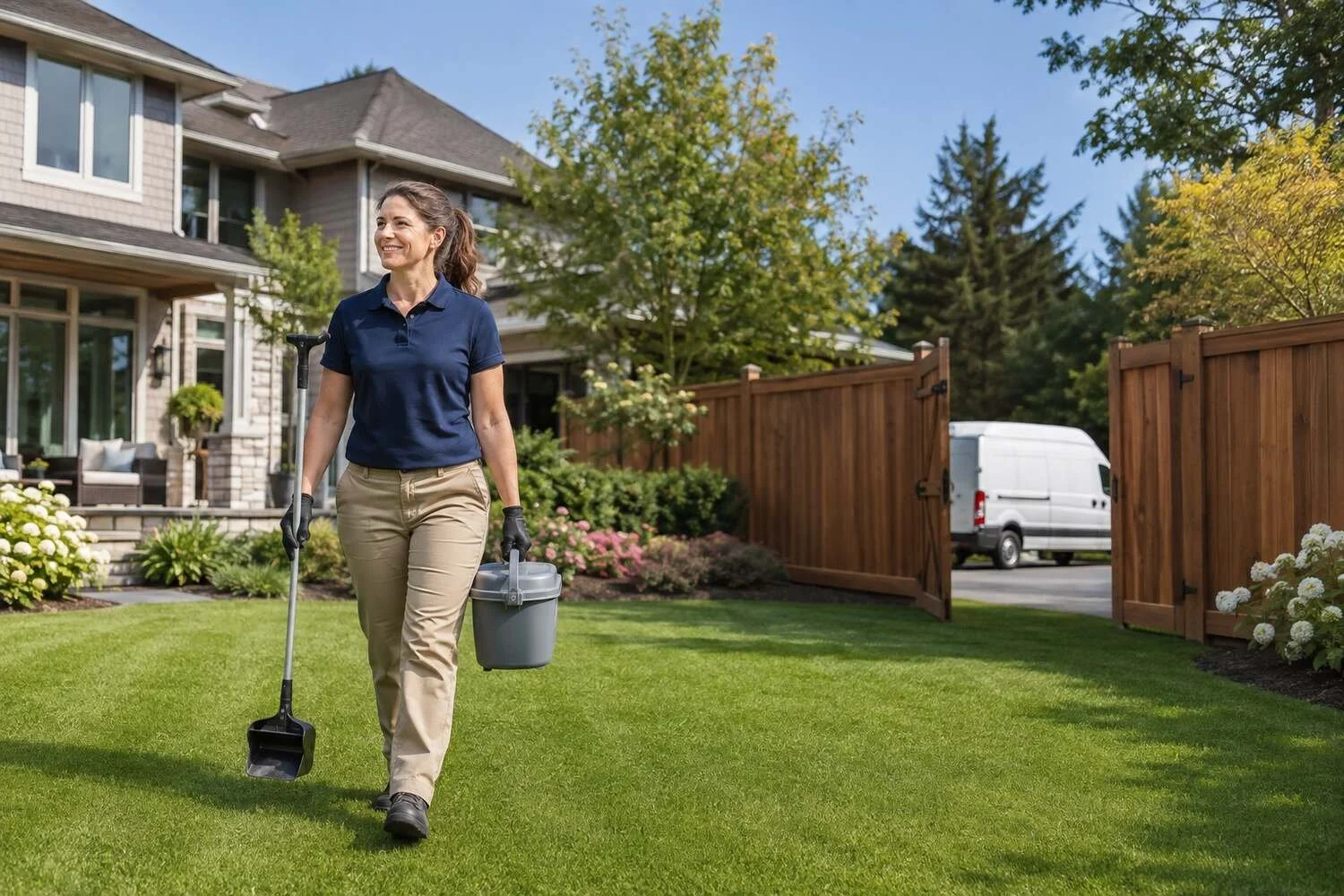
Pet waste removal is one of the fifty, and nobody would call it glamorous. It is also cheap to start, and it produces a customer relationship that is unusually hard to end: the dog produces the work whether or not anyone feels like dealing with it, and the household has already decided it does not want the job. Nobody cancels this service.
What it asks in return is patience — two or three years of quietly filling in neighborhoods — and most people will not do that, which is precisely why it works for the people who will.
The industry: small service, very large spending base
There is no tidy national figure for this specific service. It is a small, fragmented segment made almost entirely of local owners, which is itself worth knowing. What can be measured is the spending base underneath it. The American Pet Products Association put U.S. pet care spending above $150.6 billion in 2024, with roughly $12.6 billion of that going to services — grooming, daycare, boarding, training, sitting, and walking. [S1] About 66% of U.S. households own a pet. [S2]
For context on how the adjacent pet-services trades behave, pet grooming and boarding runs about $15.4 billion in 2026 across roughly 169,481 businesses — a field growing in owner count at about 7.3% a year. [S3] These are small businesses serving the same households you would be serving, on the same recurring rhythm.
The labor benchmark comes from grounds maintenance work. The figure that matters is not the route technician's hourly rate. It is what a first-line supervisor of those crews would have to be paid to do the work you would otherwise be doing. That wage swings further between metro areas than it does between service categories, so plan against your own market's. Every profit number later in this article has to survive it, and the real cost runs higher once payroll taxes and insurance go on top.
The takeaway is not the size of any one number. It is that a very large share of American households own a dog, spend willingly on services for it, and already buy several recurring services from small local owners.
Why pet waste removal made the list
Every category in the research had to clear four tests. Clear three and you usually have a self-employed job in disguise.
Does it pay after you replace yourself? It can, and this is a category where being imprecise about how will cost you the answer. The ticket is modest, so the arithmetic runs entirely through density — yards per hour. Get a neighborhood genuinely full and a technician's wage fits underneath the route comfortably, because the equipment cost is close to nothing and there is no material cost at all.
Does the revenue recur? About as reliably as recurring revenue gets. Weekly or bi-weekly service on a subscription, in perpetuity. The dog does not stop producing work and the customer does not want the job, so the decision to cancel requires the household to volunteer for a chore it is already paying to avoid.
Does it survive a recession? Well. It is inexpensive per household and tied to a chore people genuinely do not want to do, and the spending behavior behind it is unusually stubborn: people cut their own spending long before they cut anything tied to the dog.
Will it still need humans in ten years? Completely. Walking a fenced backyard and clearing it by hand is physical work performed on a different property every time. Software can plan the route. It cannot walk the lawn.
Four for four, on an entry price low enough to start without borrowing.
The research on this category kept rewarding a discipline that looks like the opposite of ambition. The owners who built something had a rule: no customer outside the subdivisions currently being worked, however much that customer wanted the service. Two solid years of turning down business. What it produces by the end is a route where eight or nine yards can be cleared without moving the truck more than a few hundred feet — and at that point the revenue per hour stops resembling a chore business at all. The owners who took every customer who called were reliably busier and reliably worse off. From the lending side of the desk this is the rare category where the useful question is not how many customers there are, but how close together they sit. Saying no to the wrong customer is the strategy here.
What it takes to make this one work
A note on the tags. Every category in the fifty cleared the same four tests; far more never made it through. The tags do not grade a business — they tell you what has to line up for it to work in your hands. Pet waste removal carries two: Works anywhere and Best paired. Together they are the instruction manual.
The condition: two to three years of route building. Density is the whole game, and the ticket is smaller than in the skilled-trade routes, which means this category rewards persistence more than cleverness.
The move that meets it: take one neighborhood at a time and refuse to serve outside it until it is full. That is the entire operating discipline, and it is harder than it sounds, because turning down a paying customer feels wrong every single time. Do it anyway. A full subdivision produces far more revenue per hour than a scattered city, and revenue per hour is the only number that matters in a low-ticket route.
Then, because the second tag is Best paired, add the adjacent services onto the same streets. Mobile pet grooming, come-to-you dog training and lawn care all reach the same households on the same rhythm, and none of them needs another vehicle.
The upside: what that patience buys is unusually good. A weekly contract, almost no equipment cost, a customer who essentially never leaves, and an entry price low enough to start this weekend. It is a rare combination: revenue that recurs by default, and a start cheap enough to attempt while employed.
What it costs to get in — the three paths
| Path | Typical cost range | Best for |
|---|---|---|
| Startup | $3,000 – $8,000 | Truck + supplies + insurance |
| Acquisition (estimate) | $30,000 – $100,000 | Established route |
| Franchise | $76,000 – $95,000 | Brand + recurring billing (examples: DoodyCalls, Pet Butler) |
Franchise brands are named as examples, not endorsements. Franchise investment figures reflect a franchisor's most recent Franchise Disclosure Document (FDD) and change annually — verify each brand's current FDD (Item 7 for the initial-investment range; Item 19 for any financial-performance representation) before pursuing one. [S4]
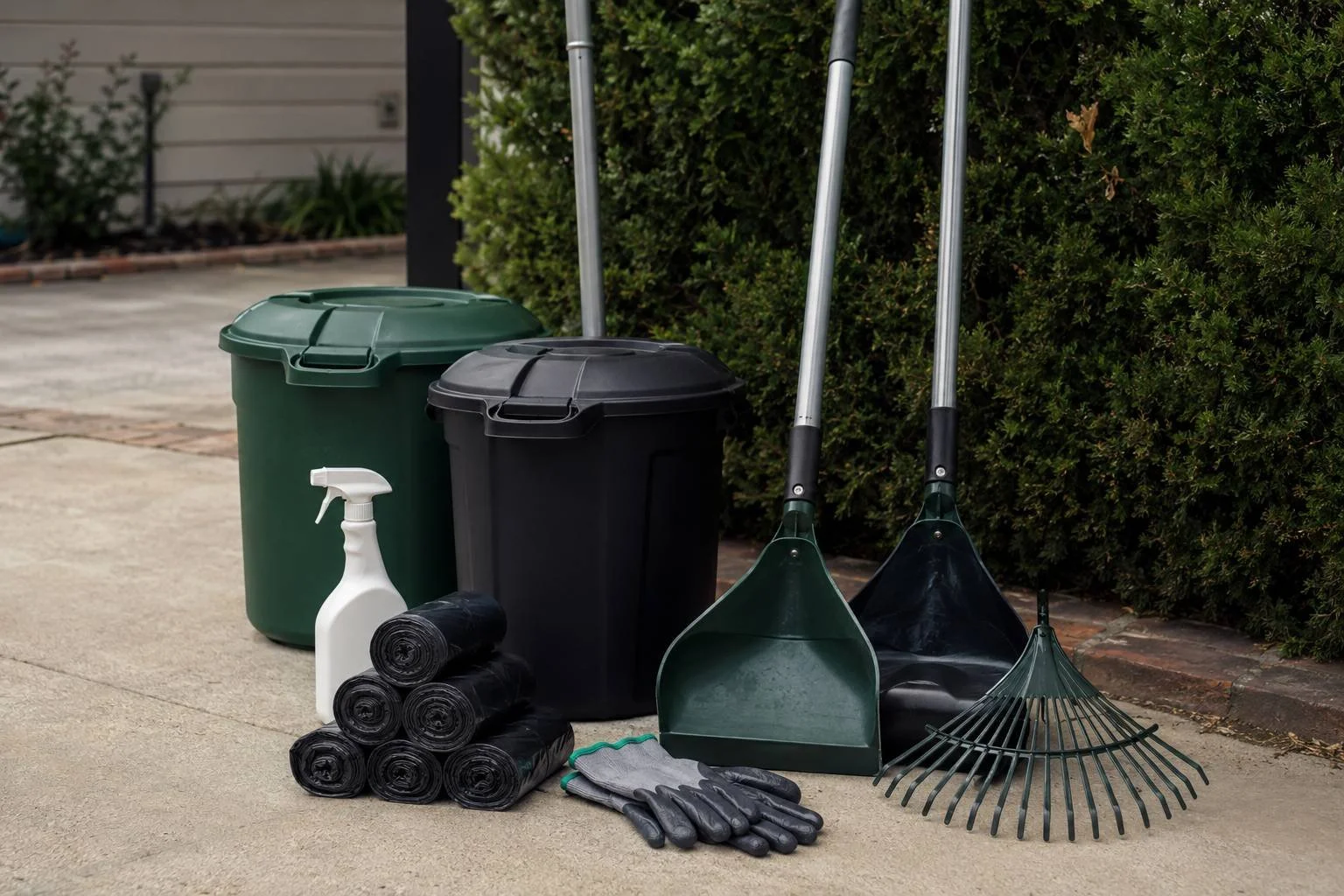
Almost all of that is the vehicle. The actual tools are scoopers, rakes, sealed bins and sanitizing supplies, and if you already own something you can drive, the working end of this business costs a few hundred dollars. There is no specialized equipment and no inventory to carry.
Now look at what that does to the acquisition column. A route sells for $30,000 to $100,000, which is many times the cost of the equipment attached to it. That gap is the asset. You are not buying tools; you are buying two or three years of somebody else's neighborhood-filling discipline.
Then set the franchise column beside it, because the comparison is unusually stark in this category. A franchise here starts at roughly $76,000 — more than the entry price of an established route — and what it buys is a brand, a billing system and a territory. What it does not buy is a single customer. You still have to fill the neighborhoods yourself, over the same two or three years, while paying a royalty on every dollar.
That is not an argument against franchising. It is an argument for knowing exactly what you are paying for. A franchise premium usually buys you a shortcut. Here, the shortcut is the route, and the route is in the middle column.
How people actually fund it

At $3,000 to $8,000, this is about as accessible as a business gets — genuinely startable on weekends without leaving a paycheck behind. That is the same tier where a W-2 can stayin place while the business builds.
This category suits that approach particularly well, because the route-building years described above are exactly the years you would want a paycheck underneath you anyway. A $30,000 to $100,000 route acquisition moves into SBA Microloan and CDFI direct lending range.
One pattern I watched from the lending chair: a qualified buyer walks into a national bank, gets declined, and concludes they cannot be funded. They never learn that a CDFI across town, or a Community Advantage lender, exists precisely for deals this size. Two free national directories will show you the ones near you — the Opportunity Finance Network CDFI locator and SBA Lender Match. [S5]
Finding the lender is the easy half. A waste route also has a specific tell an underwriter looks for: yards per hour and customer tenure — how tightly clustered the stops are, and how long the average subscriber has been on service. A dense route with multi-year customers is far more bankable than a longer customer list spread thin, because one of those produces predictable hours and the other produces drive time. Start recording both before anyone asks.
The profit reality: owner-replacement cash flow

Here is the calculation that decides more of these deals than anything else in them. A waste route looks profitable because the owner is walking every yard, driving between them, signing up new customers, and keeping the books — none of it priced. The honest test: after you pay your technicians, and after you pay a manager a market wage to run the route the way you run it, is there enough left for you to own the thing?
Be precise about this category, because the guide is: the ticket is smaller than in the skilled-trade routes, so the per-visit price will not rescue a loose route. Yards per hour is the entire lever.
A technician clearing eight or nine stops in an hour inside a saturated subdivision earns a wage that leaves genuine cash flow behind it. The same technician driving four minutes between stops does not, and no price increase fixes that, because customers in a low-ticket service compare prices by nature.
The compensating advantage is real, though: the cost side is nearly bare. No materials, no specialized equipment, no inventory. Once the density is there, very little stands between revenue and what the owner keeps.
The category-level math is easy — you just did it. Running it on a specific route, where the seller's "profit" hides his own unpriced walking and driving hours and the real question is stop clustering rather than customer count, is where people freeze. That is the job of the course, Microbusiness Millionaire: Operating System — the four tests turned into a repeatable screen you run on a real deal.
The benefits of owning a pet waste removal business
A low entry cost, most of it the vehicle. Scoopers, bins and insurance are the rest of it.
Weekly subscription revenue. Recurring by design, billed on a schedule.
Customers who never leave. The dog does not stop, and the owner does not want the job.
Almost no cost side. No materials, no inventory, no specialized equipment.
Pairings that need no second vehicle. Grooming, training and lawn care ride the same streets.
What separates the strong owners from the struggling ones
One neighborhood filled before the next is opened. The defining discipline in this category, and the hardest to hold. Turning down a customer outside the area you are filling is what produces the density everything else depends on.
Yards per hour measured, not customer count. The count flatters and the clustering pays. Track the number that actually decides the day.
Two or three years planned for. This is a route built patiently, and knowing that up front is what makes the early quiet months feel like progress rather than a stall.
Density before discounting. The ticket is already modest, so revenue per hour rises by tightening the map rather than by cutting the price.
Licenses, permits, and regulations
Requirements here are light, but a few specifics deserve confirming rather than assuming. Expect a general business license and sales-tax registration where applicable, plus commercial auto and general liability insurance.
Then deal with disposal, because it is the item most owners overlook and the one that can reshape a route. Pet waste is generally not compostable through municipal yard-waste programs, and hauling collected waste means following your local rules on how and where it may be disposed. Some jurisdictions require it to go to a permitted facility rather than a residential bin, and transporting accumulated waste can raise solid-waste hauling questions in a few areas. Confirm this before you build a route around a disposal assumption, not after.
Beyond that, expect ordinary sanitation and biohazard handling practices. And because the work happens inside fenced yards, settle the practical questions early: gate access, keys or codes, and whether dogs are loose during service. Confirm your liability coverage contemplates animal-related injury — this is the one exposure in an otherwise low-risk trade.
Start with your city or county and the free SBA "Apply for licenses and permits" tool. [S6] (General information, not legal advice — confirm your local waste disposal and hauling requirements before you take paid work.)
Build a portfolio, not a job
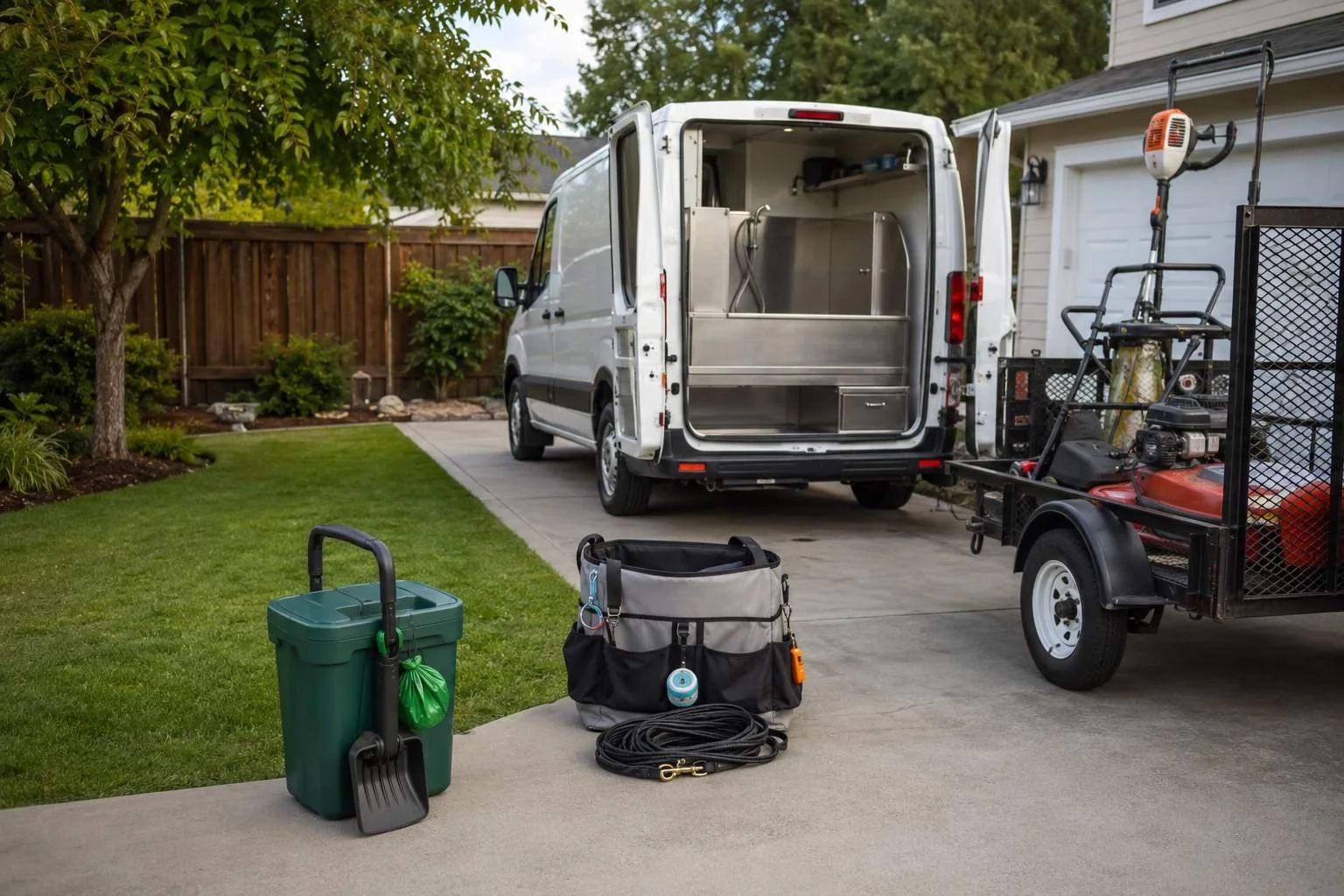
Pet waste removal pairs unusually well, and the reason is access rather than skill: it puts you in the same backyards every single week, which almost no other residential service manages. It is a route business, and the services that stack with it are the other routes running the same streets.
Mobile pet grooming reaches the identical household and the identical dog. Come-to-you dog training meets them earlier in the animal's life. And lawn care works the exact same yards on a similar weekly rhythm, with no additional vehicle required. One saturated subdivision can support all of it, and the weekly visit is what makes every other service an easy conversation rather than a sale.
Pet boarding takes that dog when the family travels and is a natural referral partner, but it is a facility — it stacks at one address, on different logic. Refer to a boarding facility gladly. Build alongside the routes.
That is the difference between owning a route and owning a portfolio. You are not building a scooping business. You are building the weekly relationship a few hundred pet-owning households on a handful of streets depend on, anchored by contracts that essentially never churn. A portfolio like that, with documented density and multi-year customers, sells to a buyer as one asset — which is how it ends up worth over a million dollars at sale, instead of a truck and a scooper.
Frequently asked questions
Is a pet waste removal business profitable? It can be, once the route is dense. The ticket is modest, so yards per hour is the lever — a saturated neighborhood covers a technician's market wage with real cash flow left over, while a scattered customer list spends it on drive time. The cost side is nearly bare, which helps considerably.
How much does it cost to start a pet waste removal business? Roughly $3,000 to $8,000 for a vehicle, supplies and insurance, with the vehicle accounting for most of it. About $30,000 to $100,000 to acquire an established route, or $25,000 to $80,000 for a franchise with a brand and recurring billing systems.
How long does it take to build a route? Two to three years of neighborhood-by-neighborhood building. The discipline is refusing customers outside the area you are currently filling, which is what produces the density that makes the economics work.
Do I need a permit to dispose of pet waste? Requirements vary, and it is the item most owners overlook. Pet waste generally is not accepted by municipal composting, and some jurisdictions have specific rules about hauling and disposing of collected waste. Confirm your local requirements before building a route around a disposal assumption. [S6]
Where to go from here
Download the free guide.50 Boring Businesses That Make Millionaires is the full result of the research: fifty categories run against the four tests, what each one costs to enter by all three paths, what has to line up for it to work, and how they pair into a portfolio. Free at microbusinessmillionaire.com.
Read the book.The Microbusiness Millionaire: How Ordinary People Build Extraordinary Wealth One Microbusiness at a Time follows four people who each reached a portfolio worth more than a million dollars by a different path. One keeps a hospital job and uses CDFI financing to acquire one stable service business, then another, then a third. One saves on a single income for three years, leaves a master plumber's wage, and stacks trade service lines starting with an SBA microloan. One uses an SBA Community Advantage loan to open a franchise, then opens three more. One starts with about $5,000 on the side and keeps a W-2 for years, building the slowest and most patient version of the same result. Four starting points, four amounts of money, four portfolios worth over a million dollars at sale. The book is coming soon — join the email list at microbusinessmillionaire.com to hear when it lands.
Join the next cohort — Microbusiness Millionaire: Operating System. The book gives you clear examples of how it's done. The course is the step-by-step system for doing it yourself: screening a real company against the four tests, running the owner-replacement cash-flow math on a seller's actual numbers, knowing when to walk, knowing which lenders fund deals this size, and installing the manager who runs the business without you. Eight weeks online, five seats a cohort, waitlist first — at microbusinessmillionaire.com.
About the author
Chris Scott has spent more than twenty-five years in the small-business arena. As the director of a Community Development Financial Institution (CDFI), he reviewed loan applications and made the approve-or-decline decisions. Later, at the U.S. Small Business Administration (SBA), he monitored lending programs. Across those two roles, thousands of business plans and loan applications crossed his desk. He still works at the SBA, now in its venture capital division. His research into which microbusinesses build wealth — and which quietly build a job — became The Microbusiness Millionaire and the free companion guide, 50 Boring Businesses That Make Millionaires.
Sources & references
[S1] American Pet Products Association (APPA) — U.S. pet care spending projected above $150.6bn in 2024, including approximately $12.6bn on services such as grooming, daycare, boarding, training, and sitting/walking.
[S2] Pet ownership data — approximately 66% of U.S. households owned a pet as of 2023.
[S3] IBISWorld, Pet Grooming & Boarding in the US — market size approximately $15.4bn in 2026 after a ~3.9% five-year CAGR; approximately 169,481 businesses as of 2025, a count growing about 7.3% per year over the prior five years. ibisworld.com
[S4] U.S. Federal Trade Commission, Franchise Rule / FDD Items 7 and 19. ftc.gov. Franchise range shown reflects published Item 7 estimated initial investment for DoodyCalls (approximately $76,450–$93,850, 2025 FDD) and Pet Butler (to approximately $95,000). Verify the current FDD before relying on either.
[S5] Opportunity Finance Network CDFI Locator (ofn.org); SBA Lender Match (sba.gov).
[S6] U.S. Small Business Administration, Apply for licenses and permits (sba.gov); local solid-waste disposal and hauling requirements for collected pet waste; municipal composting exclusions; general liability considerations for animal-related injury.
[Internal] 50 Boring Businesses That Make Millionaires — Pet Waste Removal entry (tags, three-path entry-cost table, portfolio pairings, framework note, "what it takes to make this one work"), drawn from the author's research and filtered through the underwriting criteria he applied as a CDFI lender.
This article is for general information only and is not legal, financial, tax, or investment advice. Category-level figures are reference points, not a specific-deal projection; individual businesses vary. Consult a CPA, attorney, business broker, franchise consultant, or CDFI loan officer before acting.
Last updated: 8/24/2026