

How to Start a Pest Control Business
Recurring revenue accounts for more than 85% of residential pest control income, which makes this closer to a subscription than a service. Here is what a pest control business costs, what it pays after you replace yourself, and why the renewal rate rather than the truck is the whole value of the company.
Chris Scott — former CDFI director, SBA manager
As the director of a Community Development Financial Institution (CDFI), I reviewed loan applications and made the approve-or-decline decisions. Later, at the U.S. Small Business Administration (SBA), I monitored lending programs and saw which loans were approved and which were denied. Across those two roles, thousands of business plans and loan applications crossed my desk. I still work at the SBA, now in its venture capital division. That work is where I learned what a durable business looks like on paper, and what a business that only looks durable looks like on paper.
It is not, however, where the list of fifty came from. That came from years of research, running category after category through the same four questions: Is it profitable? Does it have recurring revenue? Is it recession resistant? Is it AI resistant? Those four questions are the framework behind the book, The Microbusiness Millionaire, and they are what separated the categories that built real wealth from the ones that quietly built a job with a P&L attached. Fifty survived the screen. Far more never made it through.
Pest control is one of the fifty, and it is also one of only nine that carry no structural condition at all — nothing has to line up first, no season to cover, no partner category needed. What follows is the market, the four questions, the three ways in and what each costs, how people fund it, and where the money actually ends up.
The industry: recurring by design
The U.S. pest control industry reached about $29.7 billion in 2026, growing at a 3.4% compound rate over the prior five years. [S1] It is spread across roughly 34,000 businesses nationwide — fragmented enough that an independent owner competes against companies its own size, and full of owners nearing retirement with a customer list to sell. [S2]
But the number that matters most is not the market size. It is this: according to the industry's own annual strategic analysis, recurring revenue accounts for 85.4% of residential pest control service revenue, across roughly 13.3 million residential customers. Commercial service revenue grew nearly 7% in 2025. [S3]
Sit with that figure. In most service businesses you win every job. In pest control, the overwhelming majority of the money renews on a schedule whether or not the customer thought about you at all.
On the labor side, employment for pest control workers is projected to grow 5% from 2024 to 2034 — faster than average — with about 13,400 openings a year. [S4] What one of those workers earns is the wage this whole model rests on. It is a local number, not a national one; the Resource Directory in the free tools shows where to look up yours. That wage is the price of replacing yourself — what a manager would have to be paid to do the work you would otherwise be doing. Every profit number later in this article has to survive it, and the real cost runs higher once payroll taxes and insurance go on top.
Why pest control made the list
Every category in the research had to clear four tests. Clear three and you usually have a self-employed job in disguise: income while you work, nothing left when you stop.
Does it pay after you replace yourself? It does, and for a structural reason rather than a lucky margin: the revenue arrives on a schedule, so the wage of the person who replaces you is a known cost set against known income. That is measured after paying technicians and after paying someone to run the routes you would otherwise run yourself.
Does the revenue recur? This is the category's defining trait. Quarterly residential service and commercial contracts mean the customer list renews itself. That 85.4% recurring figure is the whole argument: you are not selling treatments, you are selling a subscription that happens to involve a truck.
Does it survive a recession? Pest control is treated as an essential service, not a discretionary one. People do not tolerate roaches when money is tight. Demand dipped only slightly during the pandemic before rebounding. [S3]
Will it still need humans in ten years? Someone has to walk the perimeter, get into the crawlspace and identify what is actually happening. Software can route the truck. It cannot crawl under the house.
Four for four.
The research on this category kept coming back to one number that most owners cannot produce on request: what percentage of quarterly accounts renewed last year. Ask an owner about their business and the answer is usually the truck, the equipment, the sprayer. Ask for the renewal rate and it has to be found in the software, if it is tracked at all. That number, not the truck, is the entire value of the company. A customer list of nine hundred accounts renewing at 81% is an annuity. The same nine hundred accounts renewing at 60% is a treadmill. From the lending side of the desk the distinction is decisive, because one of those is collateral that behaves predictably and the other is a business quietly refilling itself every year. Most owners in this category never learn which one they own.
What it takes to make this one work
A note on the tags. Every category in the fifty cleared the same four tests; far more never made it through. The tags do not grade a business — they tell you what has to line up for it to work in your hands. Pest control carries the Works anywhere tag: one of only nine categories with no structural condition, no season to cover, and no geography that decides it. Pests are a fact of every market in the country.
What does matter is entirely inside your control, and it is what the rest of this article is about: the applicator license, the density of the routes you build or buy, and the renewal rate you either measure or do not.
What it costs to get in — the three paths
| Path | Typical cost range | Best for |
|---|---|---|
| Startup | $15,000 – $40,000 | Pesticide license + truck + initial equipment |
| Acquisition | $164,000 – $250,000 | Inherited routes + customer list |
| Franchise (full-service) | $50,000 – $205,000 | Routes pre-mapped, brand recognition. Examples: Truly Nolen, Pestmaster. |
One thing to watch in the franchise column, because it is easy to compare the wrong things. The brands above sell general pest control — the quarterly residential and commercial work this whole article is about. The best-known names in the category are often mosquito-only brands, and those are a seasonal, single-service business that runs in warm months and stops. They are a perfectly good thing to own, and further down this article you will see mosquito work recommended as an overlay on an existing quarterly list. But an outdoor-only franchise is not a substitute for the recurring core, and several of them cost more to enter than a full-service brand does. Check what is actually being sold before you compare two numbers.
Franchise brands are named as examples, not endorsements. Franchise investment figures reflect a franchisor's most recent Franchise Disclosure Document (FDD) and change annually — verify each brand's current FDD (Item 7 for the initial-investment range; Item 19 for any financial-performance representation) before pursuing one. [S5]
The gap between the startup and acquisition numbers is the whole strategic question. Starting costs $15,000 to $40,000 and gets you a license and a truck — but no accounts, and the accounts are the business.
Put the two side by side and the difference is not really money, it is time. The startup path spends four or five years building the list the acquisition path hands you on the first morning. The acquisition path spends roughly ten times the cash to skip those years. Neither is the right answer in general; the right answer depends on which of the two you actually have.
Acquisition costs six figures and hands you the renewing customer list on day one. Which is right depends on whether you have time or capital, and it is a genuine decision rather than a formality.
How people actually fund it

An acquisition at $164,000 to $250,000 sits squarely in CDFI direct lending and SBA Community Advantage territory — the community-lender tiers most first-time buyers have never heard of.
One pattern I watched from the lending chair: a qualified buyer walks into a big national bank, gets declined, and concludes they cannot be funded. They never learn that a CDFI across town, or a Community Advantage lender, specializes in exactly this size of deal. Two free national directories will show you the ones near you — the Opportunity Finance Network CDFI locator and SBA Lender Match. [S6]
A $15,000 to $40,000 startup is a different conversation altogether — often an SBA Microloan, sometimes savings.
Finding the lender is the easy half. A pest control business also has a specific tell an underwriter looks for, and it is the same number the box above describes: the renewal rate, documented, alongside account count and route density. A customer list renewing in the eighties reads as something close to contracted revenue; one renewing in the sixties reads as a business that has to refill itself every year. Start recording it before anyone asks.
The profit reality: owner-replacement cash flow

Here is the calculation that separates a business from a job.
A pest control company almost always looks more profitable than it is, because the owner is running routes, selling, scheduling, and handling callbacks — for free. The honest test: after you pay the technicians, and after you pay someone a market wage to run the operation the way you have been running it, is there anything left for you as the owner?
Put numbers on it. Start with what a technician costs where you operate. [S4] A manager who can genuinely run routes, hold the license requirements and keep customers renewing costs more than that — well more, at every point in the distribution. The closest Bureau of Labor Statistics comparison is first-line supervisors of landscaping and grounds services, and the gap between that wage and the technician wage is the part people miss. [S7] Look up both for your own area, then add payroll taxes and insurance to the manager figure. That loaded number is what goes in the model — not the technician wage, which is what most sellers quietly substitute when they describe their own labor. Whatever the business shows as profit has to survive paying both.
If it survives, you own a business. If it only works because you are the one in the truck at seven in the morning, you own a job with a P&L attached — and you find that out the day you try to buy a second territory.
Running that math on a category is easy — you just did. Running it on a specific company with a real seller's real numbers, where the renewal rate is buried in software and the seller would rather talk about the truck, is where people freeze. That is the job of the course, Microbusiness Millionaire: Operating System — it turns the four tests into a system you run on an actual deal before you sign anything.
The benefits of owning a pest control business
Contractual recurring revenue. Quarterly service is a subscription. You know what next quarter looks like before it arrives.
Essential-service demand. Not discretionary. It holds when other categories wobble.
AI resistance. Someone has to physically be there, in the crawlspace, identifying what is actually happening.
A license that keeps the field thin. The pesticide applicator requirement is a real barrier — an obstacle to you once, and a permanent one to everyone who might otherwise compete.
Pricing power through density. Routes get more profitable the tighter they are. Scale compounds instead of dragging.
A liquid exit. A documented customer list with a known renewal rate sells well, and consolidators are actively buying. That enterprise value, rather than the monthly income, is where the wealth shows up.
What separates the strong owners from the struggling ones
The renewal rate measured. The defining habit in this category. Your renewal percentage is your valuation, and knowing it is what lets you improve it.
The owner-replacement math done first. Price routes with a manager's wage already in them, and the day you hire one changes nothing about your cash flow.
Density before account count. Accounts clustered tightly earn far more than the same number spread across a metro, because windshield time is the silent cost in any route business.
Competing on the technician, not the price. National brands will always go lower. The technician who shows up on time and knows the customer's name is what holds a renewal.
A second licensed applicator on the bench. If you are the only licensed name, the business cannot run — or sell — without you. A second license is what makes it an asset.
Callbacks watched as a signal. A rising callback rate is the earliest warning that renewals are about to move, and it arrives months before the revenue does.
Licenses, permits, and regulations
Pest control is a licensed trade, and this is the one part of the setup you cannot work around.
Every state requires a pesticide applicator license. The categories vary — general household, termite, fumigation, wildlife — and each typically involves an exam, a set number of supervised experience hours, and continuing education to keep it current. Requirements and reciprocity differ meaningfully from state to state, so start with your state's department of agriculture or pesticide regulatory agency rather than a national summary.
Alongside the license you will need a registered entity, general liability coverage, and often a pesticide-specific insurance endorsement that standard liability does not include. Use the free SBA "Apply for licenses and permits" tool next to your state agency. [S8] (General information, not legal advice — confirm your local requirements.)
Build a portfolio, not a job
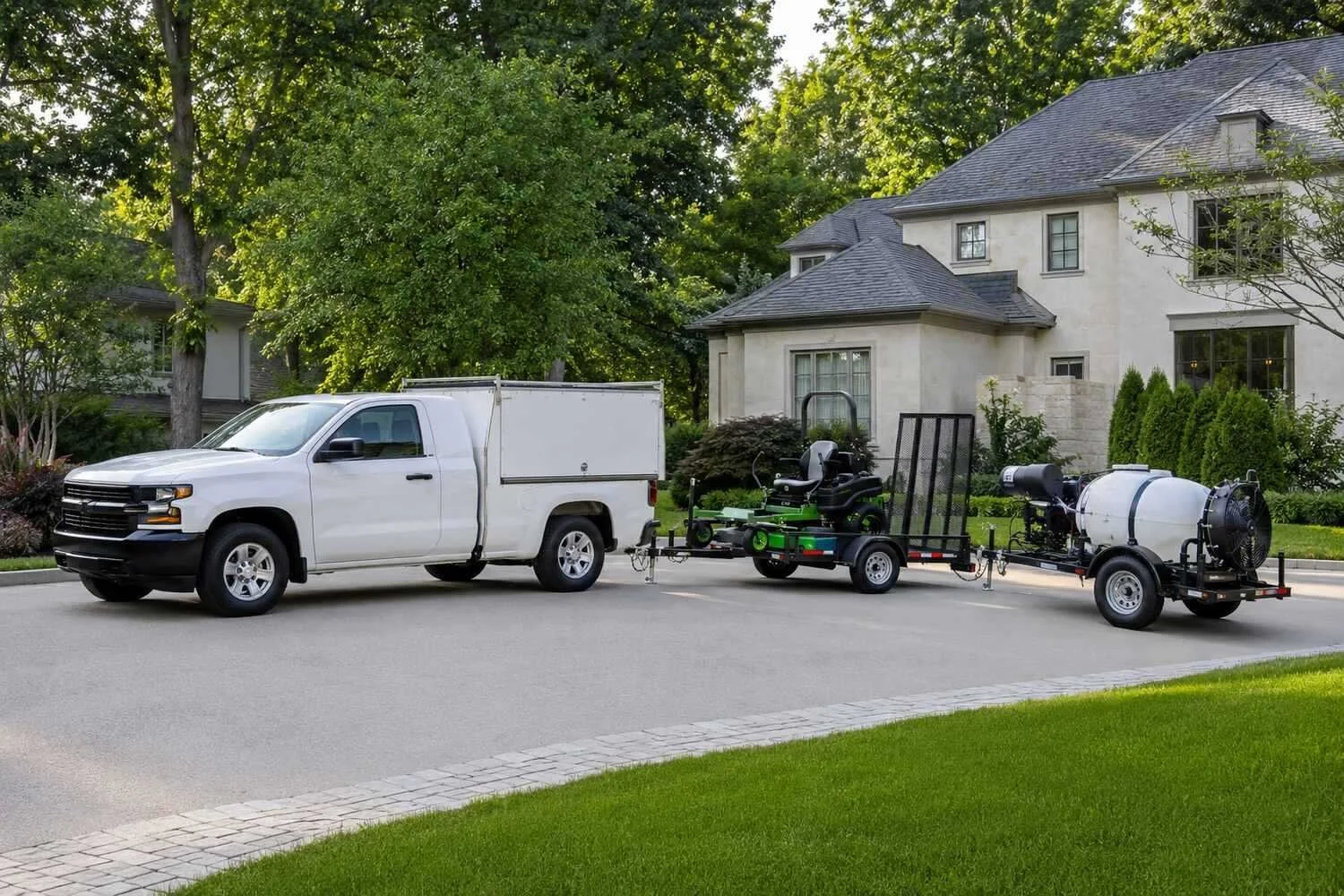
Pest control anchors a route portfolio: it stacks along a territory, on properties you are already driving to four times a year. It pairs naturally with lawn care, mosquito control, wildlife removal, and termite specialty work — same customers, same trucks, same routes, often the same visit.
Mosquito control in particular is a seasonal overlay on an existing quarterly customer list: you are selling an addition to people who already let you into their yard four times a year. Add termite or wildlife specialty work and you have premium-priced services flowing through a list you already own. Start with the quarterly accounts, then sell the next service to the people already on them.
That is the difference between owning a truck and owning a portfolio. You are not building a spray route. You are building the property-services relationship a few hundred households rely on, anchored by revenue that renews on a schedule rather than on a decision. A portfolio like that, with a documented customer list and a known renewal rate, sells to a buyer as one asset — which is how it ends up worth over a million dollars at sale, instead of a truck and a sprayer.
Frequently asked questions
Is a pest control business profitable? At scale, yes, though the honest answer is not a percentage. It is whether the routes still produce cash after paying technicians and a manager to replace the owner's labor. Pest control tends to clear that test because the revenue renews on a schedule, so the manager's wage is set against income you can predict rather than income you have to go and win.
How much does it cost to start a pest control business? Roughly $15,000–$40,000 to start from scratch, about $164,000–$250,000 for an acquisition, or $50,000–$150,000 for a franchise.
Do I need a license for pest control? Yes. Every state requires a pesticide applicator license, with categories, exams, experience hours, and continuing education that vary by state. Check your state's agriculture or pesticide agency. [S8]
Can I start pest control part-time? It takes more planning than some categories because of the license and the route commitment, but the $15,000 to $40,000 startup path is workable alongside a W-2 if you build the customer list slowly and schedule around it.
Where to go from here
Download the free guide.50 Boring Businesses That Make Millionaires is the full result of the research: fifty categories run against the four tests, what each one costs to enter by all three paths, what has to line up for it to work, and how they pair into a portfolio. Free at microbusinessmillionaire.com.
Read the book.The Microbusiness Millionaire: How Ordinary People Build Extraordinary Wealth One Microbusiness at a Time follows four people who each reached a portfolio worth more than a million dollars by a different path. One keeps a hospital job and uses CDFI financing to acquire one stable service business, then another, then a third. One saves on a single income for three years, leaves a master plumber's wage, and stacks trade service lines starting with an SBA microloan. One uses an SBA Community Advantage loan to open a franchise, then opens three more. One starts with about $5,000 on the side and keeps a W-2 for years, building the slowest and most patient version of the same result. Four starting points, four amounts of money, four portfolios worth over a million dollars at sale. The book is coming soon — join the email list at microbusinessmillionaire.com to hear when it lands.
Join the next cohort — Microbusiness Millionaire: Operating System. The book gives you clear examples of how it's done. The course is the step-by-step system for doing it yourself: screening a real company against the four tests, running the owner-replacement cash-flow math on a seller's actual numbers, knowing when to walk, knowing which lenders fund deals this size, and installing the manager who runs the business without you. Eight weeks online, five seats a cohort, waitlist first — at microbusinessmillionaire.com.
About the author
Chris Scott has spent more than twenty-five years in the small-business arena. As the director of a Community Development Financial Institution (CDFI), he reviewed loan applications and made the approve-or-decline decisions. Later, at the U.S. Small Business Administration (SBA), he monitored lending programs. Across those two roles, thousands of business plans and loan applications crossed his desk. He still works at the SBA, now in its venture capital division. His research into which microbusinesses build wealth — and which quietly build a job — became The Microbusiness Millionaire and the free companion guide, 50 Boring Businesses That Make Millionaires.
Sources & references
[S1] IBISWorld, Pest Control in the US — Market Size, 2026 ($29.7bn; 3.4% CAGR 2021–2026). ibisworld.com
[S2] IBISWorld, Pest Control in the US — Number of Businesses, 2026 (34,076). ibisworld.com
[S3] National Pest Management Association / Specialty Consultants LLC, A Strategic Analysis of the U.S. Structural Pest Control Industry, 26th ed., 2025 (recurring revenue 85.4% of residential service revenue; ~13.29M residential customers; commercial revenue +7.0%). npmapestworld.org
[S4] U.S. Bureau of Labor Statistics, Occupational Outlook Handbook: Pest Control Workers (5% projected growth 2024–34; ~13,400 annual openings). bls.gov/ooh
[S5] U.S. Federal Trade Commission, Franchise Rule / FDD Items 7 and 19. ftc.gov
[S6] Opportunity Finance Network CDFI Locator (ofn.org); SBA Lender Match (sba.gov).
[S7] U.S. Bureau of Labor Statistics, Occupational Employment and Wage Statistics, First-Line Supervisors of Landscaping, Lawn Service, and Groundskeeping Workers (SOC 37-1012), used as the closest published comparison to a pest control route supervisor. bls.gov/oes
[S8] U.S. Small Business Administration, Apply for licenses and permits (sba.gov); state departments of agriculture / pesticide regulatory agencies.
[Internal]50 Boring Businesses That Make Millionaires — Pest Control entry (tag, three-path entry-cost table, portfolio pairings, framework note), drawn from the author's research and filtered through the underwriting criteria he applied as a CDFI lender.
This article is for general information only and is not legal, financial, tax, or investment advice. Category-level figures are reference points, not a specific-deal projection; individual businesses vary. Consult a CPA, attorney, business broker, franchise consultant, or CDFI loan officer before acting.
Last updated: 8/24/2026