
How to Start a Mobile Massage Therapy Business
Massage therapy employment is projected to grow fifteen percent this decade, roughly five times the average across all occupations, and a licensed therapist can start for the price of a table. Here is what a mobile massage business costs, what it pays after you replace yourself, and the fork every operator in this category eventually reaches.
Chris Scott — former CDFI director and SBA management
As the director of a Community Development Financial Institution (CDFI), and as management at the U.S. Small Business Administration (SBA), I saw thousands of business plans and loan applications cross my desk. That work is where I learned what a durable business looks like on paper, and what a business that only looks durable looks like on paper.
It is not, however, where the list of fifty came from. That came from years of research, running category after category through the same four questions: Is it profitable? Does it have recurring revenue? Is it recession resistant? Is it AI resistant? Those four questions are the framework behind the book, The Microbusiness Millionaire, and they are what separated the categories that built real wealth from the ones that quietly built a job with a P&L attached. Fifty survived the screen. Far more never made it through.
Mobile massage therapy is one of the fifty, and it is one of the few where a licensed operator can start for a couple of thousand dollars and keep an unusually large share of every dollar billed.
It also comes with the clearest fork among the fifty: at some point you decide whether you are building a practice or a business. Both work, and both are legitimate destinations. Choosing on purpose is what separates the operators who do well from the ones who stall.
The industry: growing, licensed, and moving toward the client
Massage services in the United States are roughly an $18.9 billion industry in 2025, growing at about a 6.3% compound rate over five years as the category shifted from occasional luxury toward regular self-care and clinical referral. [S1] The field is fragmented — mostly small independent practices and franchised studios.
The occupational picture is among the strongest of any category in the fifty. Massage therapy runs to roughly 168,000 workers. The Bureau of Labor Statistics projects employment growth of 15% from 2024 to 2034, close to five times the 3% average across all occupations. That is about 24,700 openings a year. [S2] What a therapist is paid is the price of replacing yourself — what you would owe someone to deliver the sessions you are delivering now. Therapist pay is set locally, so look up the rate where you practice. Every profit number later in this article has to survive it, and the real cost runs higher once payroll taxes and insurance go on top.
Two details matter for an owner. Part-time work is common and many therapists are self-employed, so the median understates what a full, well-priced client list produces. And that growth rate against a licensed occupation is what a shortage looks like — good for your rates, and the thing to plan around when you hire.
Why mobile massage made the list
Every category in the research had to clear four tests. Clear three and you usually have a self-employed job in disguise.
Does it pay after you replace yourself? It can, and this is where the fork appears. As a solo practice the economics are among the best among the fifty — no lease, no front desk, and a very large share of each session retained. As a multi-therapist business it works when the schedule is full and the bookings are contracted rather than assembled one at a time, which is exactly what corporate wellness provides.
Does the revenue recur? Yes, through the rebooking rhythm. Clients using massage for pain management or maintenance return on a two-to-four-week cycle, and corporate wellness contracts turn that into something firmer: scheduled sessions booked by an employer rather than assembled one client at a time.
Does it survive a recession? Better than it used to. The shift from spa indulgence toward therapeutic and clinical use — pain management, injury recovery, employer wellness programs — has moved much of the demand into the category people protect rather than cut first.
Will it still need humans in ten years? Emphatically. Skilled hands-on soft-tissue work delivered to a specific body with specific complaints requires trained judgment, which is why the license exists at all. Software can book the session. It cannot do the work. Very low AI exposure.
Four for four, on a capital requirement small enough to begin alongside a job.
The research on this category kept returning to one question worth asking early: is this a practice or a business? Both answers work, and the operators who did well had picked one. Some chose a practice cleanly — solo, priced at the top of the local market, a tight geographic circle to keep drive time down, and a share of revenue most business owners would envy. Others chose a business and did the unglamorous thing that makes it work, chasing corporate wellness contracts, because an employer booking a standing half-day fills a schedule in a way individual clients never quite do. The pattern that struggled was the one that hired a second therapist while still filling the calendar one appointment at a time. From the lending side of the desk that shows up as a request to finance capacity before there is committed work to put in it, which is a difficult loan to write in any industry.
What it takes to make this one work
A note on the tags. Every category in the fifty cleared the same four tests; far more never made it through. The tags do not grade a business — they tell you what has to line up for it to work in your hands. Mobile massage carries one: Solo first. That is the instruction manual.
The condition: state licensing is required, licensed therapists are in limited supply, and the work is physically demanding — there is a real ceiling on how many sessions one pair of hands can deliver in a week, year after year.
The move that meets it: decide early whether you are building a practice or a business.
A solo practice keeps more of every dollar than almost anything else among the fifty and can run profitably for years. That is a legitimate destination in its own right, not a waiting room for something bigger.
If you want a business, treat therapist recruiting and retention as the main job rather than an occasional task, and go after corporate wellness contracts — the version of this category that scales best, because the sessions are recurring, scheduled and booked by an employer rather than one client at a time. A contract that fills a therapist's Tuesday is worth more than a dozen individual clients who might rebook.
The upside: whichever fork you take, you are in a licensed occupation growing at roughly five times the average rate, with clients who rebook every two to four weeks, no lease, and a startup cost measured in thousands. Very few categories let you begin this small and still hold real pricing power.
What it costs to get in — the three paths
| Path | Typical cost range | Best for |
|---|---|---|
| Startup (solo) | $2,000 – $8,000 | Licensing + table + supplies |
| Franchise | $445,000 – $1,060,000 | A fixed-location spa — a different business. See below. Example: Massage Heights. |
| Acquisition | $30,000 – $80,000 | Client list + recurring agreements + equipment |
Franchise brands are named as examples, not endorsements. Franchise investment figures reflect a franchisor's most recent Franchise Disclosure Document (FDD) and change annually — verify each brand's current FDD (Item 7 for the initial-investment range; Item 19 for any financial-performance representation) before pursuing one. [S3]
That third row needs explaining, because it is the odd one out on the whole list. There is effectively no mobile massage franchise. The recognizable brands in this trade are fixed-location membership spas, and Massage Heights — now trading as Heights Wellness Retreat — discloses an estimated initial investment of roughly $445,000 to $1,060,000 in its current FDD, driven mostly by leasehold improvements and construction. [S6]
That is a different business, not a bigger version of this one. It has premises, a lease, a membership base and a build-out, and at that price it sits well beyond the $350,000 SBA Community Advantage ceiling and outside what a community lender writes. If a spa is what you want, it is a legitimate thing to want — but it belongs to a different chapter than this article.
Which leaves the first two rows as the real paths here, and that is not a limitation. It is the point of a category you can enter for the price of a table.
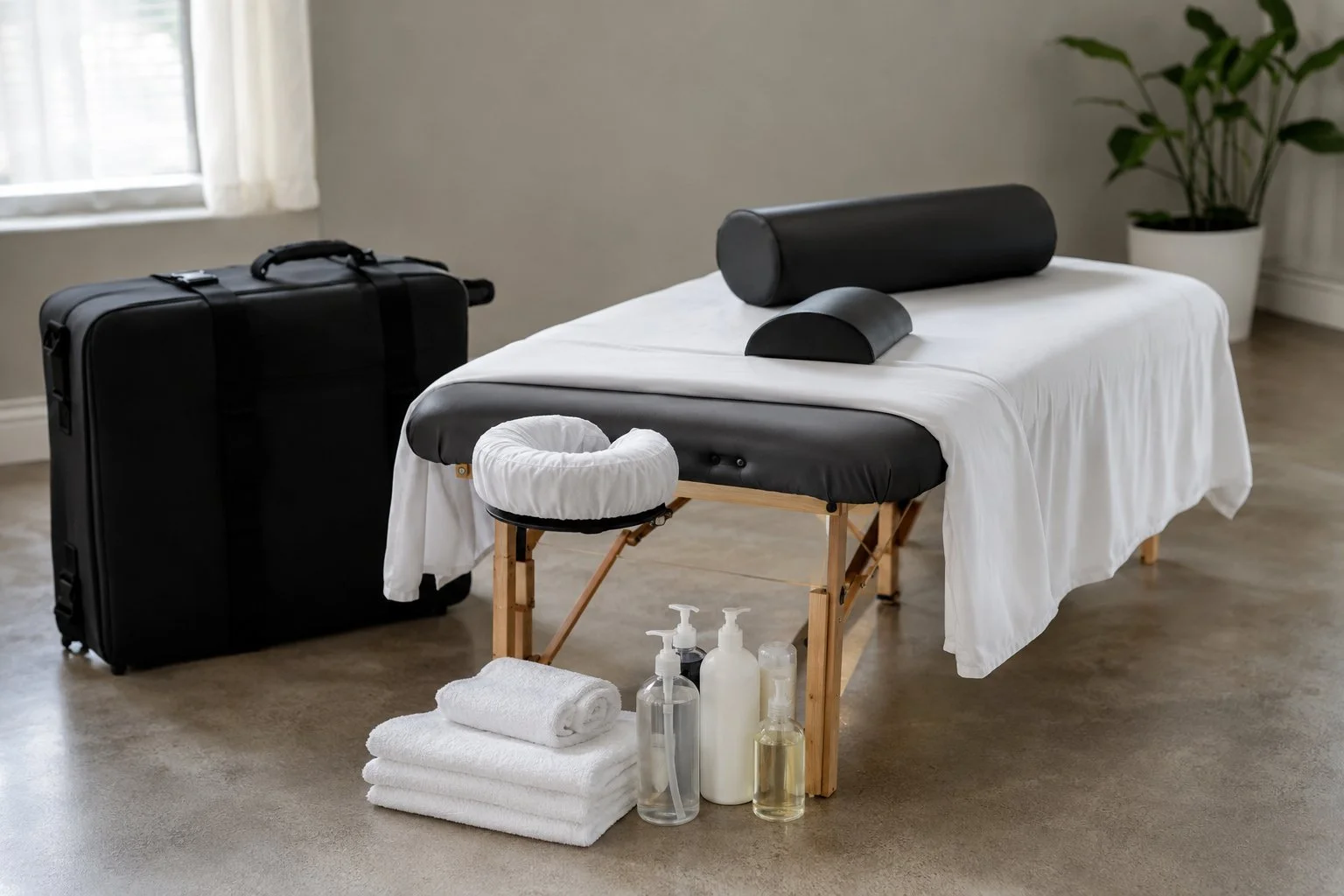
A $2,000 to $8,000 solo start sits near the bottom of the entry ladder in the fifty — a table, bolsters, linens, oils and licensing. The real cost is training, paid in program hours rather than dollars, and it is what keeps this field populated by qualified people.
The acquisition path buys not the table but the client list — rebooking clients, and ideally the corporate contracts attached to them. That is the asset.
How people actually fund it

At $2,000 to $8,000 this is one of the few categories among the fifty a person can genuinely start beside a full-time job — the same tier the book's side-hustle path starts in, keeping a W-2 in place while the business builds. Evenings and weekends fill first, the client list grows, and the decision to go full-time gets made from evidence rather than hope.
A $30,000 to $80,000 acquisition of an established client list moves up into SBA Microloan and CDFI direct lending territory.
One pattern I watched from the lending chair, across every industry that came through: a qualified buyer walks into a national bank, gets declined, and concludes they cannot be funded. They never learn that a CDFI across town, or a Community Advantage lender, exists precisely for deals this size. Two free national directories will show you the ones near you — the Opportunity Finance Network CDFI locator and SBA Lender Match. [S4]
Finding the lender is the easy half. A massage practice also has a specific tell an underwriter looks for: rebooking rate and contracted hours — what share of clients are on a standing cycle, and how many hours a week are committed under corporate wellness agreements rather than booked individually. A client list anchored in contracts and rebooking clients is far more bankable than a busy but ad-hoc calendar, because one of those transfers to a new owner and the other largely walks out the door. Start recording both before anyone asks for them.
The profit reality: owner-replacement cash flow

Here is the calculation that decides more of these deals than anything else in them. A massage practice looks profitable because the owner is delivering every session, driving between them, booking the clients, and keeping the books — none of it priced. The honest test: after you pay your therapists, and after you pay a lead therapist a market wage to deliver sessions the way you deliver them, is there enough left for you to own the thing?
How this category answers depends on which fork you took. As a solo practice the replacement math is almost beside the point, in the best way — you keep a very large share of revenue, and that is a fine destination if chosen deliberately.
As a business, the arithmetic turns on how full the calendar stays. A therapist's wage is covered only when the calendar is genuinely full, and full calendars come from contracted, scheduled work far more reliably than from individual bookings. That is why corporate wellness matters beyond the revenue itself: it is what makes a second therapist economic. A practice built on standing employer contracts leaves real room after paying a lead therapist. One built on hoping clients rebook usually does not.
The category-level math is easy — you just did it. Running it on a specific practice, where the seller's "profit" hides her own unpriced session and travel hours and the real question is how much of the client list survives her hands leaving, is where people freeze. That is the job of the course, Microbusiness Millionaire: Operating System — the four tests turned into a repeatable screen you run on a real deal.
The benefits of owning a mobile massage business
An entry small enough to test alongside a job. A table, linens and licensing — a start measured in thousands.
No lease, no front desk. Mobile delivery removes the largest fixed costs a studio carries.
A growing licensed occupation. BLS projects 15% growth through 2034, five times the average.
Clients who rebook. Therapeutic clients return on a two-to-four-week cycle.
A contract path that scales. Corporate wellness turns bookings into a standing schedule.
What separates the strong operators from the struggling ones
The fork chosen deliberately. Practice or business — pick one early and build toward it. Both are good outcomes; what stalls is drifting between them and getting neither the cash flow of the first nor the scale of the second.
Contracted hours before the second therapist. A hire needs committed work waiting for them. Land the corporate agreement first and the calendar is full on their first day.
Corporate wellness pursued properly. Employer contracts are the most reliable way to fill a week in this category, and they are won by asking rather than by advertising.
The travel priced in. Coming to the client is the premium the whole model rests on. Charge for it, and keep the territory tight enough that drive time stays short.
Licenses, permits, and regulations
Massage therapy is a licensed profession in most of the country, and the requirements are worth confirming rather than assuming. Expect state licensure with required training hours from an approved program and an examination, plus a general business license and sales-tax registration. Many cities add a local establishment or practitioner permit, and some require background checks — rules that distinguish licensed therapeutic practice from unlicensed operations, and that work in a legitimate operator's favor. Working in clients' homes makes professional liability insurance essential alongside general liability, and if you handle client health information under a clinical referral, confirm what privacy obligations apply. Draping and consent standards are part of practice-act compliance in most states. Start with your state massage therapy board and the free SBA "Apply for licenses and permits" tool. [S5] (General information, not legal advice — confirm your state licensure and local permit requirements before you take paid clients.)
Build a portfolio, not a job
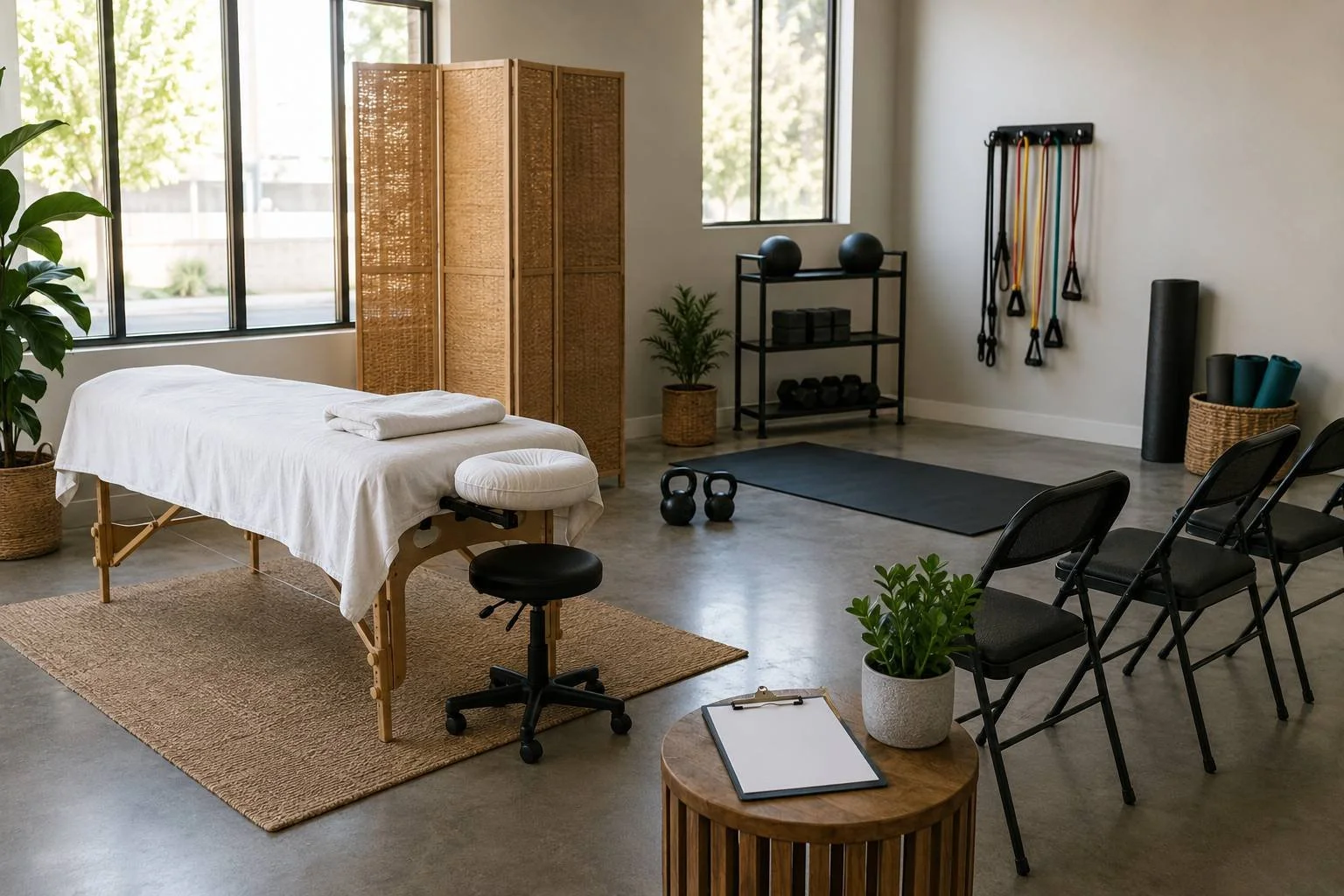
Mobile massage is a route business: it stacks along a territory, on clients you are already driving to, and it anchors a wellness cluster built around the same person and the same recurring rhythm.
It pairs most naturally with personal training — the same body, the same goals, often the same week — and trainers are among the best referral sources a therapist has. It extends into broader wellness services, and its strongest partner is corporate wellness, where a single employer relationship carries massage, training and programming on one contract. The operator who trains the client on Monday and treats the strain on Thursday becomes the wellness relationship a household, and an employer, keeps on retainer.
That is the difference between owning a table and owning a portfolio. You are not building a schedule of appointments. You are building the wellness relationship a few hundred clients and a handful of employers rely on, anchored by licensed hands-on work nobody can automate. A portfolio like that, with contracted hours and a documented client list, sells to a buyer as one asset — which is how it ends up worth over a million dollars at sale, instead of a table and a bottle of oil.
Frequently asked questions
Is a mobile massage business profitable? As a solo practice it is among the strongest in the fifty — no lease, and the operator keeps a large share of every session. As a business the honest test is how full the calendar stays: whether a lead therapist's calendar is full enough, usually through corporate contracts, to cover a market wage and still leave real cash flow for the owner.
How much does it cost to start a mobile massage business? Roughly $2,000 to $8,000 for licensing, a table and supplies, with no premises and no inventory. About $30,000 to $80,000 to acquire an established client list with equipment, or $50,000 to $120,000 for a franchise with a booking platform.
Do I need a license for massage therapy? Most states license massage therapists, requiring approved training hours and an exam, and many cities add a local permit and background check. Confirm your state board's requirements before taking paid clients. [S5]
How does a mobile massage business grow past one therapist? Through contracted hours rather than individual bookings. Corporate wellness agreements provide recurring, scheduled sessions booked by an employer — what reliably fills a second therapist's calendar and makes the hire economic.
Where to go from here
Download the free guide.50 Boring Businesses That Make Millionaires is the full result of the research: fifty categories run against the four tests, what each one costs to enter by all three paths, what has to line up for it to work, and how they pair into a portfolio. Free at microbusinessmillionaire.com.
Read the book.The Microbusiness Millionaire: How Ordinary People Build Extraordinary Wealth One Microbusiness at a Time follows four people who each reached a portfolio worth more than a million dollars by a different path. One keeps a hospital job and uses CDFI financing to acquire one stable service business, then another, then a third. One saves on a single income for three years, leaves a master plumber's wage, and stacks trade service lines starting with an SBA microloan. One uses an SBA Community Advantage loan to open a franchise, then opens three more. One starts with about $5,000 on the side and keeps a W-2 for years, building the slowest and most patient version of the same result. Four starting points, four amounts of money, four portfolios worth over a million dollars at sale. The book is coming soon — join the email list at microbusinessmillionaire.com to hear when it lands.
Join the next cohort — Microbusiness Millionaire: Operating System. The book gives you clear examples of how it's done. The course is the step-by-step system for doing it yourself: screening a real company against the four tests, running the owner-replacement cash-flow math on a seller's actual numbers, knowing when to walk, knowing which lenders fund deals this size, and installing the operator who runs the business without you. Eight weeks online, five seats a cohort, waitlist first — at microbusinessmillionaire.com.
About the author
Chris Scott has spent more than twenty-five years in the small-business arena. As the director of a Community Development Financial Institution (CDFI) and as management at the U.S. Small Business Administration (SBA), he saw thousands of business plans and loan applications cross his desk. His research into which microbusinesses build wealth — and which quietly build a job — became The Microbusiness Millionaire and the free companion guide, 50 Boring Businesses That Make Millionaires.
Sources & references
[S1] IBISWorld, Massage Services in the US — market size approximately $18.9bn in 2025, ~6.3% CAGR 2020–2025; highly fragmented field of independent practices and franchised studios. ibisworld.com
[S2] U.S. Bureau of Labor Statistics, Occupational Outlook Handbook / Occupational Employment and Wage Statistics, Massage Therapists (SOC 31-9011) — approximately 168,000 employed; employment projected to grow 15% from 2024 to 2034 against a 3% average for all occupations, with about 24,700 openings per year; part-time work is common and many therapists are self-employed. bls.gov/ooh
[S3] U.S. Federal Trade Commission, Franchise Rule / FDD Items 7 and 19. ftc.gov
[S4] Opportunity Finance Network CDFI Locator (ofn.org); SBA Lender Match (sba.gov).
[S5] U.S. Small Business Administration, Apply for licenses and permits (sba.gov); state massage therapy board licensure requirements; local massage establishment/practitioner permits and background checks; professional liability insurance considerations.
[S6] Massage Heights / Heights Wellness Retreat franchise disclosure data as reported by franchise-filing aggregators and lending analyses of recent FDDs: total estimated initial investment reported at $445,000–$1,060,000 (2026 reading), with narrower readings of $472,199–$551,771 and $622,428–$819,659, on an initial franchise fee of $34,500–$49,500. The brand operates fixed-location membership spas rather than mobile services. No mobile massage franchise of comparable scale was identified. Reported figures vary between aggregators and filing years; verify the current FDD directly.
[Internal]50 Boring Businesses That Make Millionaires — Mobile Massage Therapy entry (tag, three-path entry-cost table, portfolio pairings, framework note, "what it takes to make this one work"), drawn from the author's research and filtered through the underwriting criteria he applied as a CDFI lender.
This article is for general information only and is not legal, financial, tax, or investment advice. Category-level figures are reference points, not a specific-deal projection; individual businesses vary. Consult a CPA, attorney, business broker, franchise consultant, or CDFI loan officer before acting.
Last updated: 8/22/2026.