

How to Start a Mobile Detailing Business
You can start this one on a Saturday for the price of a pressure washer and never miss a paycheck. Here is what a mobile detailing business costs, what it pays after you replace yourself, and why the decision that matters most is whether you ever hire anyone at all.
Chris Scott — former CDFI director and SBA management
As the director of a Community Development Financial Institution (CDFI), and as management at the U.S. Small Business Administration (SBA), I saw thousands of business plans and loan applications cross my desk. That work is where I learned what a durable business looks like on paper, and what a business that only looks durable looks like on paper.
It is not, however, where the list of fifty came from. That came from years of research, running category after category through the same four questions: Is it profitable? Does it have recurring revenue? Is it recession resistant? Is it AI resistant? Those four questions are the framework behind the book, The Microbusiness Millionaire, and they are what separated the categories that built real wealth from the ones that quietly built a job with a P&L attached. Fifty survived the screen. Far more never made it through.
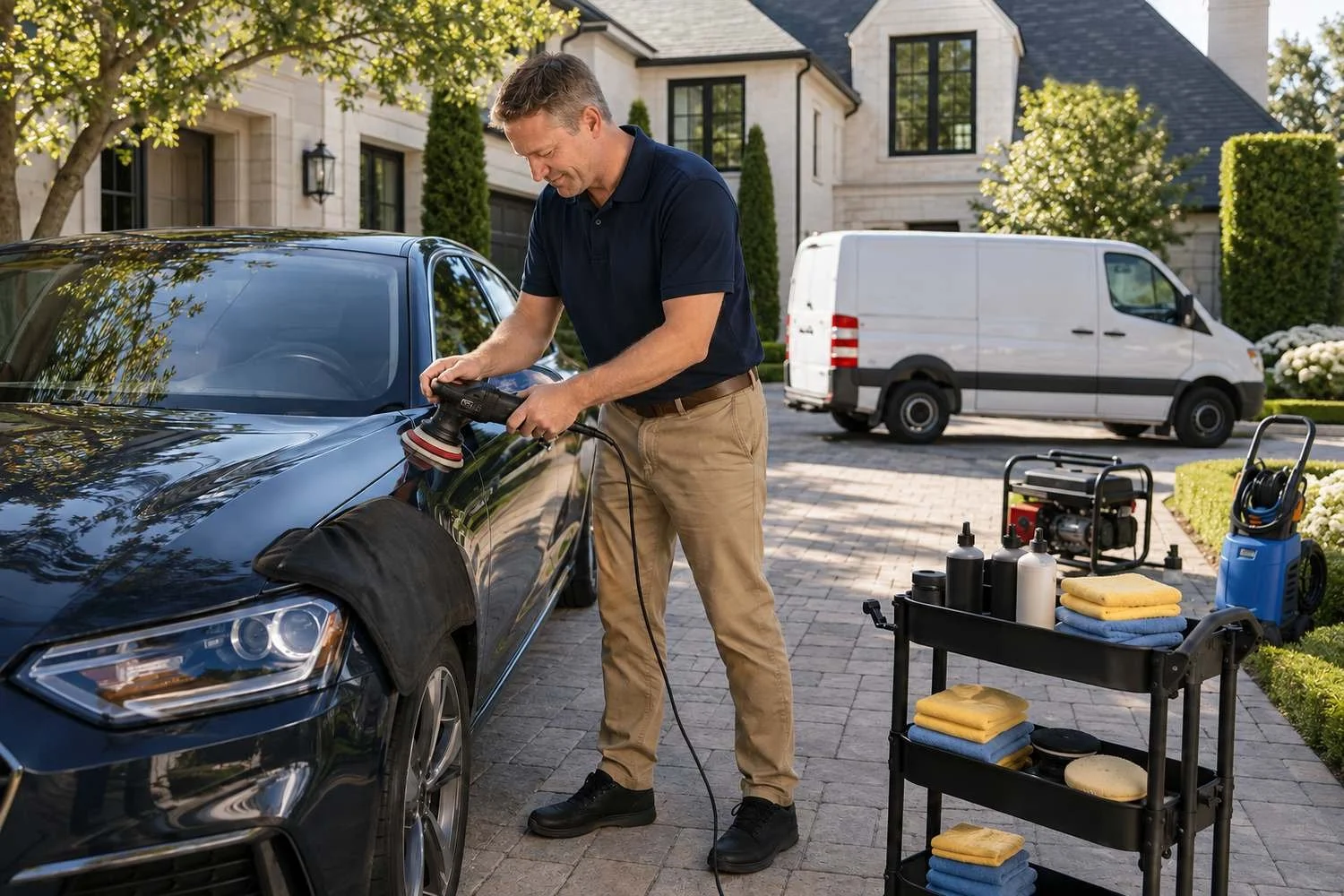
Mobile detailing is one of the fifty, and it has a characteristic almost nothing else on the list shares: an unusually large share of the revenue is the owner's own skilled labor. Paint correction, ceramic coating and window tint are priced for a result rather than for an hour, and performed at the customer's location with a few thousand dollars of equipment.
That single fact runs through everything below. It is why the weekend start works, why the cash flow is strong while you are the one doing the work, and why the numbers change materially the day you pay somebody else to do it.
A word on the neighbor.Mobile car wash is also one of the fifty, and the two run off similar trucks to similar customers, which makes them easy to confuse. They are not the same business. A wash is volume work on a schedule — exterior clean, quick interior, half an hour a vehicle, a modest price, repeated across a lot of them. Detailing is craft work sold by the job, measured in hours per car at several hundred dollars a time. A detailing business is built on skill. A wash business is built on contracts. They pair beautifully off the same truck and the last section explains how — but they are priced, staffed and valued differently, and the mistake is starting one while running it like the other.
The industry: huge, fragmented, and made for small operators
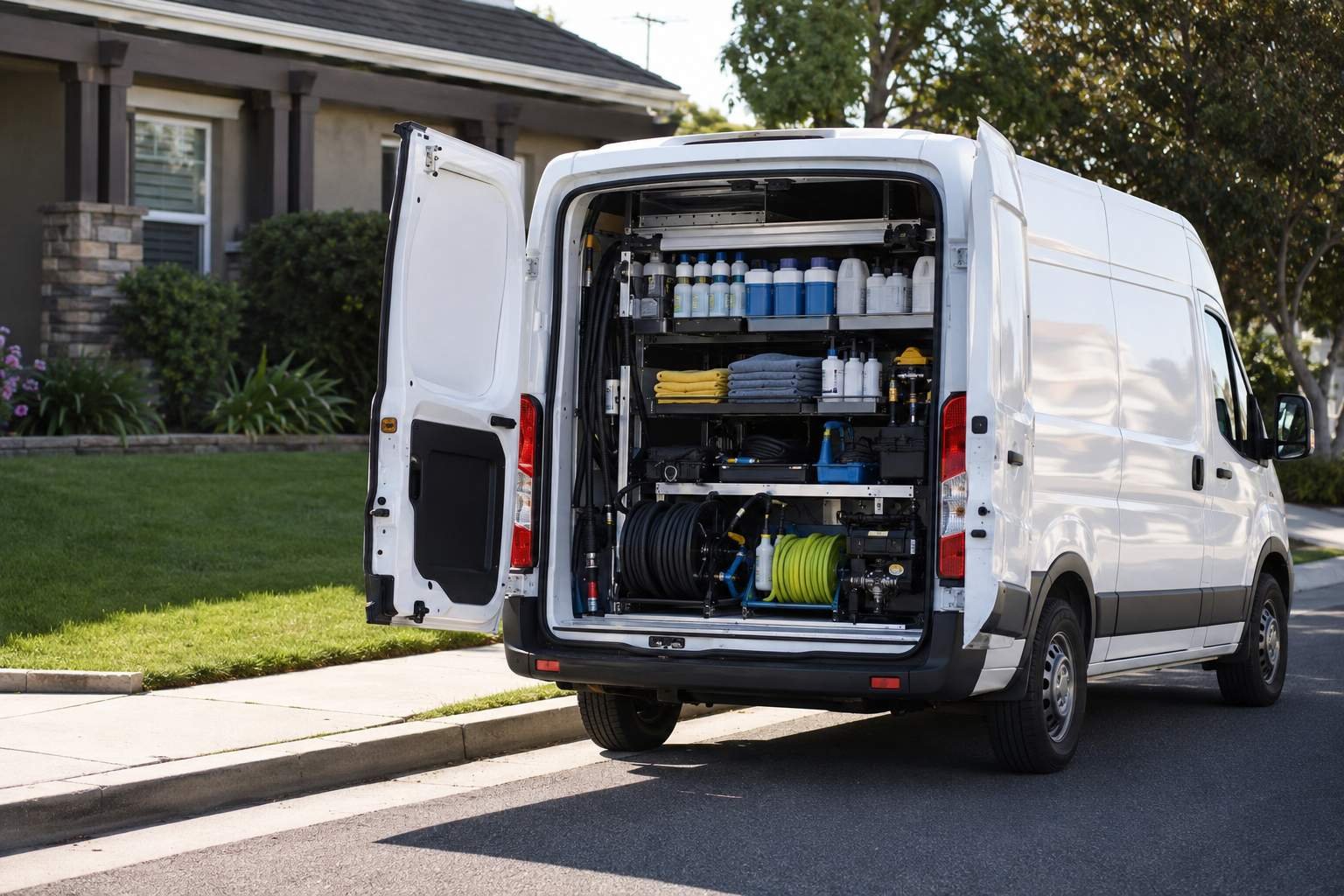
The U.S. car wash and auto detailing market runs about $18.7 billion in 2025, spread across roughly 57,900 businesses employing nearly 198,000 workers, and it's deeply fragmented — the fifty largest companies hold less than 20% of it. [S1] That IBISWorld category explicitly includes mobile washing and detailing services, and the fragmentation is the point: this is a market built for small, owner-run operators who show up at the customer's door.
Do the arithmetic on those two numbers and the average business in the category turns over about $320,000 a year across roughly three or four people. This is a market of small owner-run operations, not of chains.
The base labor line is modest — cleaners of vehicles and equipment is an entry-level cleaning classification — but it describes basic vehicle washing rather than the business worth building. [S2] Skilled detailers doing paint correction, ceramic coating and tint command well above that base rate. Both rates live in your own market rather than in a national table; the Resource Directory in the free tools shows where to find them, because those are specialized services a tunnel wash cannot deliver at any price. That wage is the price of replacing yourself — the cost of handing the work to someone who is not you. Every profit number later in this article has to survive it, and the real cost runs higher once payroll taxes and insurance go on top.
Hold on to that gap between the base wage and the skilled rate. It is the whole economics of this category, and it is the reason the tag below says what it says.
Why mobile detailing made the list
Every category in the research had to clear four tests. Clear three and you usually have a self-employed job in disguise.
Does it pay after you replace yourself? This is the honest picture, and it is the most important paragraph in the article. Solo, the cash flow is strong — strong enough to surprise people at this entry price. It compresses substantially once you are paying detailers, because so much of what you were keeping was payment for your own hands. That is not a flaw in the category. It is the defining feature of it, and it turns replacing yourself into a decision you make on purpose rather than a milestone you drift toward.
Does the revenue recur? On a schedule, and more reliably at the premium end than at the cheap one. Cars get dirty again, and ceramic and paint-correction clients return for maintenance on the coating they have already paid for. Fleet accounts stack on top. A satisfied detailing customer is a standing appointment rather than a transaction.
Does it survive a recession? The premium end holds up, because somebody protecting a $40,000 vehicle keeps protecting it, and fleet accounts are sticky by contract. And the structure helps as much as the demand: a mobile operation with no lease can wait out a soft quarter on a fraction of what a fixed location needs.
Will it still need humans in ten years? Hand detailing, paint correction and tint are physical, skill-dependent craft performed on a different vehicle every time. Software can book the job and price the package. It cannot cut a panel back or lay a film without a bubble. Very low AI exposure.
Four for four, on an entry small enough to begin on a Saturday.
This is the category the research found people underestimating most consistently, and the pattern is always the same shape. Somebody starts on weekends with a pressure washer and a generator, keeps the W-2, and inside a year is turning work away — because solo detailing throws off cash unlike almost anything else available at that entry price. What happens next is what separates the operators. One takes that cash and quietly funds a second business with it, keeping detailing as a lean route he runs himself. Another decides he wants a platform, hires detailers, and accepts that the per-job economics will compress in exchange for building something larger. Both are defensible. The failure is neither of those — it is drifting into staffing without deciding, losing the solo cash flow and not getting a platform in return. From the lending side of the desk this category behaves unlike the rest of the fifty, and it is worth saying why: a business whose cash flow depends on the owner's own hands is not straightforwardly bankable, because the thing generating the money walks out of the door when the owner does. An underwriter will look for the revenue that survives the founder — fleet contracts, recurring maintenance clients, work booked to the business rather than to the man. If you intend to borrow against this one, that is the half of the business to build deliberately, and early.
What it takes to make this one work
A note on the tags. Every category in the fifty cleared the same four tests; far more never made it through. The tags do not grade a business — they tell you what has to line up for it to work in your hands. Mobile detailing carries one: Solo first. On this category the tag is less a condition than an instruction manual.
Solo first: the economics are tied to your hands
The condition: a large share of what a solo detailer keeps is payment for skilled labor he is not charging himself for. Pay somebody else to do that work at a market wage and the cash flow compresses — not to nothing, but to something that looks like an ordinary service business rather than a remarkable one. The economics are tied to your hands, and they do not transfer for free.
The move that meets it: treat the decision to hire as a decision, made once, deliberately, with the arithmetic done first. Stay solo while the cash flow is strong and use it to fund the next business — which is how a good many portfolios in the fifty actually get started. Or staff up on purpose, knowing the per-job economics will settle, because what you want is a platform rather than a route.
There is no wrong answer between those two. There is a wrong way to arrive at either: drifting into hiring without running the numbers, losing the solo cash flow and not getting a platform in exchange for it.
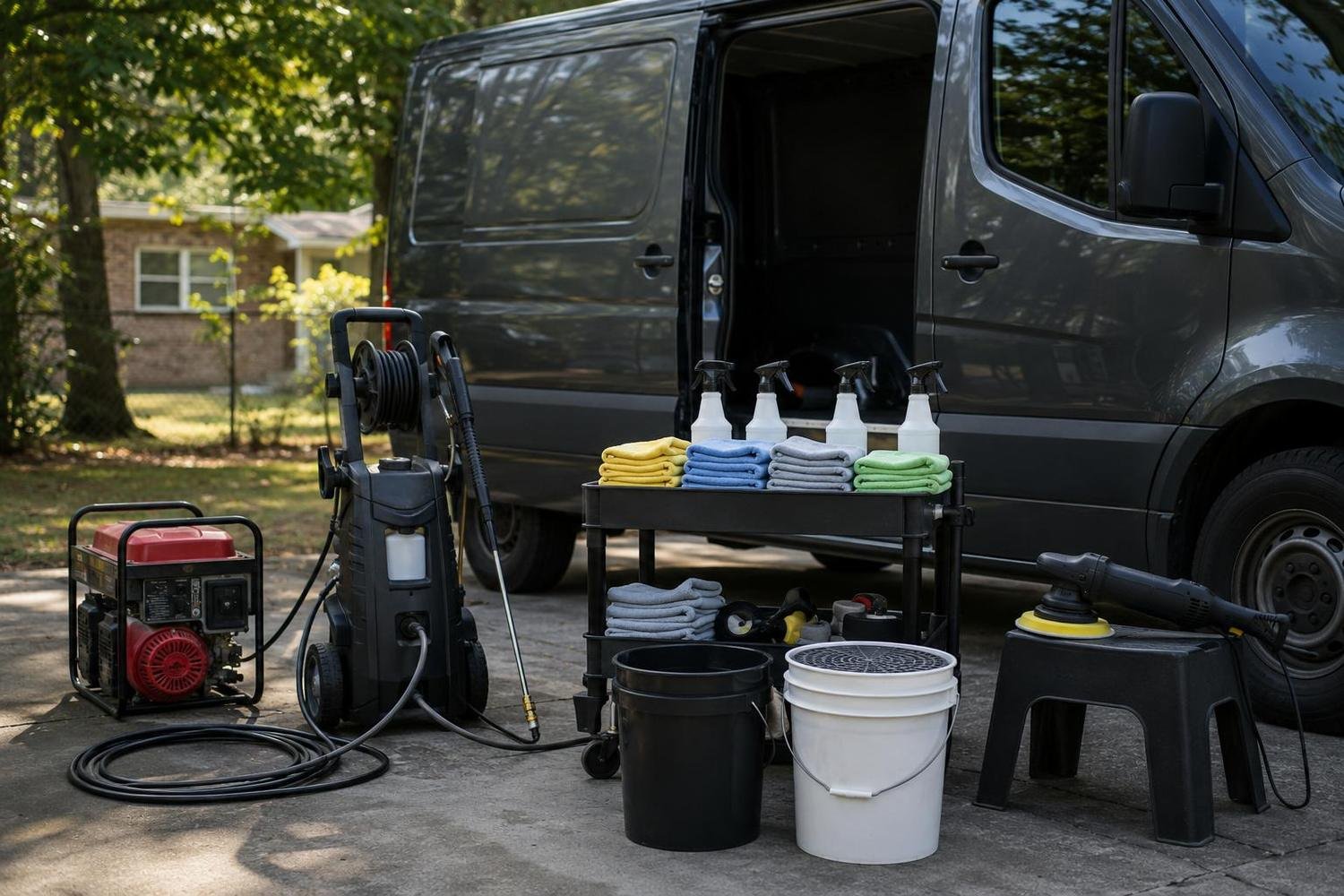
The upside: very little else in the fifty lets you test the whole proposition this cheaply. You can start on a weekend with a pressure washer and a generator, keep every paycheck while you find out whether you are any good at it, and let the cash flow tell you what to do next rather than committing first and hoping.
Whether it ends up a lean cash engine that funds the next thing or a staffed platform in its own right, the on-ramp is about as forgiving as owning a business gets.
What it costs to get in — the three paths
| Path | Typical cost range | Best for |
|---|---|---|
| Startup (solo) | $2,000 – $8,000 | Truck + pressure washer + supplies |
| Acquisition | $30,000 – $100,000 | Truck + customer list + recurring accounts |
| Franchise | $85,000 – $255,000 |
The ranges above are my category estimate from the lending chair, not any brand's published figure. Brands are named as real examples so you can check them yourself, not as endorsements, and their actual investment ranges may differ from the range above. Each franchisor's Franchise Disclosure Document (FDD) is the authoritative source and refiles annually: check Item 7 for the initial-investment range and Item 19 for any financial-performance representation before pursuing one. [S3]
Put the first row and the last row side by side, because in this category the gap between them is the widest on the whole list. DetailXPerts is reported at roughly $88,500 to $195,100 on a fee of $35,000, and Spiffy at roughly $116,550 to $256,400. [S6] Against a $2,000 solo start, that is a factor of more than forty.
What the money buys is not the ability to detail a car. You can do that with the kit in the first row, and the skill is learned by doing it. What a franchise sells here is demand — a brand, a booking platform, and in Spiffy's case national fleet relationships. Which is worth knowing precisely because this article argues that the work is the easy part and the customers are the hard part. Just be clear that you are buying the hard part, and at that price.
That startup number sits near the bottom of the entry ladder in the fifty, alongside lawn care and window cleaning, and it buys a real business rather than a hobby: a truck you probably already own, a pressure washer, a generator and supplies.
The acquisition row buys a truck plus an existing customer list, which is worth considering if you would rather step into repeat work than spend a year building it. But the headline is the first row. Very few categories let you find out whether you want to own a business for the price of the equipment.
How people actually fund it

Most people never borrow to start this one, and that is the point of a $2,000 to $8,000 entry. It is the tier the book's side-hustle path begins in — start small alongside a W-2, keep the job, and let the business fund itself before a lender is ever part of the conversation.
When you do want capital, to acquire a route or buy into a franchise, a $30,000 to $255,000 deal spans the SBA Microloan, CDFI direct lending and SBA Community Advantage range, with everything below $350,000 inside what community lenders are built to write.
One pattern I watched from the lending chair, across every industry that came through: a qualified borrower walks into a national bank, gets declined, and concludes he cannot be funded. He never learns that a CDFI across town, or a Community Advantage lender, exists precisely for deals this size. Two free national directories will show you the ones near you — the Opportunity Finance Network CDFI locator and SBA Lender Match. [S4]
Finding the lender is the easy half. Detailing has a specific tell an underwriter looks for, and it follows directly from everything above: the share of revenue that comes from recurring maintenance clients, fleet contracts and premium ceramic and tint work, rather than from one-off jobs. A customer list with repeat clients and fleet agreements is far more bankable than a busy weekend calendar, because one of those survives the owner taking a month off and the other does not. Bring that breakdown before anyone asks for it.
The profit reality: owner-replacement cash flow

Here is the calculation that decides more of these deals than anything else in them. A detailing business looks profitable because the owner is doing the detailing, booking the jobs, driving the route and keeping the books — none of it priced. The honest test: after you pay your detailers, and after you pay a lead detailer a market wage to do the work the way you do it, is there enough left over for you to own the thing?
This category forces that question earlier and harder than any other in the fifty, which is a mercy rather than a difficulty. Solo, the cash flow is strong — but a large share of it is your labor, unpriced, and the moment you pay a detailer to replace your hands the arithmetic settles toward what an ordinary service business looks like.
That is not a problem to be hidden from a buyer or from yourself. It is the decision, and it has two respectable answers: keep it lean and take the owner cash flow, or staff up knowingly and build something larger with different economics. What matters is running the replacement math before you hire rather than discovering it afterwards, when the wage is already going out every month and the cash you used to keep has gone with it.
The category-level math is easy — you just did it. Running it on a specific company, where the seller's "profit" is really his own unpriced detailing hours and the solo-versus-staffed question changes the entire valuation, is where people freeze. That is the job of the course, Microbusiness Millionaire: Operating System — the four tests turned into a repeatable screen you run on a real deal.
The benefits of owning a mobile detailing business
A weekend start that costs almost nothing. A couple of thousand dollars, and you keep every paycheck while you find out if you like it.
Strong cash flow while you run it yourself. Very little of the money goes to overhead, because there is almost none.
Premium, AI-proof work. Paint correction, ceramic coating, and tint are specialized craft a tunnel wash cannot touch.
No lease to feed. A mobile operation carries almost no fixed cost, which protects the cash flow and gets you through soft quarters.
A cash engine for the next business. Many operators use the solo cash flow to fund their second microbusiness.
What separates the strong operators from the struggling ones
The hiring decision made once, on purpose. The defining choice in this category. Strong operators run the replacement arithmetic before the first detailer is hired and then commit to an answer — lean route or staffed platform. Both build something worth owning. Only the drift between them costs you the cash flow without buying the scale.
Priced against the result, not against the tunnel. The money here is in paint correction, ceramic and tint, which are sold on what the customer gets rather than on how long it took. Operators who price that way never end up racing a $10 express wash toward the bottom, because they are not in that race at all.
Fleet and recurring accounts built alongside the one-offs. Repeat clients and fleet contracts are the sticky, bankable half of this business and the half that survives you taking a week off. They are also the half a lender and a buyer will actually pay for, so build them from the beginning rather than when you need them.
Ceramic and tint priced for the skill. These are specialized services with real consequences when done badly, and the operators who charge accordingly attract the customers who wanted them done properly. Pricing them by the hour gives away both the money and the kind of client the work was meant to win.
Water handled to the local standard from the first job. Runoff rules decide where you are allowed to work, and reclamation practice is what lets you take commercial and municipal jobs that the operator with a hose and a driveway cannot touch.
Licenses, permits, and regulations
Mobile detailing is lightly regulated compared with the trades, but three items are worth confirming rather than assuming, and two of them decide where you may work.
Water runoff and wastewater rules are the real watch item. Many municipalities regulate where wash water may go, and mobile operators frequently need reclamation practices to stay compliant — which is less a formality than a key: it is what opens commercial car parks and municipal lots to you. Window tint carries state limits on allowable darkness, expressed as a VLT percentage, and they vary by state and by window.
Beyond that, expect a general business license and sales-tax registration, plus general liability, commercial auto, and care, custody and control coverage — that last one matters here more than in most categories, because you are working on an asset worth more than your truck. Start with your city or county and the free SBA "Apply for licenses and permits" tool. [S5] (General information, not legal advice — confirm your local water-runoff and tint rules before you take paid work.)
Build a portfolio, not a job
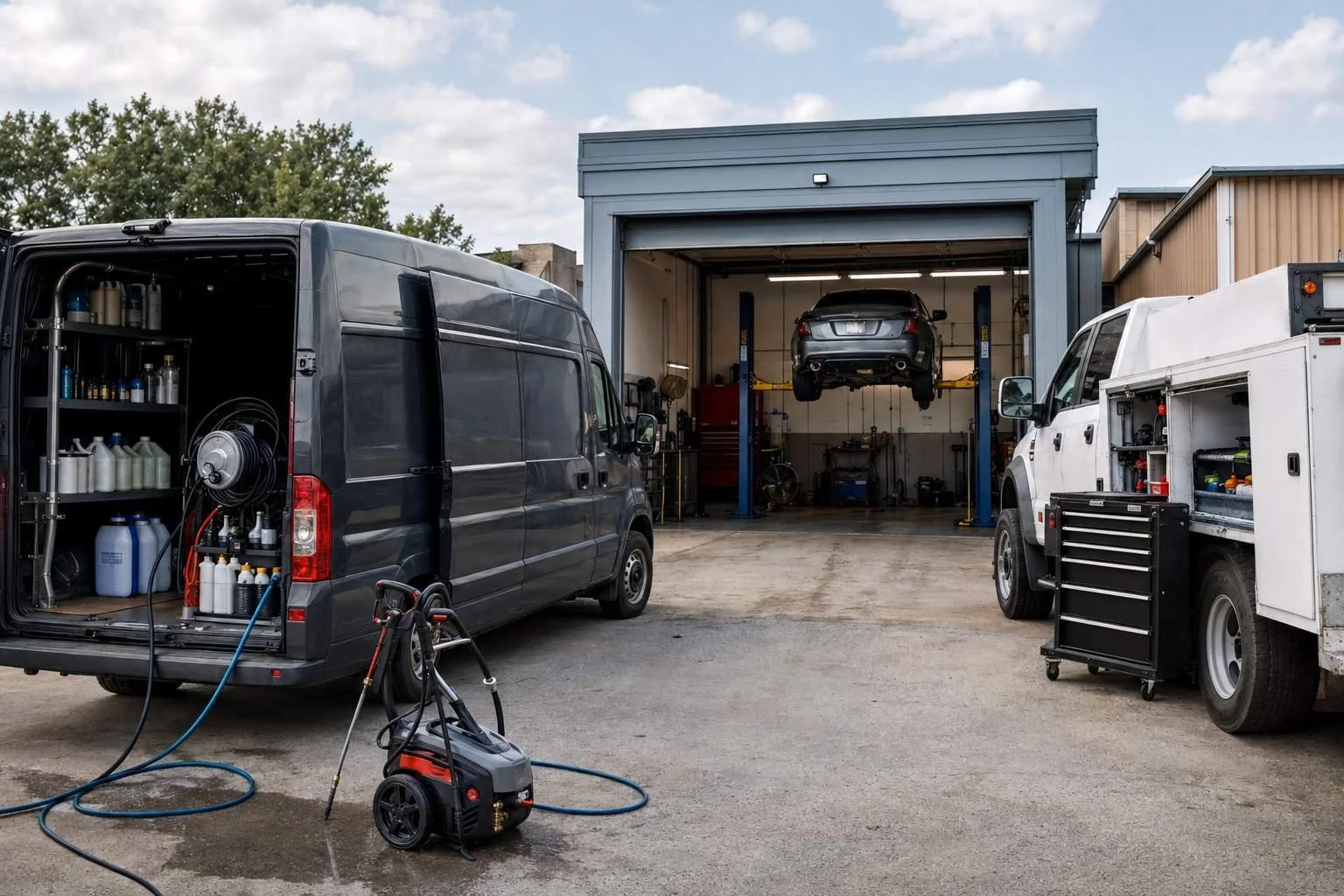
Mobile detailing is craft work — sold by the job, priced on the result, performed one vehicle at a time — and it anchors a mobile automotive cluster that it very often pays for. That funding role is the unusual thing here and worth naming: in this cluster, detailing is frequently the cash engine rather than the destination.
Mobile auto glass and a mobile mechanic operation reach the same customers the same way, off adjacent trucks, and both are craft work sold by the job. Fleet washing pairs differently and deliberately — it is volume work on contract, which is exactly what detailing lacks, so it supplies the recurring, bankable revenue that makes the whole cluster lendable. And auto repair sits at the end of the road if you ever decide to anchor the cluster in a fixed location.
Power washing is the outlier and the closest thing to a free option: same pressure-washing skill, same equipment, an entirely different surface and customer.
That is the difference between owning a truck and owning a portfolio. The thing being built is not one detailing van — it is the automotive-services relationship a few hundred households and fleets rely on, frequently bankrolled by the cash the solo years threw off. A portfolio like that, with documented recurring clients and fleet contracts, sells to a buyer as one asset. That is how it ends up worth over a million dollars at sale, rather than a pressure washer and a generator.
Frequently asked questions
Is a mobile detailing business profitable? Run solo it produces strong cash flow for the money invested, because there is almost no overhead and a large share of what you keep is payment for your own skilled work. The arithmetic settles once you pay detailers, which is why the honest move is to decide on purpose whether you are keeping a lean route or building a staffed platform.
How much does it cost to start a mobile detailing business? As little as $2,000 to $8,000 to start solo with a truck, a pressure washer and supplies, which is near the bottom of the entry ladder in the fifty. About $30,000 to $100,000 to acquire a truck and an existing customer list. Franchising runs far higher — roughly $85,000 to $255,000 depending on the brand. [S6]
Do I need a license to start mobile detailing? Usually a general business license and sales-tax registration, plus attention to local water-runoff and wastewater rules and state window-tint limits. Confirm your city and county requirements first. [S5]
Is mobile detailing a good side hustle? It is one of the most forgiving starting points in the fifty. You can begin on weekends with a pressure washer and a generator, keep the W-2 the whole time, and let the cash flow decide when — or whether — you go full time, or use it to fund the next business instead.
Where to go from here
Download the free guide.50 Boring Businesses That Make Millionaires is the full result of the research: fifty categories run against the four tests, what each one costs to enter by all three paths, what has to line up for it to work, and how they pair into a portfolio. Free at microbusinessmillionaire.com.
Read the book.The Microbusiness Millionaire: How Ordinary People Build Extraordinary Wealth One Microbusiness at a Time follows four people who each reached a portfolio worth more than a million dollars by a different path. One keeps a hospital job and uses CDFI financing to acquire one stable service business, then another, then a third. One saves on a single income for three years, leaves a master plumber's wage, and stacks trade service lines starting with an SBA microloan. One uses an SBA Community Advantage loan to open a franchise, then opens three more. One starts with about $5,000 on the side and keeps a W-2 for years, building the slowest and most patient version of the same result. Four starting points, four amounts of money, four portfolios worth over a million dollars at sale. The book is coming soon — join the email list at microbusinessmillionaire.com to hear when it lands.
Join the next cohort — Microbusiness Millionaire: Operating System. The book gives you clear examples of how it's done. The course is the step-by-step system for doing it yourself: screening a real company against the four tests, running the owner-replacement cash-flow math on a seller's actual numbers, knowing when to walk, knowing which lenders fund deals this size, and installing the operator who runs the business without you. Eight weeks online, five seats a cohort, waitlist first — at microbusinessmillionaire.com.
About the author
Chris Scott has spent more than twenty-five years in the small-business arena. As the director of a Community Development Financial Institution (CDFI) and as management at the U.S. Small Business Administration (SBA), he saw thousands of business plans and loan applications cross his desk. His research into which microbusinesses build wealth — and which quietly build a job — became The Microbusiness Millionaire and the free companion guide, 50 Boring Businesses That Make Millionaires.
Sources & references
[S1] IBISWorld, Car Wash & Auto Detailing in the US (NAICS 81119a), 2025 — market size ~$18.7bn; ~57,900 businesses; ~197,800 employed; fifty largest companies hold under 20% of the market; category includes mobile washing and detailing. ibisworld.com
[S2] U.S. Bureau of Labor Statistics, Occupational Employment and Wage Statistics, Cleaners of Vehicles and Equipment (SOC 53-7061) — the base cleaning classification for this work; skilled mobile detailers (paint correction, ceramic, tint) command well above this base rate. bls.gov/oes
[S3] U.S. Federal Trade Commission, Franchise Rule / FDD Items 7 and 19. ftc.gov
[S4] Opportunity Finance Network CDFI Locator (ofn.org); SBA Lender Match (sba.gov).
[S5] U.S. Small Business Administration, Apply for licenses and permits (sba.gov); local business licensing, water-runoff/wastewater rules, and state window-tint (VLT) limits.
[S6] Mobile detailing franchise disclosure data as reported by franchise-filing aggregators reading recent FDDs: DetailXPerts approximately $88,500–$195,100 on an initial franchise fee of $35,000, with other readings at $92,000–$150,000; Spiffy approximately $116,550–$256,400 on a fee of $36,000–$40,000. Reported figures vary between aggregators and filing years; verify the current FDD directly for any brand.
[Internal]50 Boring Businesses That Make Millionaires — Mobile Detailing & Tint entry (tag, three-path entry-cost table, portfolio pairings, framework note, "what it takes to make this one work") and Mobile Car Wash entry (pairings). Drawn from the author's research and filtered through the underwriting criteria he applied as a CDFI lender.
This article is for general information only and is not legal, financial, tax, or investment advice. Category-level figures are reference points, not a specific-deal projection; individual businesses vary. Consult a CPA, attorney, business broker, franchise consultant, or CDFI loan officer before acting.
Last updated: 8/22/2026.