

How to Start a Holiday Light Installation Business
Six weeks of work, paid for in advance, sold to customers you already have. Here is what a holiday light installation business costs, what it pays after you replace yourself, and why this is the one category among the fifty that is designed to be half of something rather than all of it.
Chris Scott — former CDFI director and SBA management
As the director of a Community Development Financial Institution (CDFI), and as management at the U.S. Small Business Administration (SBA), I saw thousands of business plans and loan applications cross my desk. That work is where I learned what a durable business looks like on paper, and what a business that only looks durable looks like on paper.
It is not, however, where the list of fifty came from. That came from years of research, running category after category through the same four questions: Is it profitable? Does it have recurring revenue? Is it recession resistant? Is it AI resistant? Those four questions are the framework behind the book, The Microbusiness Millionaire, and they are what separated the categories that built real wealth from the ones that quietly built a job with a P&L attached. Fifty survived the screen. Far more never made it through.
Holiday light installation is one of the fifty, and it is the most unusual entry among them. Every other category comes with a market size, a labor benchmark and a growth rate. This one has to be shown differently, because measuring it the normal way would tell you something false.
The market is your customer list
Here is the honest thing, and it's the whole business case.
There is no meaningful industry figure for holiday light installation, and you should be skeptical of anyone who quotes you one. What gets measured is what Americans spend buying decorations at retail — a real number from a real source, answering a different question than the one you are asking. Nobody counts the service. It is a six-week specialty performed largely by companies whose actual business is something else for the other forty-six weeks.
That is not a data gap. It is the answer.
The market for your holiday lighting business is the customer list you already own. Not a territory, not a demographic, not a total addressable anything. The houses you already mow. The storefronts whose gutters you already clean. Every one is a customer who already has your number, already lets you on their roof, and already pays your invoices — and every October, every one of them is deciding whether to climb a ladder in the cold or write a check.
That is why the category cannot be sized in the usual way, and why it does not matter. Your market is a number you already know.
What the data does tell you is that the underlying behavior is durable. Americans planned to spend $890.49 per person on holiday gifts, food, decorations, and other seasonal items in 2025 — the second-highest figure in that survey's twenty-three-year history, in a year when consumers were cautious about nearly everything else. [S1] Be precise about what that proves: it measures retail purchases, not installation. It does not size your market. It tells you the holiday itself does not get cancelled, which is the only thing you actually needed to know.
Why holiday lights made the list
Every category in the research had to clear four tests. Clear three and you usually have a self-employed job in disguise.
Does it pay after you replace yourself? It does, and it clears this test in a way nothing else among the fifty manages, because the person who replaces you is already on your payroll. That is worth the section below; it is the most important idea in this post.
Does the revenue recur? Annually, and durably. A customer who liked their lights last December calls in September. Better still, you can take the deposit before you buy the inventory, which means the customer funds your working capital rather than a lender.
Does it survive a recession? People cut a lot of things before they cut Christmas. That is what the $890.49 is really telling you. [S1] The commercial side holds even better — for a retail plaza or a restaurant, holiday lighting is marketing spend with a tax treatment attached, not a personal indulgence.
Will it still need humans in ten years? Someone has to be on a ladder in December clipping lights to a roofline. Software can schedule the install. It cannot climb. Very low AI exposure.
Four for four, in six weeks.
The research on this category kept producing the same surprising finding, which is that a great many operators who set out to borrow for holiday lights end up not needing to. The sequence goes like this. An exterior-services operator — a window cleaner, a gutter contractor, a lawn crew — decides to add lighting and starts pricing a small line of credit for inventory. Then they ask their existing customers first, take deposits from a few dozen of them in October, and discover the deposits cover the lights. From the lending side of the desk that is an unusual thing to watch, because almost nothing else works that way: the customer funds the working capital before the business spends any. What those operators found was not a new business. It was revenue sitting inside the one they already had, and it had been there every year they had been open.
What it takes to make this one work
A note on the tags. Every category in the fifty cleared the same four tests; far more never made it through. The tags do not grade a business — they tell you what has to line up for it to work in your hands. Holiday lights carries one: Best paired. That is the instruction manual.
The condition: a calendar that starts in January. The window runs roughly November to January and it is tight — three difficult weeks is the whole year, and there is no recovering a lost season in March.
The move that meets it: run the full annual cycle rather than the season alone. Window cleaning, gutter cleaning and power washing through the warm months, lights in November, snow removal behind it. One customer, one truck, four seasons. If you already own one of those businesses, holiday lighting is not a startup at all — it is a service line, and you can add it this year.
And notice who agrees. Both national holiday lighting franchises say the same thing in their own paperwork. Christmas Decor — nearly 300 franchisees across the U.S. and Canada — reports that the majority of them were already running a seasonal business when they came aboard. [S3]
Shine goes further. Its Franchise Disclosure Document states plainly that it does not offer franchises for holiday lighting only. [S4] You cannot buy lights by themselves from the people who sell lights for a living. They will sell you window cleaning, gutters and pressure washing alongside it, or nothing at all. That is not a sales tactic. It is a franchisor steering every franchisee toward the version of this business that works.
The upside: inside its window the economics are as good as anything among the fifty. The cash flow is strong, and it is prepaid — you collect deposits in October and buy inventory with the customer's money. It runs on a route you already own, so you are not buying customers, a truck, insurance or a crew. And your commercial customers can write it off, which makes it the easiest sale in exterior services. Six weeks at a high rate, on infrastructure that is already paid for.
What it costs to get in — the three paths
| Path | Typical cost range | Best for |
|---|---|---|
| Startup | $5,000 – $15,000 | Lights + ladders + storage |
| Acquisition | $30,000 – $80,000 | Customer list + lights inventory |
| Franchise | $20,000 – $185,000 | Brand + product sourcing + territory. Examples: Christmas Decor at the low end, Shine at the high end. |
Franchise brands are named as examples, not endorsements, and the range shown is a category estimate rather than any single brand's published figure. Franchise investment figures reflect a franchisor's most recent Franchise Disclosure Document (FDD) and change annually — verify each brand's current FDD (Item 7 for the initial-investment range; Item 19 for any financial-performance representation) before pursuing one. [S5]
That franchise row is worth reading carefully, because it is far wider at the bottom than most people expect. Christmas Decor's own 2026 filing puts the total investment at $21,550 to $116,250, on a fee starting near $9,400 — which makes it one of the least expensive franchises in the fifty, not one of the more expensive. Shine, which sells holiday lighting alongside window and gutter cleaning, sits nearer $107,000 to $182,000 because you are buying a year-round business with a seasonal line attached. [S6]
Worth noticing what the cheaper of those two is actually built for. Christmas Decor is sold explicitly as an add-on to an existing warm-season home-services company — which is the argument this article has been making since the second paragraph, offered back to you as a franchise agreement. If you already run the lawn route, that is the version to look at first.
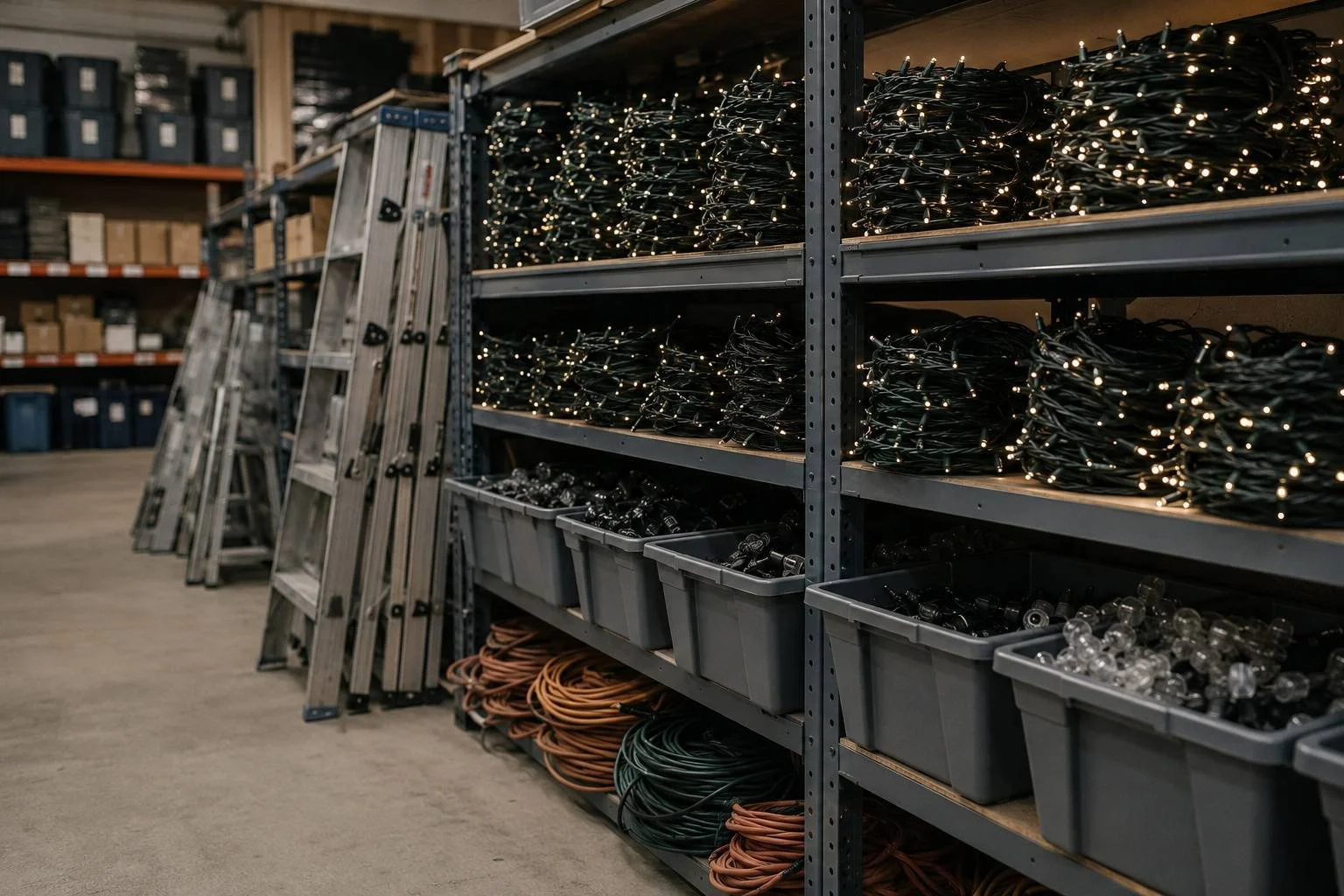
That $5,000 figure sits low on the entry ladder in the fifty, and there is a reason it is that cheap: you are not buying a business. You are buying inventory and a ladder. Everything that normally makes a business expensive — the truck, the insurance, the crew, the customers — you are expected to already have. That is not a catch. It is the design.
Note what the acquisition row is actually buying: "customer list + lights inventory." That inventory is custom-cut to specific houses. A customer list of eighty homes comes with eighty sets of lights already measured to eighty rooflines, which is worth considerably more than the same lights in a box.
How people actually fund it

Mostly, they do not — and that is the honest answer. A $5,000–$15,000 startup funded by October deposits is the first rung in the book, The Microbusiness Millionaire: the tier where the side-hustle path keeps a W-2 in place and builds on weekends, because the entry price allows it and the season fits around a job.
Where a lender does enter is the $30,000–$80,000 acquisition, or a small working-capital line if you are scaling faster than deposits cover. That sits in SBA Microloan and CDFI direct lending territory. Two free national directories will show you the ones near you — the Opportunity Finance Network CDFI locator and SBA Lender Match. [S6]
One piece of advice specific to this category: if you are borrowing, borrow against the host business rather than the lights. An underwriter reading a seasonal six-week venture reads risk. An underwriter reading an established exterior-services route adding a proven high-cash-flow service line to existing customers reads a good loan. Same deal, same money, and the difference is entirely in which business the file is about.
The profit reality: the supervisor is already paid for

This is the most important section in the post, and it's the one place holiday lights breaks the pattern of the other forty-nine.
Every other category has to answer the same question: after you pay the crew, and after you pay a supervisor a market wage to do your job, is there anything left? A first-line supervisor of landscaping and grounds crews earns a supervisor's wage. That wage swings harder between one metro and the next than it does between service lines, so the figure to plan on is your own market's. [S2] For lawn care, for snow removal, for power washing — that number has to come out of the profit before you own anything.
Holiday lights does not pay it. The host business already did.
That is the whole thing. Run correctly, this is not a business with its own owner, its own crew, and its own supervisor. It is six weeks of high-rate work handed to a supervisor who's already on salary, performed by a crew that is already on payroll, using a truck that is already insured, sold to customers who already pay you. The added cost of the season is lights, clips, and storage. Nearly everything else was a sunk cost in July.
Which is why the arithmetic that makes most categories sobering makes this one look extraordinary — and why running it standalone gives away the exact advantage that put it on the list. A standalone holiday lighting company carries a full year of overhead to work six weeks. The same six weeks added to a route you already own is close to pure cash flow. Same work. Same customers. Completely different business.
Doing that math on a specific business — where the seller's inventory is custom-cut to houses that may or may not renew — is where people freeze. That is the job of the course, Microbusiness Millionaire: Operating System — the four tests turned into a repeatable screen you run on a real deal.
The benefits of owning a holiday light installation business
A small entry with no premises. $5,000 and a ladder, if you already have the route.
Prepaid. You collect deposits in October and buy inventory with the customer's money. Almost nothing else works this way.
The overhead is already paid. Truck, crew, insurance, customers — all sunk costs from the warm months.
A tax write-off for your commercial customers, which makes it the easiest sale in exterior services.
It closes the calendar. With lawn care and snow, it's the last piece of a twelve-month route.
What separates the strong operators from the struggling ones
Deposits before inventory. The deposit is the working capital, and taking it first is what makes this category unusual. In that order the customer funds the lights; in the other order you are financing custom-cut strings for houses that have not committed.
All three services priced. Install, takedown and storage are three pieces of work — January labor and a year of space among them. Price all three and the season pays for itself twice.
Quoted by the roofline, not the foot. A steep three-story slate and a single-story ranch are not the same job at the same rate. Price the access rather than the length.
The route kept tight. Six weeks with weather in them leaves no spare days. Sell the street you already service, and the season stays inside the window.
Good strings bought once. Cheap lights fail in December, on a roof, in front of the customer whose lawn you want in April. The lights are the cheapest part of the job and the most expensive place to economize.
Licenses, permits, and regulations
There is no occupational license for hanging holiday lights, which makes the real exposure insurance and safety rather than paperwork: a registered entity, general liability at the limits your commercial contracts demand, commercial auto, and workers' comp for crew. The genuine risk in this category is work at height — ladder and fall-protection practice is where the claims come from, and it's worth training and documenting properly before your first roof. Some municipalities and HOAs regulate display timing, brightness, or electrical load, and commercial installs may touch local electrical permitting. Start with your state and municipal offices and the free SBA "Apply for licenses and permits" tool. [S7] (General information, not legal advice — confirm your local requirements.)
Build a portfolio, not a job
This is the last piece of the exterior-services portfolio, and it's the piece that closes the loop.
Lawn care April to November. Power washing, window cleaning, and gutters through the warm months. Holiday lights in November. Snow removal December to March. One truck. One crew. One customer list. One brand. A calendar with no holes in it — and every one of those services sold to a person who already knows your face.
That is the difference between owning a seasonal specialty and owning a portfolio. You are not building a Christmas light company. You are building the property-services vendor for a few hundred addresses, of which lights are six good weeks. A portfolio like that, with a documented customer list across four seasons, sells to a buyer as one asset — which is how it ends up worth over a million dollars at sale, instead of a garage full of inventory.
Frequently asked questions
Is a holiday light installation business profitable? Inside its window, exceptionally — but the honest answer depends entirely on what it is attached to. Added to an exterior-services route, the crew, truck, insurance and customers are already paid for, so the added cost of the season is close to just the lights. Run standalone, you are carrying a year of overhead to work six weeks.
How much does it cost to start a holiday light installation business? Roughly $5,000 to $15,000 for lights, ladders and storage, and the number stays small because the truck and the customers are assumed to be there already. About $30,000–$80,000 to buy an existing customer list with inventory, or $50,000–$180,000 for a franchise.
Can you make a living from holiday lights alone? It is the wrong question to start from. The category is tagged Best paired for a reason: it is built to be six weeks of a twelve-month business. The operators who do well add it to window cleaning, gutters, power washing or lawn care, and pair the other end of the year with snow.
When do you actually sell holiday lighting? September and October, to customers you already have. The deposits fund the inventory, the install runs November into early December, and takedown is January. Selling in November means starting a season already underway.
Where to go from here
Download the free guide.50 Boring Businesses That Make Millionaires is the full result of the research: fifty categories run against the four tests, what each one costs to enter by all three paths, what has to line up for it to work, and how they pair into a portfolio. Free at microbusinessmillionaire.com.
Read the book.The Microbusiness Millionaire: How Ordinary People Build Extraordinary Wealth One Microbusiness at a Time follows four people who each reached a portfolio worth more than a million dollars by a different path. One keeps a hospital job and uses CDFI financing to acquire one stable service business, then another, then a third. One saves on a single income for three years, leaves a master plumber's wage, and stacks trade service lines starting with an SBA microloan. One uses an SBA Community Advantage loan to open a franchise, then opens three more. One starts with about $5,000 on the side and keeps a W-2 for years, building the slowest and most patient version of the same result. Four starting points, four amounts of money, four portfolios worth over a million dollars at sale. The book is coming soon — join the email list at microbusinessmillionaire.com to hear when it lands.
Join the next cohort — Microbusiness Millionaire: Operating System. The book gives you clear examples of how it's done. The course is the step-by-step system for doing it yourself: screening a real company against the four tests, running the owner-replacement cash-flow math on a seller's actual numbers, knowing when to walk, knowing which lenders fund deals this size, and installing the operator who runs the business without you. Eight weeks online, five seats a cohort, waitlist first — at microbusinessmillionaire.com.
About the author
Chris Scott has spent more than twenty-five years in the small-business arena. As the director of a Community Development Financial Institution (CDFI) and as management at the U.S. Small Business Administration (SBA), he saw thousands of business plans and loan applications cross his desk. His research into which microbusinesses build wealth — and which quietly build a job — became The Microbusiness Millionaire and the free companion guide, 50 Boring Businesses That Make Millionaires.
Sources & references
[S1] National Retail Federation / Prosper Insights & Analytics, 2025 winter holiday consumer survey — consumers planned to spend $890.49 per person on average on holiday gifts, food, decorations and other seasonal items; second-highest in the survey's 23-year history. nrf.com(Cited here as evidence of the durability of holiday spending. This figure measures consumer retail purchases across several categories and is not a measure of the holiday lighting installation services market; no credible measure of that market exists.)
[S2] U.S. Bureau of Labor Statistics, OEWS, First-Line Supervisors of Landscaping, Lawn Service, and Groundskeeping Workers (SOC 37-1012), May 2025 — used as the host-business supervisory benchmark; BLS publishes no dedicated occupation for holiday lighting installers. bls.gov/oes
[S3] Christmas Decor Inc. franchise materials (christmasdecor.net) — approximately 300 franchisees across the U.S. and Canada; franchisor states that the majority of its franchisees were operating a seasonal business before joining the system.
[S4] Shine Window Care and Holiday Lighting, Franchise Disclosure Document (Shine Development Inc.) — franchisor states it does not offer franchises for businesses providing holiday lighting only; the franchised business comprises window cleaning, pressure washing, screen and gutter cleaning, house detailing, and holiday light installation, storage, and removal.
[S5] U.S. Federal Trade Commission, Franchise Rule / FDD Items 7 and 19. ftc.gov
[S6] Opportunity Finance Network CDFI Locator (ofn.org); SBA Lender Match (sba.gov).
[S7] U.S. Small Business Administration, Apply for licenses and permits (sba.gov); state and municipal requirements.
[S6] Christmas Decor franchise disclosure: the 2026 Decor Group FDD, filed with state franchise registries, states a total investment of $21,550 to $116,250 to begin operation, including $9,400 to $75,900 payable to the franchisor. Shine Window Care & Holiday Lighting is reported by franchise-filing aggregators at approximately $107,000–$182,000. Reported figures vary between aggregators and filing years; verify the current FDD directly for any brand.
[Internal]50 Boring Businesses That Make Millionaires — Holiday Light Installation entry (tag, three-path entry-cost table, portfolio pairings, framework note, "what it takes to make this one work"), drawn from the author's research and filtered through the underwriting criteria he applied as a CDFI lender.
This article is for general information only and is not legal, financial, tax, or investment advice. Category-level figures are reference points, not a specific-deal projection; individual businesses vary. Consult a CPA, attorney, business broker, franchise consultant, or CDFI loan officer before acting.
Last updated: 8/21/2026