

How to Start a Mobile Car Wash Business
Anyone can wash a car for cash on a Saturday, which is exactly why the fleet contract rather than the truck is the asset in this business. Here is what a mobile car wash costs, what it pays after you replace yourself, and why the water regulation everyone complains about is the thing that protects your accounts.
Chris Scott — former CDFI director and SBA management
As the director of a Community Development Financial Institution (CDFI), and as management at the U.S. Small Business Administration (SBA), I saw thousands of business plans and loan applications cross my desk. That work is where I learned what a durable business looks like on paper, and what a business that only looks durable looks like on paper.
It is not, however, where the list of fifty came from. That came from years of research, running category after category through the same four questions: Is it profitable? Does it have recurring revenue? Is it recession resistant? Is it AI resistant? Those four questions are the framework behind the book, The Microbusiness Millionaire, and they are what separated the categories that built real wealth from the ones that quietly built a job with a P&L attached. Fifty survived the screen. Far more never made it through.
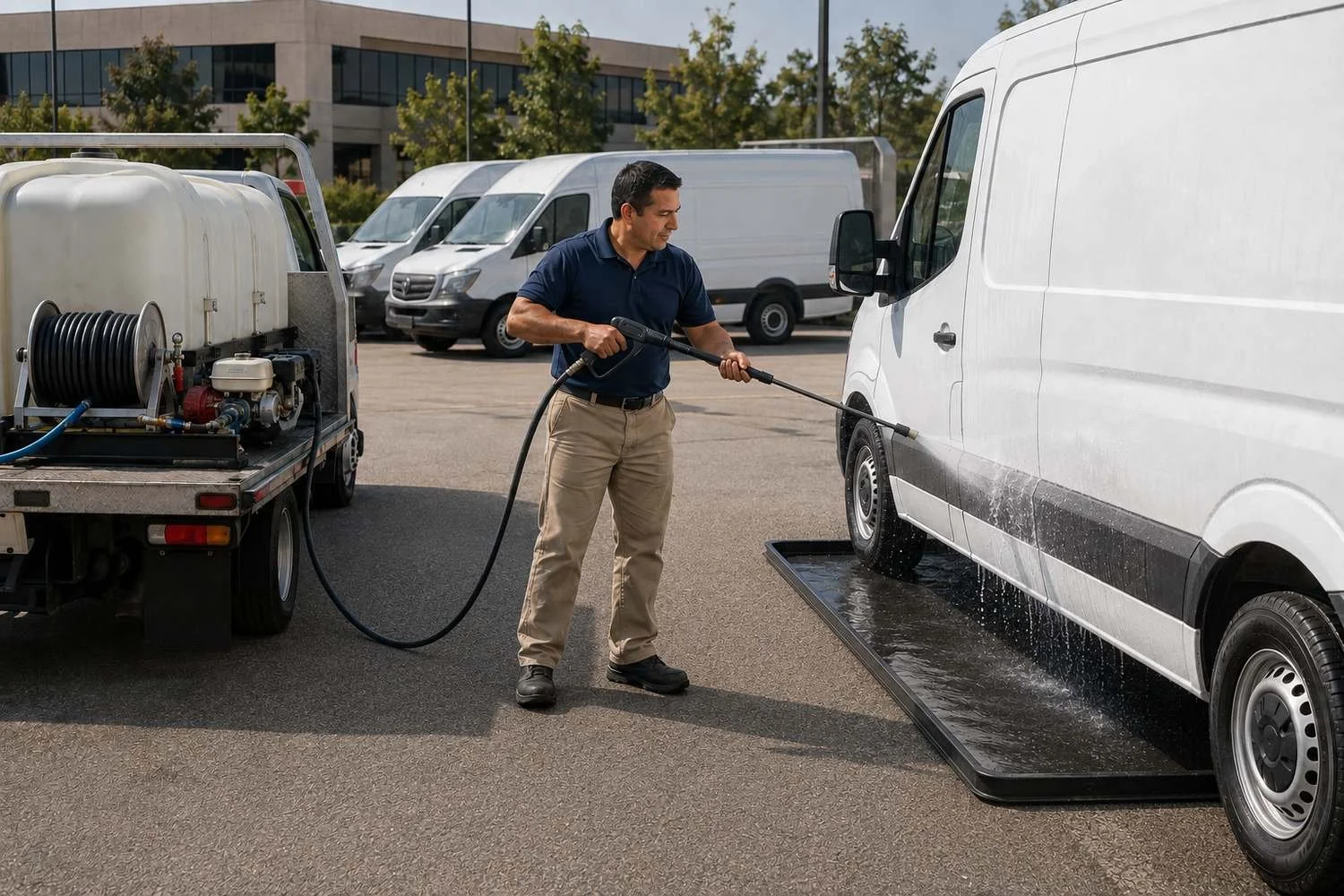
Mobile car wash is one of the fifty, and it sits near the bottom of the entry ladder — a truck, a pressure washer and supplies.
That accessibility is the whole story, in both directions. Anyone can wash a car for cash on a Saturday. What separates a business from a Saturday is who signs the invoice, and in this category the answer is a fleet manager rather than a homeowner.
A word on the difference between this and mobile detailing, because the two sit next to each other on the list and are easy to confuse. A wash is volume work on a schedule: exterior clean, quick interior, half an hour a vehicle, a modest price, repeated weekly across a lot of them. Detailing is craft work sold by the job — paint correction, ceramic coating, interior extraction — measured in hours per car at several hundred dollars a time. A wash business is built on contracts. A detailing business is built on skill.
They pair beautifully off the same truck, and a wash route is what gives you a list of vehicles to sell detailing into. But they are two different businesses with two different customers, and the mistake is starting one while pricing it like the other.
The industry: large, fragmented, and shifting professional
Car wash and auto detailing in the United States is an $18.7 billion industry in 2026, growing at about a 1.5% compound rate over five years across roughly 57,900 businesses employing nearly 197,800 people. [S1] Those numbers describe an extraordinarily fragmented field — average revenue per establishment lands near a quarter of a million dollars, which tells you this is a category of small local operators, not chains.
The demand trend underneath it is the useful one. The share of drivers who wash their cars at professional shops rather than in the driveway climbed from 50.0% in 1996 to 79.0% in 2023, according to the International Carwash Association. [S1] Professional washing has gone from optional to normal in a generation.
A note on the labor benchmark. This trade's occupation — cleaners of vehicles and equipment — is an hourly, entry-level classification. The industry's own employment and establishment figures are a more honest anchor than a national wage comparison. [S2] [S3] What you actually need are two local rates: what a washer costs in your market, and what a crew lead costs to run the route the way you run it. Neither is worth guessing at, and the Resource Directory in the free tools shows where to look them up.
The crew-lead rate is the price of replacing yourself — what a lead would have to earn to run the route in your place. Every profit number later in this article has to survive it, and the real cost runs higher once payroll taxes and insurance go on top.
The point holds either way: the labor is inexpensive and trainable, which is exactly why the contract, rather than the crew, is the asset in this business.
Why mobile car wash made the list
Every category in the research had to clear four tests. Clear three and you usually have a self-employed job in disguise.
Does it pay after you replace yourself? It does, under one condition: the work has to be contracted. Washing labor is inexpensive relative to what a fleet contract bills, so a route of recurring commercial accounts covers a crew's wages and still leaves real cash flow for the owner. A calendar of one-time residential washes does not, because you are then paying for the labor and for the constant selling that fills it.
Does the revenue recur? Through fleets, yes, and only through fleets. A dealership, rental lot, delivery operation, or corporate parking deck signs for a schedule — weekly or monthly — and that becomes an invoice you do not re-sell every week. A homeowner who liked the job might call again in the spring.
Does it survive a recession? The commercial side does, better than the consumer side. A dealership still has to present clean inventory and a delivery fleet still has to look presentable to its own customers — those are operating requirements rather than discretionary treats. That is another argument for pointing the truck at businesses.
Will it still need humans in ten years? Washing a vehicle by hand, on site, in a customer's lot is physical work performed on a different vehicle every time. Software can route the truck. It cannot hold the wand. Very low AI exposure.
Four for four — provided you sell to fleets rather than to cars.
The research on this category kept separating operators on two decisions made in the first month, and neither one was about washing. The first is who they sold to. Operators running residential work live on flyers, discount coupons and weekend calls, and every dollar of revenue costs a fresh sale. Operators who walked into a dealership or a rental agency and asked what it would take to get on the vendor schedule came away with a fixed route and a monthly invoice instead. The second decision is water reclamation. Most jurisdictions require wash water to be captured rather than run to a storm drain, and a striking number of would-be competitors never look into it — so the operator who bought the reclamation setup early is the one a corporate facilities manager can actually sign. From the lending side of the desk, that is an unusual thing to see: a regulation that everyone complains about functioning as the reason a business has less competition than it should.
What it takes to make this one work
A note on the tags. Every category in the fifty cleared the same four tests; far more never made it through. The tags do not grade a business — they tell you what has to line up for it to work in your hands. Mobile car wash carries one: Rewards a specialty. That is the instruction manual.
The condition: one-time residential washes are a transaction rather than a business — they build nothing recurring and need constant selling to keep the calendar full. The durable revenue in this category is commercial fleet work.
The move that meets it: go straight at fleets. Dealerships, rental lots, delivery operations and corporate parking are the customers who sign schedules, and a fleet contract is a monthly invoice you do not re-sell every week, on a truck that is already paid for.
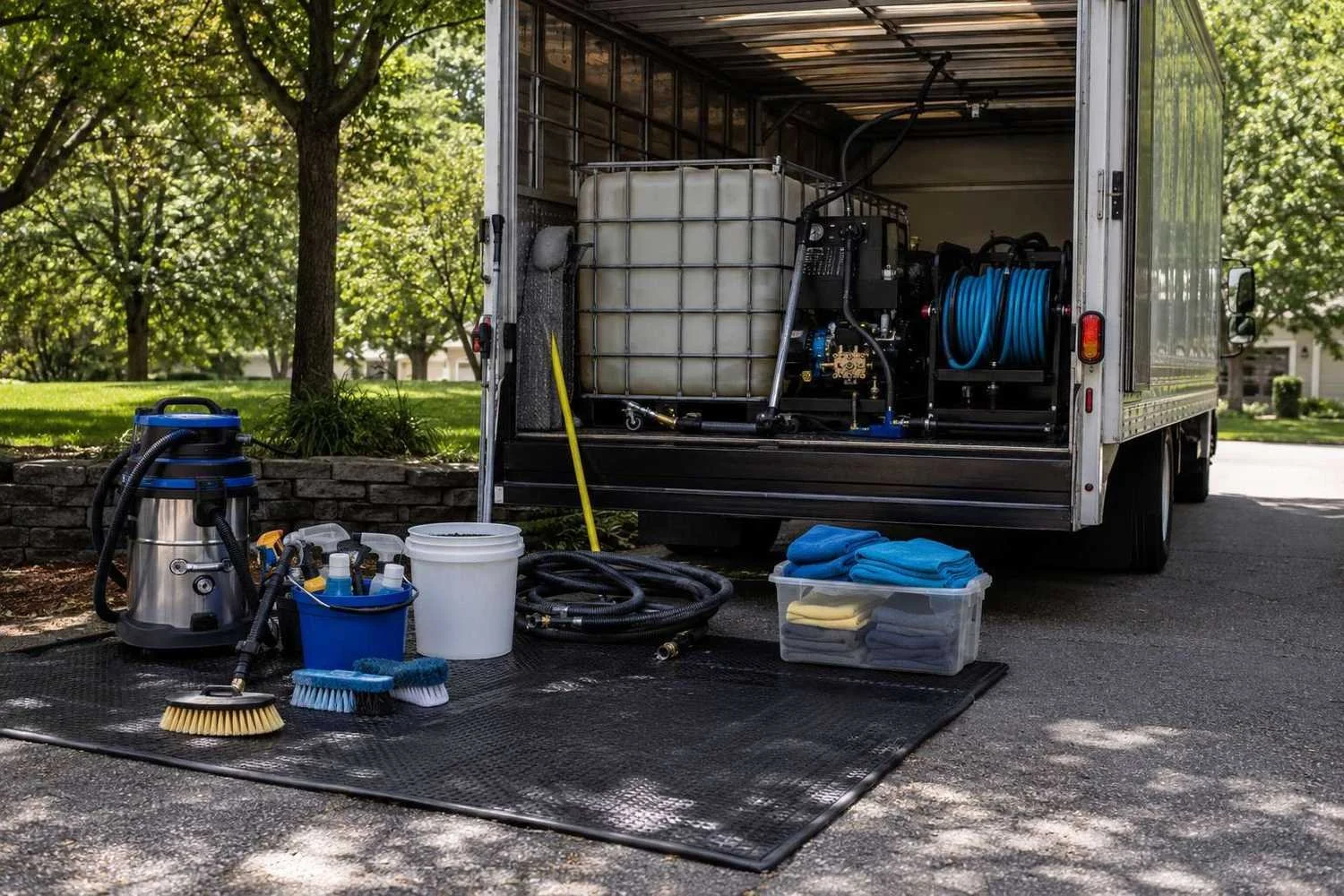
Then solve water reclamation up front. Many jurisdictions require wash water to be captured and disposed of properly rather than run to a storm drain, and buying that setup before you need it is what makes a corporate facilities manager comfortable signing. The requirement is what thins the field, so being the operator who already complies is a competitive position rather than a cost.
The upside: a route of recurring commercial contracts, entered for a few thousand dollars, in a market where nearly eighty percent of drivers now use professional services and where the compliance requirement keeps casual operators away from the accounts worth having. Very few categories among the fifty combine an entry cost this low with recurring commercial revenue this durable.
What it costs to get in — the three paths
| Path | Typical cost range | Best for |
|---|---|---|
| Startup (solo) | $3,000 – $10,000 | Truck + pressure washer + supplies |
| Acquisition | $30,000 – $100,000 | Existing fleet contracts + customer list |
| Franchise | $100,000 – $255,000 | Brand + app and booking platform + territory. Example: Spiffy. |
Franchise brands are named as examples, not endorsements. Franchise investment figures reflect a franchisor's most recent Franchise Disclosure Document (FDD) and change annually — verify each brand's current FDD (Item 7 for the initial-investment range; Item 19 for any financial-performance representation) before pursuing one. [S3]
Look hard at the distance between the first row and the last. Spiffy — an active franchisor since 2020, app-based and fleet-focused — discloses an estimated initial investment of roughly $116,550 to $256,400 on a fee of $36,000 to $40,000, with other readings at $100,000 to $200,000. [S6] That is thirty times the solo start.
What the money buys is worth naming, because in this category it is not equipment. You can wash cars with the $3,000 kit. What the franchise sells is the booking platform and the national fleet relationships — which is to say, it sells you the demand side of exactly the problem this article says is hard. Whether that is worth thirty times the entry cost depends entirely on whether you would rather spend two years knocking on the doors of property managers and dealerships yourself. Both are legitimate answers. Just be clear which one you are buying.
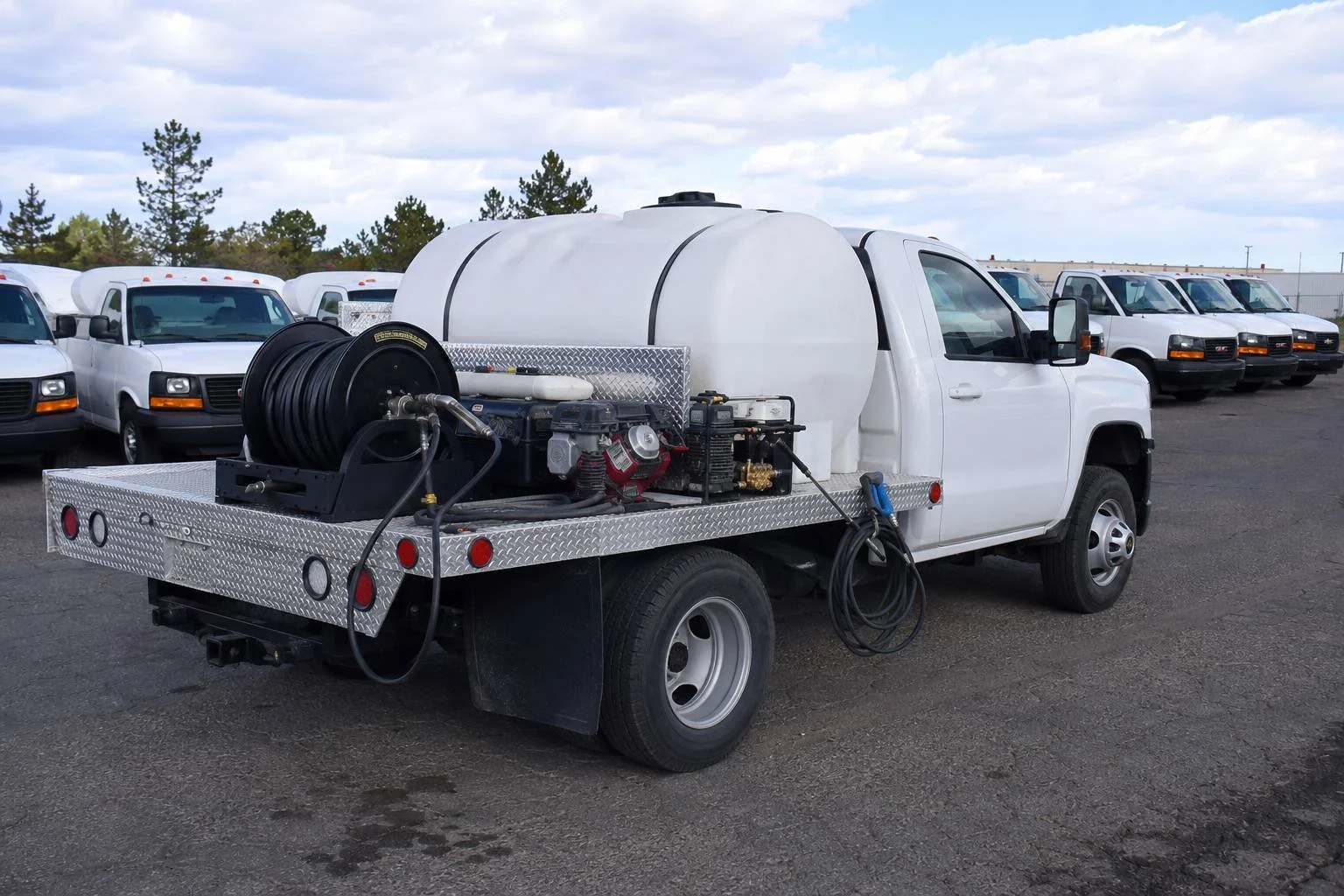
A $3,000 to $10,000 solo start is a small number by any measure, and it is genuinely achievable beside a full-time job. Budget deliberately for water reclamation equipment inside that range rather than treating it as a later upgrade.
And notice what the acquisition column actually says: existing fleet contracts. You are not buying a pressure washer for $30,000 to $100,000. You are buying signed, recurring commercial accounts, which is the whole asset in this category.
How people actually fund it
At $3,000 to $10,000, this is one of the few categories a person can start on evenings and weekends without leaving a paycheck behind — the same tier the book's side-hustle path starts in, keeping a W-2 in place while the business builds. Fleet work suits that approach, since lots are often washed after hours anyway.
A $30,000 to $100,000 acquisition of a customer list of fleet contracts moves into SBA Microloan and CDFI direct lending range.
One pattern I watched from the lending chair, across every industry that came through: a qualified buyer walks into a national bank, gets declined, and concludes he cannot be funded. He never learns that a CDFI across town, or a Community Advantage lender, exists precisely for deals this size. Two free national directories will show you the ones near you — the Opportunity Finance Network CDFI locator and SBA Lender Match. [S4]
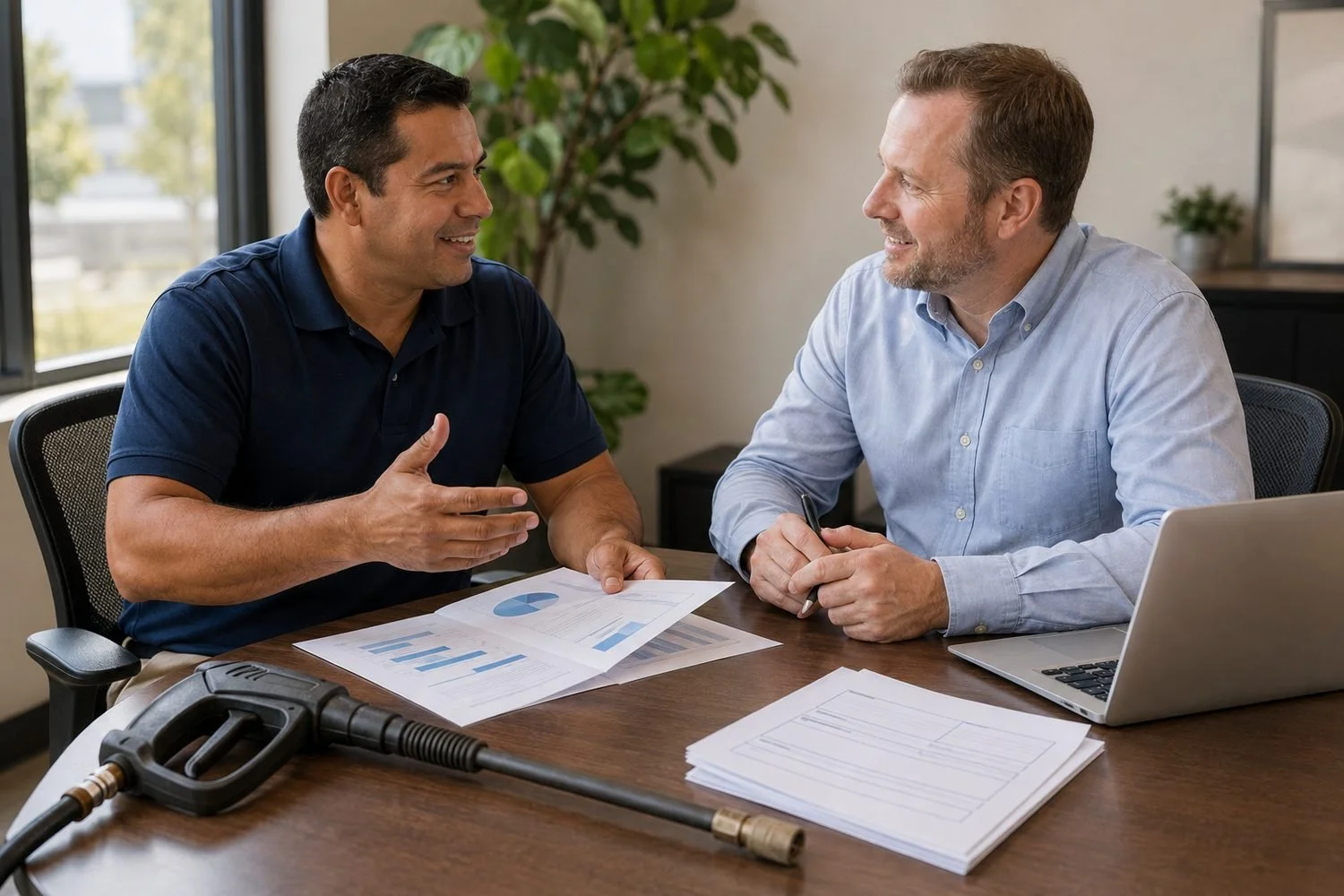
Finding the lender is the easy half. A wash business also has a specific tell an underwriter looks for: contracted monthly revenue — how many fleet accounts sit on a written schedule, what they bill, and how long they have been on it, against cash washes. A route anchored in signed commercial accounts is far more bankable than a busy weekend calendar, because one of them renews on its own and the other has to be refilled every week. Start recording that split before anyone asks for it.
The profit reality: owner-replacement cash flow

Here is the calculation that decides more of these deals than anything else in them. A wash business looks profitable because the owner is washing the vehicles, driving the route, selling the accounts, and keeping the books — none of it priced. The honest test: after you pay your washers, and after you pay a crew lead a market wage to run the route the way you run it, is there enough left for you to own the thing?
The mix decides it, and decisively. Washing labor is inexpensive, so the question is not whether you can afford a crew. It is whether the work they do arrives without being sold.
Fleet contracts arrive that way: a signed weekly route means a crew lead's day is full and billed before it starts. Residential one-offs do not, and the hidden cost there is not the washing at all — it is the constant selling, which never appears as a line item because the owner does it unpaid. A route of contracted fleet accounts leaves real room after a crew lead's wage. A calendar of one-time washes rarely does.
The category-level math is easy — you just did it. Running it on a specific company, where the seller's "profit" hides his own unpriced washing and selling hours and the real question is how much revenue sits under written contract, is where people freeze. That is the job of the course, Microbusiness Millionaire: Operating System — the four tests turned into a repeatable screen you run on a real deal.
The benefits of owning a mobile car wash
A very low entry cost. A truck, a pressure washer and supplies — startable beside a job.
Contracted monthly invoices. Fleet accounts bill on a schedule instead of being re-sold weekly.
A compliance moat. Reclamation requirements thin the field in the accounts worth having.
Commercial demand that holds. Dealerships and fleets wash as an operating requirement.
A professional-use tailwind. Nearly 79% of drivers now wash professionally, up from half in 1996.
What separates the strong operators from the struggling ones
Fleets before homeowners. The defining decision in this category. A signed schedule bills monthly without being re-sold; a one-time wash costs a fresh sale every time.
Reclamation bought early. It is a requirement in many places and the thing that qualifies you for commercial work, so it belongs in the opening budget rather than in a later upgrade.
The first fleet contract priced to keep. The schedule is the asset. Set a rate that still works once a crew is being paid to run it, because that is the rate you will be renewing for years.
Contracted revenue measured, not cars washed. Volume flatters a good week. Contracted monthly revenue is what builds a business and what a lender or a buyer actually reads.
Licenses, permits, and regulations
The business licensing is light; the water rules are the real requirement, and they are worth confirming rather than assuming. Expect a general business license and sales-tax registration, plus commercial auto and general liability insurance. The compliance that matters is environmental: under Clean Water Act stormwater rules, wash water is generally not permitted to discharge into a storm drain, and many municipalities require capture, containment, and proper disposal — reclamation mats, vacuum recovery, and sanitary-sewer discharge agreements are the common answers. Some jurisdictions add water use or drought restrictions, and working on commercial property may bring facility access, insurance certificate, and vendor-approval requirements from your customer. If you employ washers, workers' compensation applies. Start with your city or county and your state environmental agency, plus the free SBA "Apply for licenses and permits" tool. [S5] (General information, not legal advice — confirm your local wash-water discharge and reclamation rules before you take paid work.)
Build a portfolio, not a job
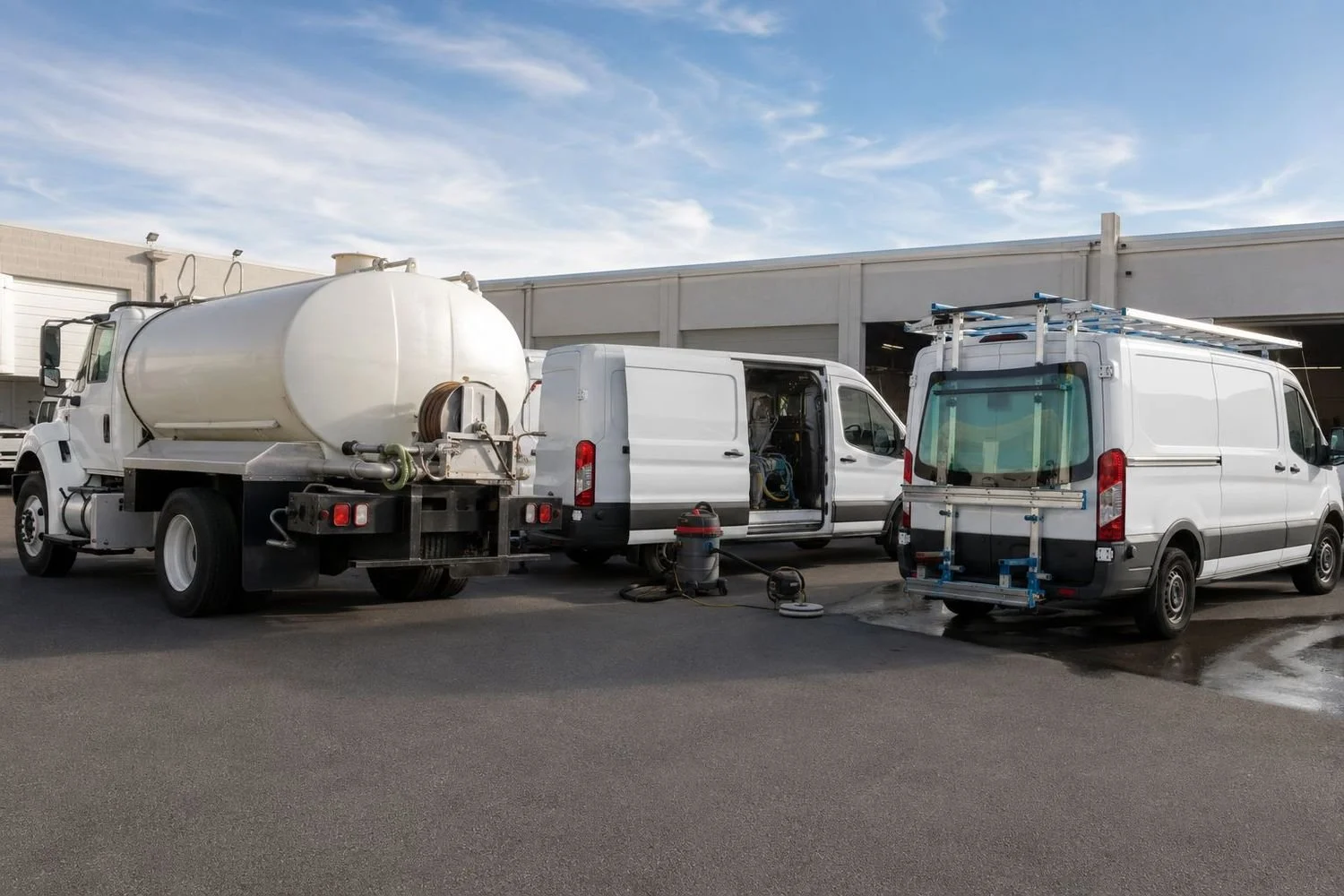
Mobile car wash is a route business: it stacks along a territory, on lots you are already driving to. It sits in a mobile automotive cluster where every neighboring category sells to the same fleet manager.
Mobile detailing is the direct addition — the same vehicles, the same visit, a much higher ticket — and it is the most natural second line. Fleet washing at scale is simply this business grown into larger accounts. And mobile auto glass reaches the identical customer, because a fleet of a hundred vehicles has chipped windshields on a predictable schedule. One relationship with a facilities manager can carry all three.
That is the difference between owning a truck and owning a portfolio. You are not building a wash round. You are building the vehicle-services relationship a set of commercial fleets depends on, anchored by contracts that bill monthly without being re-sold. A portfolio like that, with signed accounts and a documented customer list behind it, sells to a buyer as one asset — which is how it ends up worth over a million dollars at sale, instead of a truck and a pressure washer.
Frequently asked questions
Is a mobile car wash profitable? It can be, provided the revenue is contracted. Fleet accounts bill on a schedule and do not need re-selling, which is what allows a crew lead's wage to be covered with real cash flow left for the owner. A calendar of one-time residential washes usually does not clear that bar.
How much does it cost to start a mobile car wash? Roughly $3,000 to $10,000 for a truck, pressure washer and supplies, with no premises and no inventory, and water reclamation equipment belongs inside that budget. About $30,000 to $100,000 to acquire existing fleet contracts, or $50,000 to $120,000 for a franchise with brand and booking systems.
Do I need a permit for wash water? In many jurisdictions, yes. Wash water generally cannot enter a storm drain, and local rules often require capture, containment, and proper disposal. Confirm your city, county, and state environmental requirements before taking paid work. [S5]
How do I get fleet contracts? Approach the operations or facilities manager at dealerships, rental lots, delivery operations, and corporate parking, and ask what it takes to get on their vendor schedule. Being already compliant on water reclamation and insurance is usually what makes that conversation easy.
Where to go from here
Download the free guide.50 Boring Businesses That Make Millionaires is the full result of the research: fifty categories run against the four tests, what each one costs to enter by all three paths, what has to line up for it to work, and how they pair into a portfolio. Free at microbusinessmillionaire.com.
Read the book.The Microbusiness Millionaire: How Ordinary People Build Extraordinary Wealth One Microbusiness at a Time follows four people who each reached a portfolio worth more than a million dollars by a different path. One keeps a hospital job and uses CDFI financing to acquire one stable service business, then another, then a third. One saves on a single income for three years, leaves a master plumber's wage, and stacks trade service lines starting with an SBA microloan. One uses an SBA Community Advantage loan to open a franchise, then opens three more. One starts with about $5,000 on the side and keeps a W-2 for years, building the slowest and most patient version of the same result. Four starting points, four amounts of money, four portfolios worth over a million dollars at sale. The book is coming soon — join the email list at microbusinessmillionaire.com to hear when it lands.
Join the next cohort — Microbusiness Millionaire: Operating System. The book gives you clear examples of how it's done. The course is the step-by-step system for doing it yourself: screening a real company against the four tests, running the owner-replacement cash-flow math on a seller's actual numbers, knowing when to walk, knowing which lenders fund deals this size, and installing the operator who runs the business without you. Eight weeks online, five seats a cohort, waitlist first — at microbusinessmillionaire.com.
About the author
Chris Scott has spent more than twenty-five years in the small-business arena. As the director of a Community Development Financial Institution (CDFI) and as management at the U.S. Small Business Administration (SBA), he saw thousands of business plans and loan applications cross his desk. His research into which microbusinesses build wealth — and which quietly build a job — became The Microbusiness Millionaire and the free companion guide, 50 Boring Businesses That Make Millionaires.
Sources & references
[S1] IBISWorld, Car Wash & Auto Detailing in the US (NAICS 81119a) — market size $18.7bn in 2026, ~1.5% CAGR 2021–2026, approximately 57,900 businesses and 197,800 employees; International Carwash Association data cited by IBISWorld showing the share of drivers washing most often at professional shops rising from 50.0% in 1996 to 79.0% in 2023. ibisworld.com
[S2] U.S. Bureau of Labor Statistics, Occupational Employment and Wage Statistics, Cleaners of Vehicles and Equipment (SOC 53-7061) — the occupational category covering this work; an hourly, entry-level classification, which is why industry employment and establishment counts are used above as the labor benchmark rather than a national median wage. bls.gov/oes
[S3] U.S. Federal Trade Commission, Franchise Rule / FDD Items 7 and 19. ftc.gov
[S4] Opportunity Finance Network CDFI Locator (ofn.org); SBA Lender Match (sba.gov).
[S5] U.S. Small Business Administration, Apply for licenses and permits (sba.gov); U.S. Environmental Protection Agency Clean Water Act stormwater discharge rules; municipal wash-water capture, containment, and disposal requirements; state and local water-use restrictions.
[S6] Spiffy franchise disclosure data: Spiffy Franchising LLC, formed in Delaware in 2020 and franchising since that year, is reported at an estimated initial investment of $116,550–$256,400 on an initial franchise fee of $36,000–$40,000 per readings of its FDD Item 7, with other aggregators reporting $100,000–$200,000 on a $40,000 fee. Reported figures vary between aggregators and filing years; verify the current FDD directly.
[Internal]50 Boring Businesses That Make Millionaires — Mobile Car Wash entry (tag, three-path entry-cost table, portfolio pairings, framework note, "what it takes to make this one work"), drawn from the author's research and filtered through the underwriting criteria he applied as a CDFI lender.
This article is for general information only and is not legal, financial, tax, or investment advice. Category-level figures are reference points, not a specific-deal projection; individual businesses vary. Consult a CPA, attorney, business broker, franchise consultant, or CDFI loan officer before acting.
Last updated: 8/22/2026.