

How to Start a Mobile Bicycle Repair Business
Specialty bike shops have been closing for twenty years while the machines got heavier, more expensive and harder to haul anywhere — and the service work never went away. Here is what a mobile bicycle repair business costs, what it pays after you replace yourself, and why the e-bike is what turns it into a real business.
Chris Scott — former CDFI director and SBA management
As the director of a Community Development Financial Institution (CDFI), and as management at the U.S. Small Business Administration (SBA), I saw thousands of business plans and loan applications cross my desk. That work is where I learned what a durable business looks like on paper, and what a business that only looks durable looks like on paper.
It is not, however, where the list of fifty came from. That came from years of research, running category after category through the same four questions: Is it profitable? Does it have recurring revenue? Is it recession resistant? Is it AI resistant? Those four questions are the framework behind the book, The Microbusiness Millionaire, and they are what separated the categories that built real wealth from the ones that quietly built a job with a P&L attached. Fifty survived the screen. Far more never made it through.
Mobile bicycle repair is one of the fifty, and it is the most location-dependent among them — which is useful to know, because location is the one condition you can settle before spending a dollar.
In the right city it is a low-capital business with devoted customers and remarkably little competition. And the e-bike has quietly turned what used to be a hobbyist's tune-up into real service work on an expensive machine.
The industry: a shrinking shop count and a growing machine
The U.S. bicycle market runs about $9.2 billion in 2025 and is expected to grow at roughly a 2.9% compound rate through the mid-2030s, carried by commuting, fitness, and leisure demand. [S1] That headline number is not the story. Two other figures are.
The first is supply. Specialty bike shops fell from 6,195 in 2000 to roughly 3,600 by 2022 as big-box retail and online sales took the bicycle sale. [S2] What those closures did not take is the service — the wheel that needs truing and the drivetrain that needs replacing still require a mechanic, and in a lot of neighborhoods the nearest one just got further away.
The second is the machine itself. Electric bicycles went from under 1% of the U.S. market in 2019 to roughly 12.5% by 2025, and by 2024 accounted for close to 30% of U.S. bicycle revenue on around 920,000 units sold. [S3] An e-bike costs several times what a traditional bicycle costs, weighs enough that hauling it to a shop is genuinely inconvenient, and carries a motor, battery, and controller that the owner is not going to troubleshoot on the garage floor.
The labor benchmark is what you would pay a bicycle mechanic to do the work you are doing now. That is the price of replacing yourself — what a supervisor would have to be paid to take your hands off the stand. The rate is set by your city, not by the category. Plan against your own market's figure. Every profit number later in this article has to survive it, and the real cost runs higher once payroll taxes and insurance go on top.
Fewer shops, heavier and more expensive machines, and a service need that has not moved. That is the opening.
Why mobile bicycle repair made the list
Every category in the research had to clear four tests. Clear three and you usually have a self-employed job in disguise.
Does it pay after you replace yourself? It can, and the route to it runs through ticket size rather than volume. E-bike service — diagnostics, motor and drivetrain work, battery systems — bills at a level that supports a second mechanic's wage in a way that flat-tire calls do not. Build the business around that work and the arithmetic closes.
Does the revenue recur? Yes, on a maintenance rhythm. Bicycles need seasonal tune-ups, drivetrains wear on a predictable schedule, and e-bikes add service intervals of their own. Riders who commute daily are on a cycle much like a car's, and a mobile mechanic who shows up at the house becomes the one they call every time.
Does it survive a recession? It leans the right way, for a reason worth noticing: when money tightens, people repair rather than replace, and a bicycle becomes a cheaper way to commute. Repair-side demand is not the part of this market that suffers in a downturn.
Will it still need humans in ten years? Truing a wheel, adjusting a derailleur and diagnosing an e-bike motor by hand, on a different bike every time, is skilled physical work. Software can book the appointment and order the part. It cannot true the wheel. Very low AI exposure.
Four for four — in the right place, on the right machines.
The research on this category separated on the map rather than on the operator. Two versions of the same business turn up repeatedly. One runs in a dense city with bike lanes, a commuting culture, and expensive e-bikes locked outside apartment buildings with no service within two miles — and its constraint is capacity rather than customers. The other runs the identical business, with the same skills and the same van and the same price list, in a spread-out suburb where cycling is a weekend hobby and every garage holds a floor pump. From the lending side of the desk the difference is visible before either business has traded a day, because it is not a question of effort or execution. It is population density, bike infrastructure, and how people in that place actually get to work. The good news is that this is the rare condition you can check for free, in an afternoon, before committing anything.
What it takes to make this one work
A note on the tags. Every category in the fifty cleared the same four tests; far more never made it through. The tags do not grade a business — they tell you what has to line up for it to work in your hands. Mobile bicycle repair carries two: Right geography and Rewards a specialty. Together they are the instruction manual.
The condition: this category concentrates. It works in urban markets and cycling-friendly geographies, and the tickets are smaller than an auto trade's, so the customer list has to be dense enough to keep the route tight.
The move that meets it: two moves, and they work together.
First, check the map before anything else. Dense, bike-lane-equipped, commuter-heavy markets with a visible cycling culture are where this category compounds. That is a free check you can finish in an afternoon — count the bike lanes, look at how people commute, see how far the nearest shop is — and it is worth doing before you spend a dollar. Where a market does not support it, the guide's other forty-nine categories are there; that is what having a list is for.
Second, specialize in e-bikes. That is where the machines are expensive, the owners are not fixing them on the garage floor, the service work is substantial and technical, and the ticket finally supports a real business. E-bike certification and the diagnostic tools for major motor systems are the investment that separates you from a mechanic with a wrench.
The upside: in the right city, positioned on e-bikes, this is a low-capital business with devoted customers and almost no competition — the specialty shops kept closing while the machines got more expensive and harder to move. Very few categories among the fifty let you enter for a few thousand dollars into a market where the competition has been thinning for two decades.
What it costs to get in — the three paths
| Path | Typical cost range | Best for |
|---|---|---|
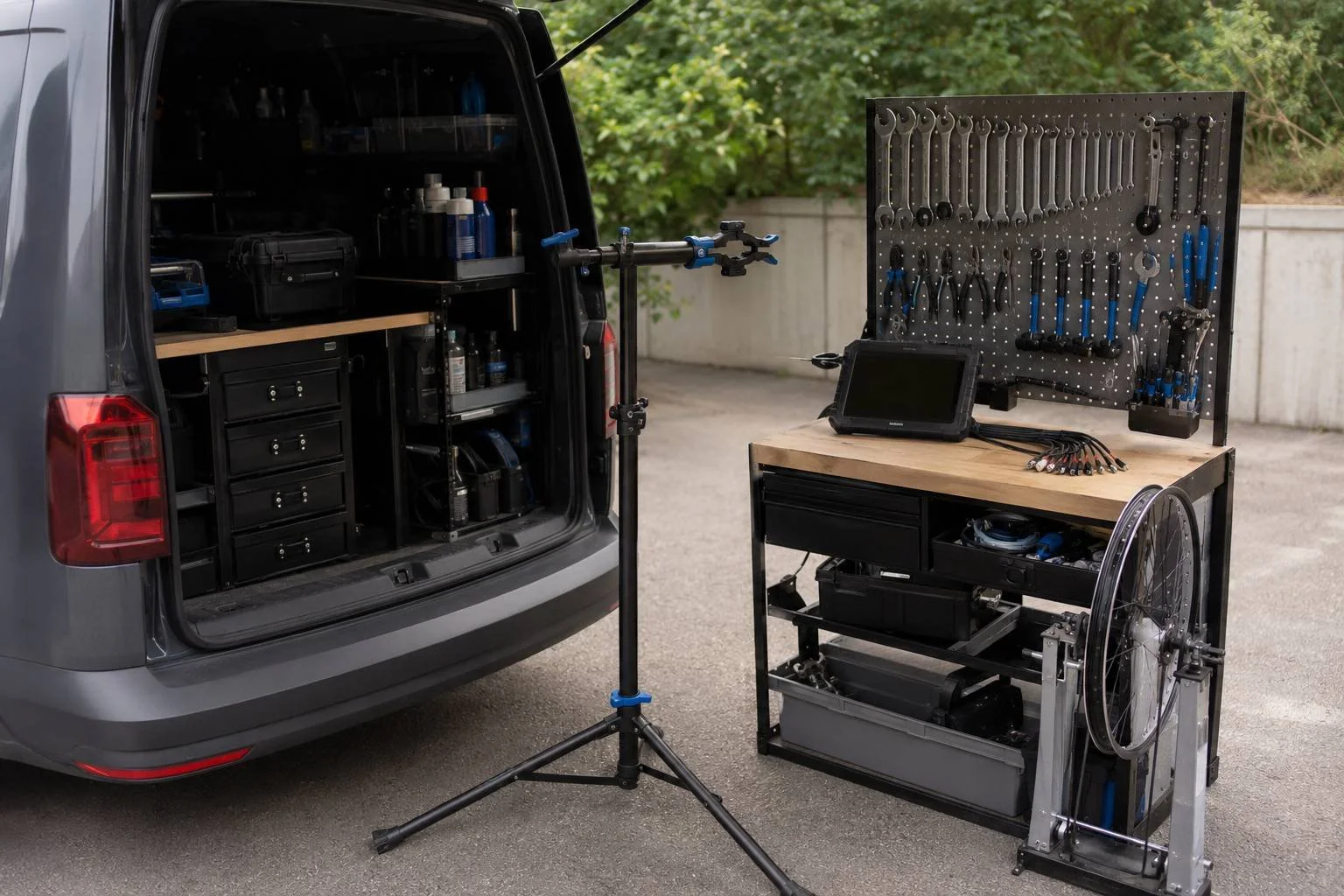
| Startup | $3,000 – $10,000 | Mobile shop conversion + tools |
| Acquisition | $20,000 – $60,000 | Customer list + equipment |
| Franchise | $30,000 – $80,000 | Fitted mobile shop + brand + territory. Example: Velofix. |
Franchise brands are named as examples, not endorsements. Franchise investment figures reflect a franchisor's most recent Franchise Disclosure Document (FDD) and change annually — verify each brand's current FDD (Item 7 for the initial-investment range; Item 19 for any financial-performance representation) before pursuing one. [S4]
This is a small franchise category and it needs a warning the larger trades do not. Brands here come and go. Velofix is still active and reported at roughly $40,000 to $50,000 in recent readings, but Beeline Bikes — for years the other major name, and one you will still find listed on directory sites — no longer appears to be awarding new franchises. [S6]
Which is worth a habit rather than a shrug. Before you plan around any brand in a niche category, confirm it is currently granting franchises and ask for a current-year FDD. A brand that stopped franchising three years ago will still have a website, a directory listing and a phone number, and none of those tell you whether there is an agreement available to sign.
These are among the smallest numbers across all three paths of any category in the fifty, which makes this a genuinely accessible entry.
Budget deliberately inside the startup range for e-bike diagnostic capability, because that is the difference between competing on tune-up pricing and owning the work nobody else in your market can do. And note that the acquisition path buys a customer list, which in a relationship-driven trade like this is worth considerably more than the tools that come with it.
How people actually fund it

A $3,000–$10,000 startup sits squarely in territory a person can self-fund or cover with a small SBA Microloan, and it is one of the most natural side entries among the fifty — the same tier the book's side-hustle path starts in, keeping a W-2 in place while the business builds. Evenings and weekends are when riders are home anyway.
A $20,000–$60,000 acquisition of an established customer list stays comfortably inside the SBA Microloan and CDFI direct lending range.
One pattern I watched from the lending chair, across every industry that came through: a qualified buyer walks into a national bank, gets declined, and concludes he cannot be funded. He never learns that a CDFI across town, or a Community Advantage lender, exists precisely for deals this size. Two free national directories will show you the ones near you — the Opportunity Finance Network CDFI locator and SBA Lender Match. [S5]
Finding the lender is the easy half. A bike repair business also has a specific tell an underwriter looks for: average ticket and repeat-customer share, and what portion of revenue comes from e-bike work rather than basic tune-ups. A customer list weighted toward e-bike service with returning riders is far more bankable than a high count of low-value repairs. Start recording both before anyone asks for them.
The profit reality: owner-replacement cash flow

Here is the calculation that decides more of these deals than anything else in them. A mobile repair business looks profitable because the owner is turning every wrench, driving between calls, booking the appointments, and keeping the books — none of it priced. The honest test: after you pay your mechanics, and after you pay a lead mechanic a market wage to service bikes the way you service them, is there enough left for you to own the thing?
In this category the answer turns almost entirely on average ticket. Basic tune-ups do not carry enough to cover a skilled mechanic's wage and still leave cash for the owner, no matter how many you do, because drive time between calls absorbs the volume.
E-bike work is what changes the arithmetic. A motor diagnostic, a drivetrain rebuild on a heavy commuter, or battery-system service bills at a multiple of a tune-up while taking only a little more time, and that spread is where a second mechanic becomes affordable. Pair it with a dense city so the route stays tight and the math closes comfortably.
The category-level math is easy — you just did it. Running it on a specific company, where the seller's "profit" hides his own unpriced wrench and driving hours, and the real question is average ticket and what share of it is e-bike work, is where people freeze. That is the job of the course, Microbusiness Millionaire: Operating System — the four tests turned into a repeatable screen you run on a real deal.
The benefits of owning a mobile bicycle repair business
A very low entry cost. A few thousand dollars for a van conversion and tools.
Thinning competition. Specialty shops fell from about 6,195 in 2000 to roughly 3,600 by 2022.
A growing specialty. E-bikes went from under 1% of the market in 2019 to about 12.5% by 2025.
Convenience customers pay for. An e-bike is heavy and awkward to transport — you come to it.
Repair-side recession behavior. People fix rather than replace, and bikes get cheaper to commute on.
What separates the strong operators from the struggling ones
The map checked first. Geography settles this category, and it is free to check. Count the bike lanes, look at how people commute, find the nearest shop — an afternoon's work that decides everything after it.
E-bike capability bought early. Certification and diagnostic tools for the major motor systems are the entire moat here, and they are what lift the ticket to a level that supports a second mechanic.
Priced on the specialty, not the tune-up. The work worth having is the work nobody else in your market is equipped to do. Price and market that, and the basic repairs come along with it.
A tight territory. Drive time is the silent cost in any trade with a modest ticket. A dense route is what turns a full day into a profitable one.
Licenses, permits, and regulations
Business licensing here is light, but a few specifics deserve confirming rather than assuming. Expect a general business license and sales-tax registration, plus commercial auto and general liability insurance, and consider that working on a customer's property brings care-custody-and-control considerations for bikes in your possession. The requirements that matter are on the electric side: lithium-ion battery handling, storage, shipping, and disposal are regulated — battery shipment falls under hazardous-materials rules, and many jurisdictions have added storage and charging requirements after e-bike battery fires. Manufacturer e-bike service certification is usually needed to work on major motor systems and to buy proprietary diagnostic tools, and it's often a practical condition of warranty work. If your van converts into a workspace, check local rules on operating from a vehicle. Start with your city or county and the free SBA "Apply for licenses and permits" tool. [S6] (General information, not legal advice — confirm your local licensing and your state's battery handling, storage, and disposal rules before you take paid work.)
Build a portfolio, not a job
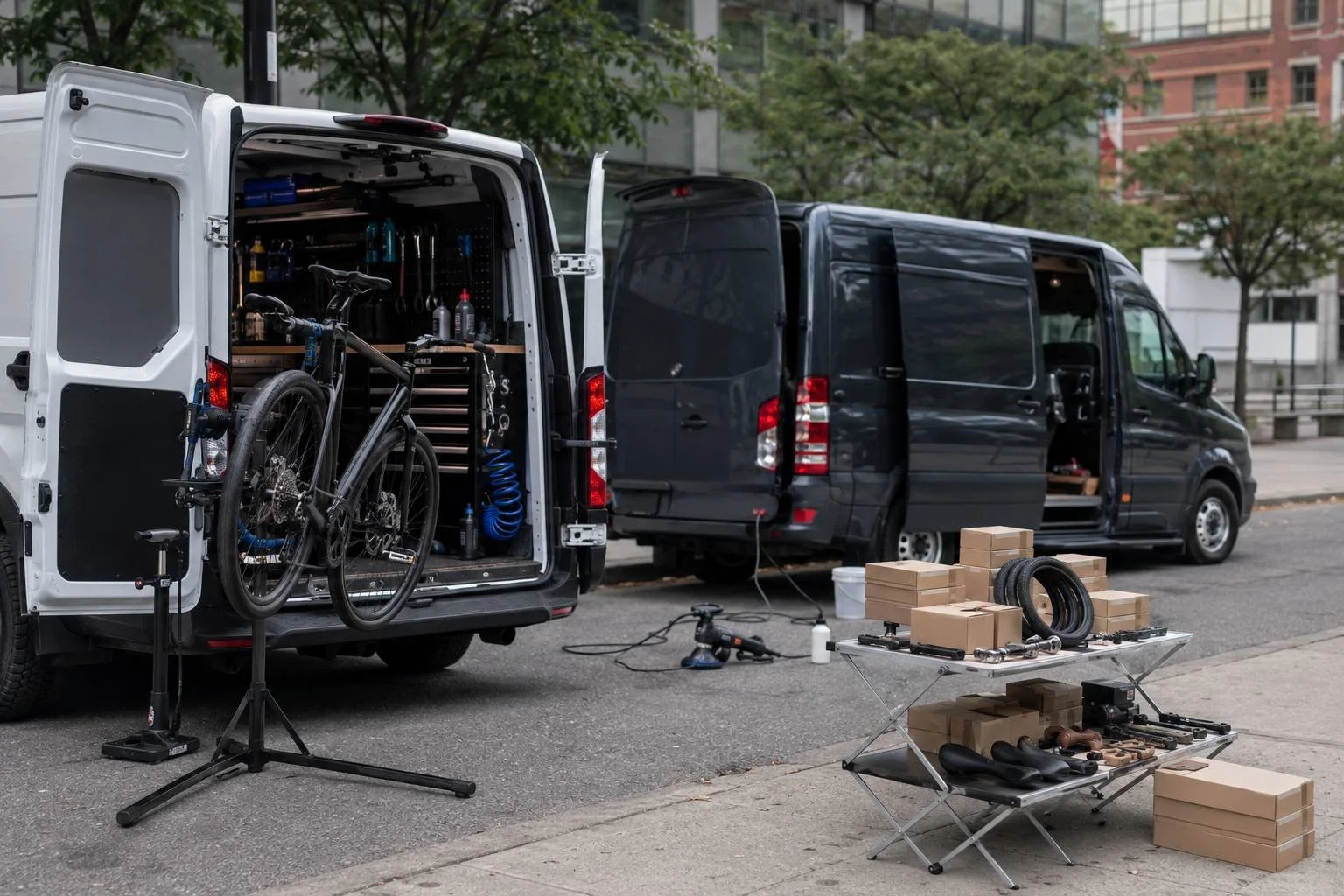
Mobile bicycle repair is a route business: it stacks along a territory, on driveways you are already visiting. It pairs naturally with the other mobile auto services — the same operating model, the same routing discipline, the same customer who values someone coming to them, and in dense cities frequently the same household that owns a car and two e-bikes.
It also pairs sideways into specialty retail: parts, accessories and consumables sold to customers you are already visiting, plus the e-bike components a big-box store does not stock or fit. That work carries a better return than the labor beside it and costs almost nothing to sell.
That is the difference between owning a van and owning a portfolio. You are not building a repair round. You are building the service relationship a neighborhood of riders depends on, anchored by e-bike work nobody else in your market is equipped to do. A portfolio like that, with a documented customer list and a meaningful average ticket, sells to a buyer as one asset — which is how it ends up worth over a million dollars at sale, instead of a van and a tool board.
Frequently asked questions
Is a mobile bicycle repair business profitable? It can be, and the honest test is average ticket. E-bike service work bills at a level that covers a lead mechanic's wage with real cash flow left for the owner; a customer list of basic tune-ups generally does not. Build toward the specialty and the answer is yes.
How much does it cost to start a mobile bicycle repair business? Roughly $3,000 to $10,000 for a mobile shop conversion and tools, which sits near the bottom of the entry ladder in the fifty. About $20,000–$60,000 to acquire an existing customer list with equipment, or $30,000–$80,000 for a franchise mobile-shop model.
Why does e-bike specialization matter so much? Because it changes both the ticket and the competition. E-bikes are expensive, heavy to transport, and carry motor, battery, and controller systems owners will not service themselves — and they went from under 1% of the U.S. market in 2019 to roughly 12.5% by 2025. [S3]
Does location really decide this business? More than in any other category among the fifty, and that is genuinely useful — because unlike most conditions, this one is knowable in advance and costs nothing to check. It concentrates in dense, cycling-friendly cities with a commuting culture, where competition is thin and customers are devoted. Check your market first, and the rest of the decisions get much easier.
Where to go from here
Download the free guide.50 Boring Businesses That Make Millionaires is the full result of the research: fifty categories run against the four tests, what each one costs to enter by all three paths, what has to line up for it to work, and how they pair into a portfolio. Free at microbusinessmillionaire.com.
Read the book.The Microbusiness Millionaire: How Ordinary People Build Extraordinary Wealth One Microbusiness at a Time follows four people who each reached a portfolio worth more than a million dollars by a different path. One keeps a hospital job and uses CDFI financing to acquire one stable service business, then another, then a third. One saves on a single income for three years, leaves a master plumber's wage, and stacks trade service lines starting with an SBA microloan. One uses an SBA Community Advantage loan to open a franchise, then opens three more. One starts with about $5,000 on the side and keeps a W-2 for years, building the slowest and most patient version of the same result. Four starting points, four amounts of money, four portfolios worth over a million dollars at sale. The book is coming soon — join the email list at microbusinessmillionaire.com to hear when it lands.
Join the next cohort — Microbusiness Millionaire: Operating System. The book gives you clear examples of how it's done. The course is the step-by-step system for doing it yourself: screening a real company against the four tests, running the owner-replacement cash-flow math on a seller's actual numbers, knowing when to walk, knowing which lenders fund deals this size, and installing the operator who runs the business without you. Eight weeks online, five seats a cohort, waitlist first — at microbusinessmillionaire.com.
About the author
Chris Scott has spent more than twenty-five years in the small-business arena. As the director of a Community Development Financial Institution (CDFI) and as management at the U.S. Small Business Administration (SBA), he saw thousands of business plans and loan applications cross his desk. His research into which microbusinesses build wealth — and which quietly build a job — became The Microbusiness Millionaire and the free companion guide, 50 Boring Businesses That Make Millionaires.
Sources & references
[S1] Global Market Insights, US Bicycle Market — U.S. market estimated at approximately $9.2bn in 2025, projected to grow at a ~2.9% CAGR through the mid-2030s on commuting, fitness, and leisure demand. gminsights.com
[S2] Bicycle industry statistics compilation — specialty bike shops declined from 6,195 in 2000 to approximately 3,600 in 2022 amid big-box and online competition.
[S3] Statista, U.S. Bicycle Industry — electric bicycles rose from under 1% of the U.S. market in 2019 to approximately 12.5% by 2025; U.S. e-bike sales of roughly 920,000 units in 2024, accounting for close to 30% of U.S. bicycle revenue. statista.com
[S4] U.S. Federal Trade Commission, Franchise Rule / FDD Items 7 and 19. ftc.gov
[S5] Opportunity Finance Network CDFI Locator (ofn.org); SBA Lender Match (sba.gov).
[S6] U.S. Small Business Administration, Apply for licenses and permits (sba.gov); U.S. Department of Transportation hazardous-materials rules for lithium-ion battery shipment; state and local e-bike battery storage, charging, and disposal requirements; manufacturer e-bike service certification requirements.
[S6] Mobile bicycle repair franchise data: Velofix (Velofix Holdings Ltd) remains an active franchisor with a current-year FDD, reported at approximately $40,000–$50,000 total investment on a liquid capital requirement of $50,000. Beeline Bikes, listed as a franchise opportunity across directory sites, shows no current franchise availability — Franchising.com lists it as unavailable pending future openings, and industry commentary refers to its existing franchises as left behind. Confirm current franchising status and request a current-year FDD before relying on any brand in this category.
[Internal]50 Boring Businesses That Make Millionaires — Mobile Bicycle Repair entry (tags, three-path entry-cost table, portfolio pairings, framework note, "what it takes to make this one work"), drawn from the author's research and filtered through the underwriting criteria he applied as a CDFI lender.
This article is for general information only and is not legal, financial, tax, or investment advice. Category-level figures are reference points, not a specific-deal projection; individual businesses vary. Consult a CPA, attorney, business broker, franchise consultant, or CDFI loan officer before acting.
Last updated: 8/22/2026.