
How to Start a Hood Cleaning Business
There are roughly 750,000 restaurants in America, every one has an exhaust hood, the fire code sets how often it must be cleaned, and certified companies number in the low hundreds nationwide. Here is what a hood cleaning business costs, what it pays after you replace yourself, and why the customer never really decides whether to buy.
Chris Scott — former CDFI director and SBA management
As the director of a Community Development Financial Institution (CDFI), and as management at the U.S. Small Business Administration (SBA), I saw thousands of business plans and loan applications cross my desk. That work is where I learned what a durable business looks like on paper, and what a business that only looks durable looks like on paper.
It is not, however, where the list of fifty came from. That came from years of research, running category after category through the same four questions: Is it profitable? Does it have recurring revenue? Is it recession resistant? Is it AI resistant? Those four questions are the framework behind the book, The Microbusiness Millionaire, and they are what separated the categories that built real wealth from the ones that quietly built a job with a P&L attached. Fifty survived the screen. Far more never made it through.
Commercial kitchen hood cleaning is one of the fifty, and one of only nine that carry the Works anywhere tag — no structural condition at all, nothing that has to line up first, no season to cover and no partner category needed. It is also the category whose entire business case can be built with arithmetic you can do in your head. So that comes first, because it is more convincing than anything else that could be said about it.
A word on the neighbor.Fire protection inspection and extinguisher service is also one of the fifty, and the two are easy to run together and easy to confuse. They serve the same restaurant kitchens on the same code-driven schedules, and a single kitchen carries both an exhaust hood and a suppression system. The difference is what the customer is buying. Hood cleaning is paid to remove the grease. Fire protection is paid to sign the tag. This one is physical work whose deliverable is a clean duct; the other is a licensed inspection whose deliverable is a certification an inspector will accept. They pair beautifully — the last section explains how — but the crew, the insurance and the licensing differ in each, and one does not qualify you for the other.
The industry: count the buildings
Most categories among the fifty have an industry figure you can look up. This one does not. It is a specialty inside a specialty and nobody sizes it cleanly, so the honest approach is the one used at a lender's desk when a borrower brings in a business the reports have never heard of: count the buildings.
There are about 749,404 restaurant locations in the United States, and the broader restaurant and foodservice industry runs to more than a million outlets employing 15.7 million people. [S1] Every commercial kitchen among them has an exhaust hood. Add the ones that are not restaurants — hotels, hospitals, schools, prisons, corporate cafeterias, stadiums — and the count goes up from there.
Now the frequency. NFPA 96 sets how often that hood gets cleaned, and it is not a suggestion: quarterly for high-volume cooking like charbroiling and wok operations, semi-annually for moderate volume, annually for low volume. [S2] A single cleaning typically runs $400 to $650 per visit.
That is the whole market, and you just built it from three cited numbers. Three-quarters of a million kitchens, times one to four visits a year, times five or six hundred dollars a visit.
Against that, here's the supply side: IKECA — the trade body, and an ANSI-accredited standards developer since 2009, whose C10, I10, and M10 standards define how this work is actually done — counts its certified membership in the low hundreds across the whole country. [S3]
Three-quarters of a million kitchens. A few hundred certified companies. Very few categories anywhere carry a ratio like that.
Why hood cleaning made the list
Every category in the research had to clear four tests. Clear three and you usually have a self-employed job in disguise.
Does it pay after you replace yourself? It does. This is route work — a scheduled list of kitchens, a defined task at each, a truck that goes to the next one. Route businesses replace their owners more cleanly than trades do, because the work is standardized and the calendar is set by a code cycle instead of by emergencies.
Does the revenue recur? Through contracts, and firmly. Recurring agreements can drive 75% or more of revenue in a mature customer list, because the customer is not deciding whether to clean the hood — NFPA 96 decided that. [S2] The only open question is whether the work is yours.
Does it survive a recession? A restaurant cutting every discretionary dollar still gets the hood cleaned, because the alternative is a failed inspection, a voided insurance policy or a grease fire. This may be the least postponable line in a restaurant's budget.
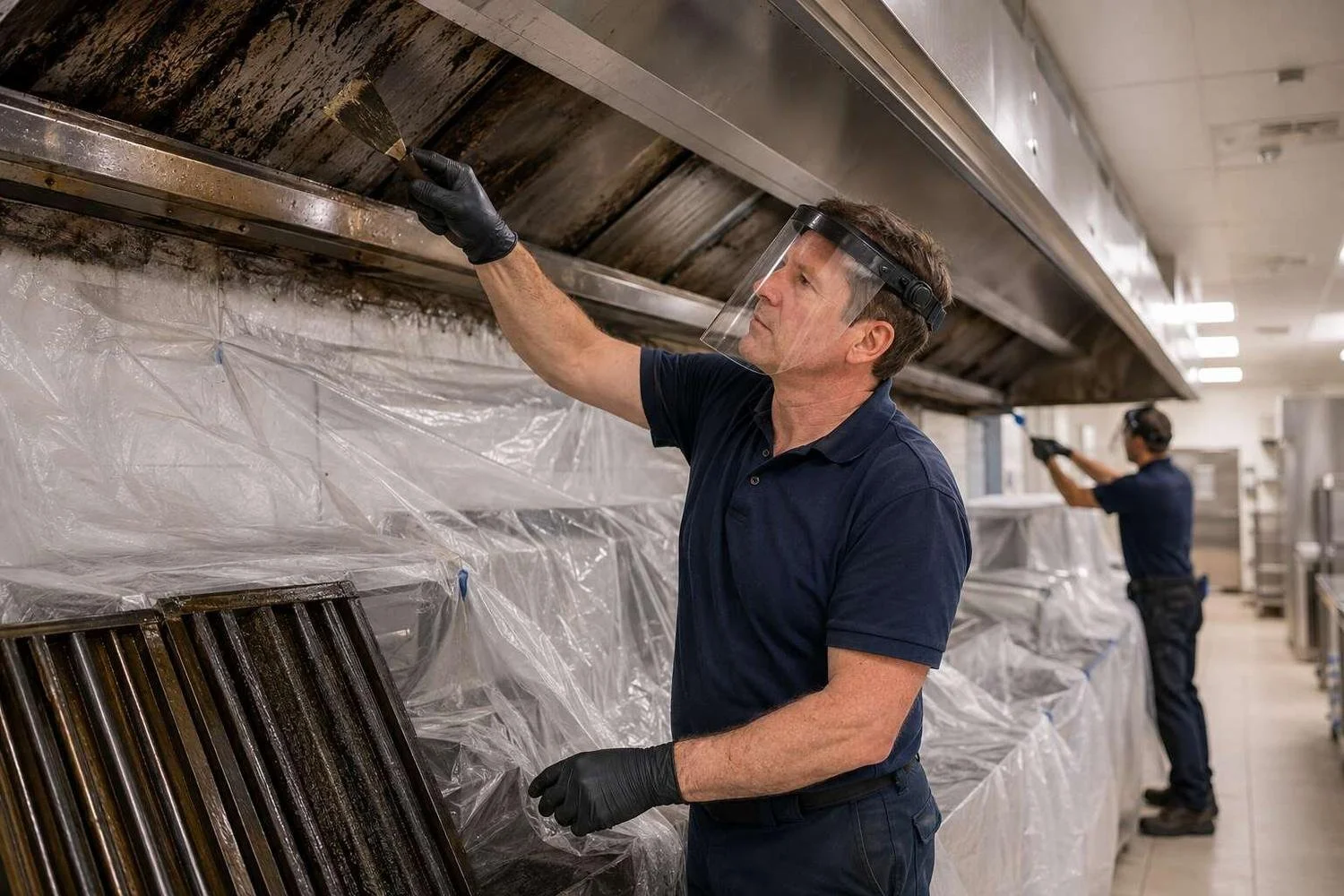
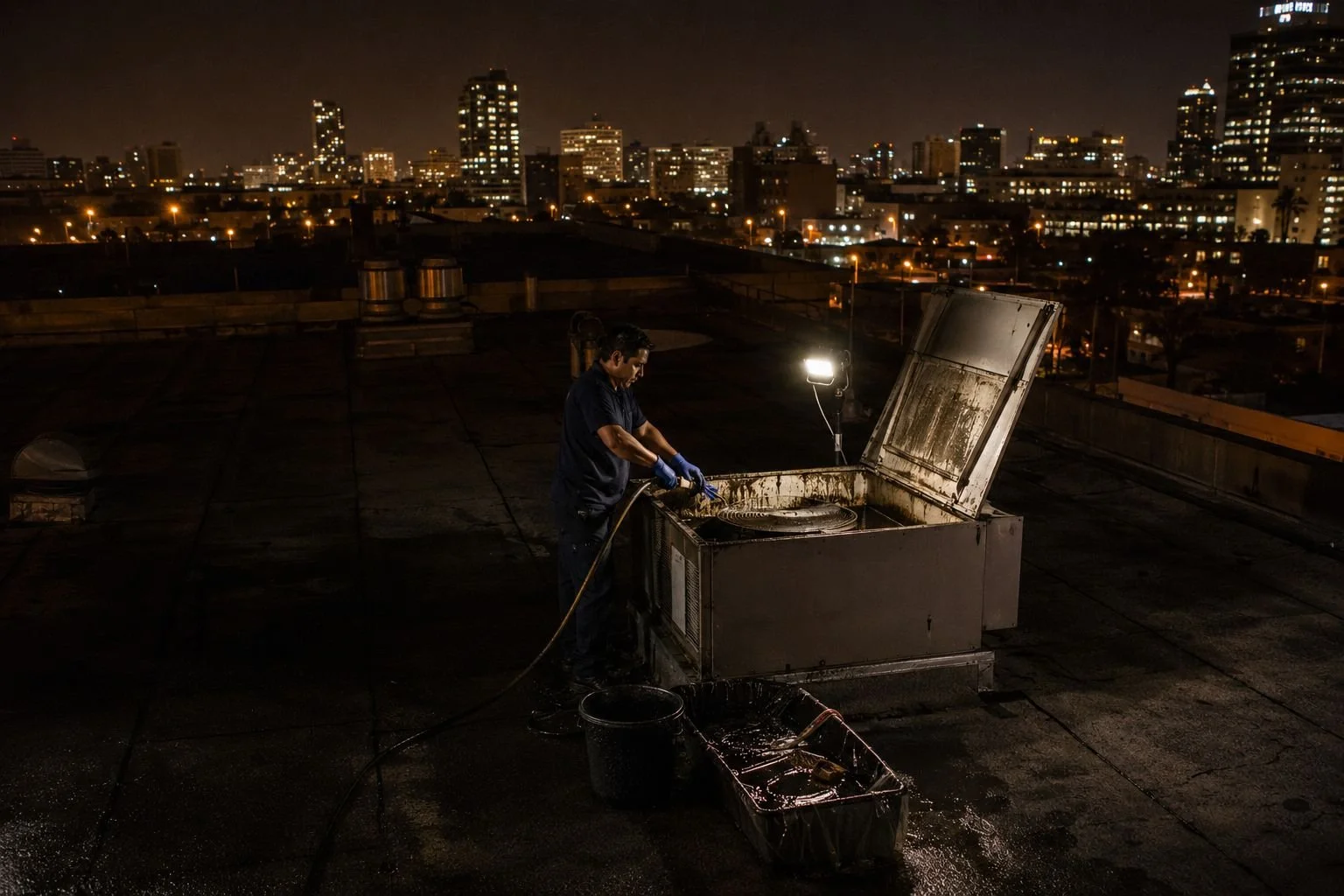
Will it still need humans in ten years? Someone has to be on the roof at two in the morning with a pressure washer and a scraper, inside a duct, in the dark. Software can schedule the visit. It cannot climb into the ductwork. Very low AI exposure.
Four for four, on a compliance clock.
The research on this category kept turning up the same answer to a question that usually has a long one: how do these operators find customers? A striking number of them do not. The fire marshal does. When a restaurant fails an inspection, the inspector's office hands the owner a short list of companies certified to fix it, and the operators on that list get called within the week — some of them having never bought an advertisement in a decade of trading. From the lending side of the desk, that is a genuinely unusual customer-acquisition model to read in an application, because the marketing line stays flat while the revenue grows. In most businesses you are competing for attention. In this one you are competing to be the name that comes up when a regulator tells a restaurant owner they have thirty days to put something right.
What it takes to make this one work
A note on the tags. Every category in the fifty cleared the same four tests; far more never made it through. The tags do not grade a business — they tell you what has to line up for it to work in your hands. Hood cleaning carries the Works anywhere tag: nothing has to line up first, there is no season to cover, and no geography makes or breaks it. Every commercial kitchen in every market runs on the same NFPA 96 clock.
What does matter is inside your control, and it is what the rest of this article is about: the certification that gets you on the fire marshal's list, and the density of the route you build or buy.
What it costs to get in — the three paths
| Path | Typical cost range | Best for |
|---|---|---|
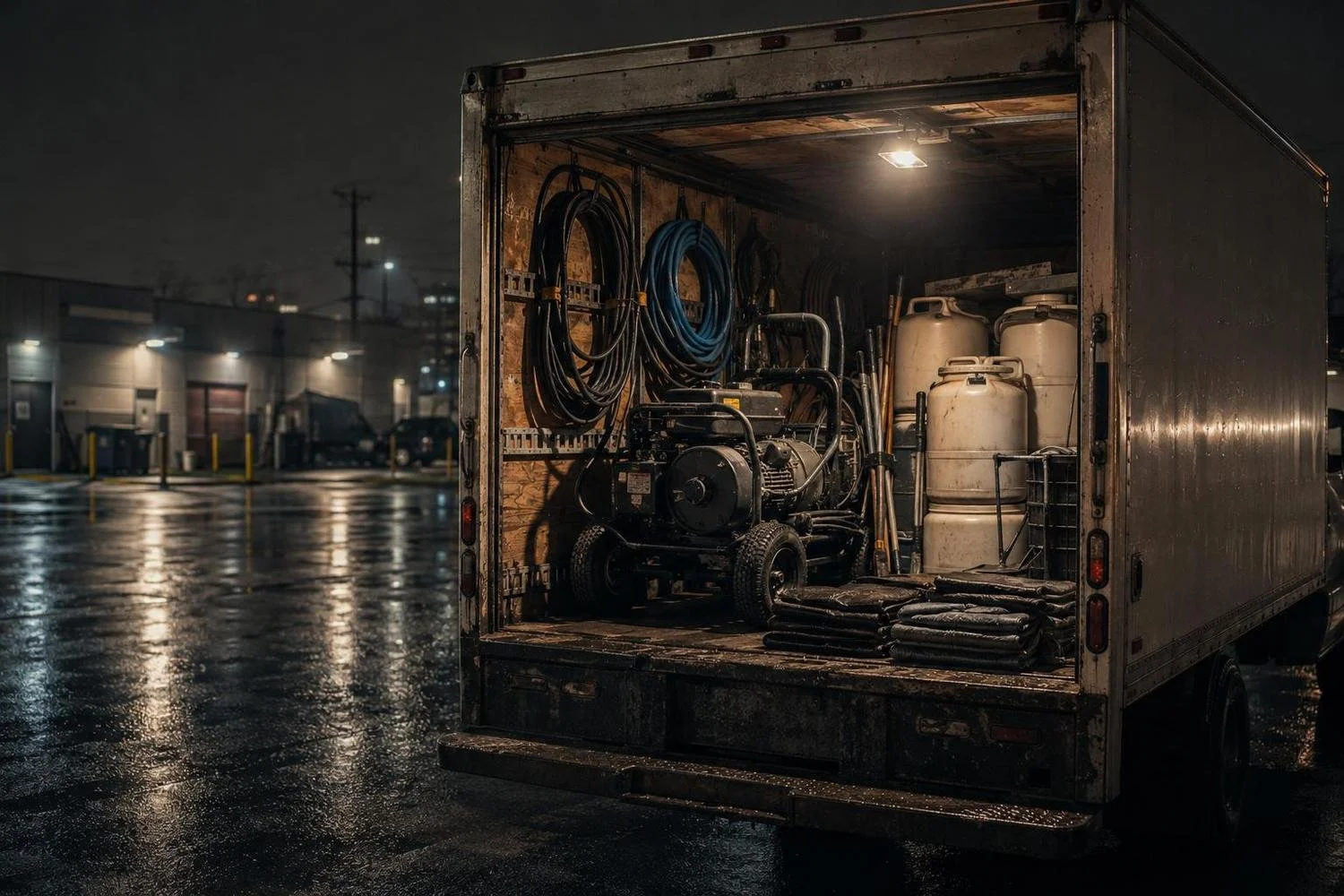
| Startup | $15,000 – $50,000 | IKECA-aligned training + pressure washer + degreasers + truck + insurance |
| Acquisition | $80,000 – $250,000 | Established customer list + specialized equipment |
| Franchise | $150,000 – $245,000 | Brand + IKECA-aligned training + customer routing + territory. Example: HOODZ. |
Franchise brands are named as examples, not endorsements, and the range shown is a category estimate rather than any single brand's published figure. Franchise investment figures reflect a franchisor's most recent Franchise Disclosure Document (FDD) and change annually — verify each brand's current FDD (Item 7 for the initial-investment range; Item 19 for any financial-performance representation) before pursuing one. [S4]
The franchise column here is unusual in that it is effectively one name. HOODZ runs around 137 territories and is the largest provider of commercial kitchen exhaust maintenance in North America; nothing else in the category franchises at that scale. Readings of its filings cluster between roughly $151,000 and $244,000 in estimated initial investment, on an initial franchise fee reported between $59,900 and $89,900. [S6]
Set that against the first row and the choice in this category is stark. The startup path costs $15,000 to $50,000 and asks you to find the restaurants yourself. The franchise costs roughly ten times the bottom of that and hands you routing, training and a brand the compliance officer already recognises. Neither is wrong. But this is a category where the customer is required by code to buy, so the thing you are paying the franchisor for is not demand — it is the head start on finding it.
That startup number is the quiet headline. $15,000 at the low end puts you into a compliance-mandated, contract-recurring, business-to-business route — and among the fifty, few entries that inexpensive open onto something this durable.
The trade-off is worth stating plainly: at $15,000 you are buying equipment and training, not customers. The acquisition path costs five to fifteen times more because it buys the one thing you cannot bootstrap, which is a signed customer list of kitchens already on a cleaning schedule.
How people actually fund it

A $15,000–$50,000 startup sits squarely in the SBA Microloan tier — the rung the book's trades path starts on. An $80,000–$250,000 acquisition moves you up to CDFI direct lending or an SBA Community Advantage loan.
One pattern I watched from the lending chair, across every industry that came through: a qualified borrower walks into a national bank, gets declined, and concludes he cannot be funded. He never learns that a CDFI across town, or a Community Advantage lender, exists precisely for deals this size. Two free national directories will show you the ones near you — the Opportunity Finance Network CDFI locator and SBA Lender Match. [S5]
Finding the lender is the easy half. This category also has an advantage most do not, and it sits in the customer list: the cleaning-frequency mix. How many accounts are quarterly, how many semi-annual, how many annual, and how long each has been on the schedule. A quarterly charbroil account is four times the revenue of an annual one and considerably more durable. Most buyers hand over a customer count and wonder why the underwriter is unmoved. Start recording the frequency split before anyone asks for it.
The profit reality: owner-replacement cash flow

Here is the calculation that decides more of these deals than anything else in them.
A hood cleaning company looks profitable because the owner is on the roof at 2 a.m., quoting during the day, invoicing on Sunday, and handling the inspection paperwork — none of it priced. The honest test: after you pay the crew, and after you pay a supervisor a market wage to run the route the way you run it, is there enough left for you to own the thing?
Real numbers, with a caveat I'll state plainly: there is no dedicated federal occupation for kitchen exhaust cleaning technicians. The nearest supervisory benchmark is first-line supervisors of housekeeping and janitorial workers. What they average is a question about your market, not the country. Look it up for the area you will hire in. [S6] Treat that as a floor rather than a target — this is certified, overnight, physically punishing work performed to an ANSI standard, and it pays above general cleaning supervision for exactly those reasons.
Whatever the company reports as profit has to survive paying that. If the profit only exists because you are the one on the roof, it was never profit — it was a job with a pressure washer attached, and you find that out the first time two kitchens want the same Tuesday night.
The category-level math is easy — you just did it. Running it on a specific company, where the seller's "profit" includes his own overnight labor and the frequency mix is buried in three years of invoices, is where people freeze. That is the job of the course, Microbusiness Millionaire: Operating System — the four tests turned into a repeatable screen you run on a real deal.
The benefits of owning a hood cleaning business
Demand written into fire code. NFPA 96 sets the frequency, so neither the customer nor the economy gets a vote. [S2]
A supply gap you can see. Three-quarters of a million kitchens; certified companies in the low hundreds. [S1][S3]
Contracts that can carry 75% or more of revenue in a mature customer list.
A $15,000 way into a business-to-business compliance route. Very few entries among the fifty open onto something this durable for that money.
A regulator who sends you customers. The fire marshal's office is the referral engine, and it's free.
What separates the strong operators from the struggling ones
Priced by frequency, not by the hood. A quarterly charbroil account and an annual sandwich shop are not the same customer. Price the schedule rather than the visit, and the customer list values itself correctly when you sell.
Cleaned to the standard, not to the eye. The inspection measures against a written standard with a measurable result. Meeting it is what keeps the account and the referral behind it.
Certification treated as the product. Your credential is what a facilities manager is buying and what an insurer wants on the report. It belongs in the price, not in the overhead.
Density before volume. This is night work against a clock. A tight cluster of kitchens earns more than a scattered county, because the shift is spent cleaning rather than driving.
Rooftop coverage carried properly. Working at height, at night, with high-pressure equipment, over someone else's building. Carry what the commercial contracts require before bidding them.
Licenses, permits, and regulations
There is no federal occupational license here, which makes the real requirements local and standards-based. The governing standard is NFPA 96, which sets cleaning frequency by cooking volume and requires the work be done by trained, qualified personnel acceptable to the authority having jurisdiction — in practice, that usually means IKECA certification, whose ANSI-accredited C10, I10, and M10 standards are the widely accepted way to meet it. [S2][S3] Beyond that: a registered entity, general liability at the limits your contracts demand, commercial auto, workers' comp, and — because this is wastewater with grease in it — local discharge and disposal rules that vary by municipality and are worth confirming before your first job. Start with your local fire marshal and the free SBA "Apply for licenses and permits" tool. [S7] (General information, not legal advice — confirm your local requirements.)
Build a portfolio, not a job
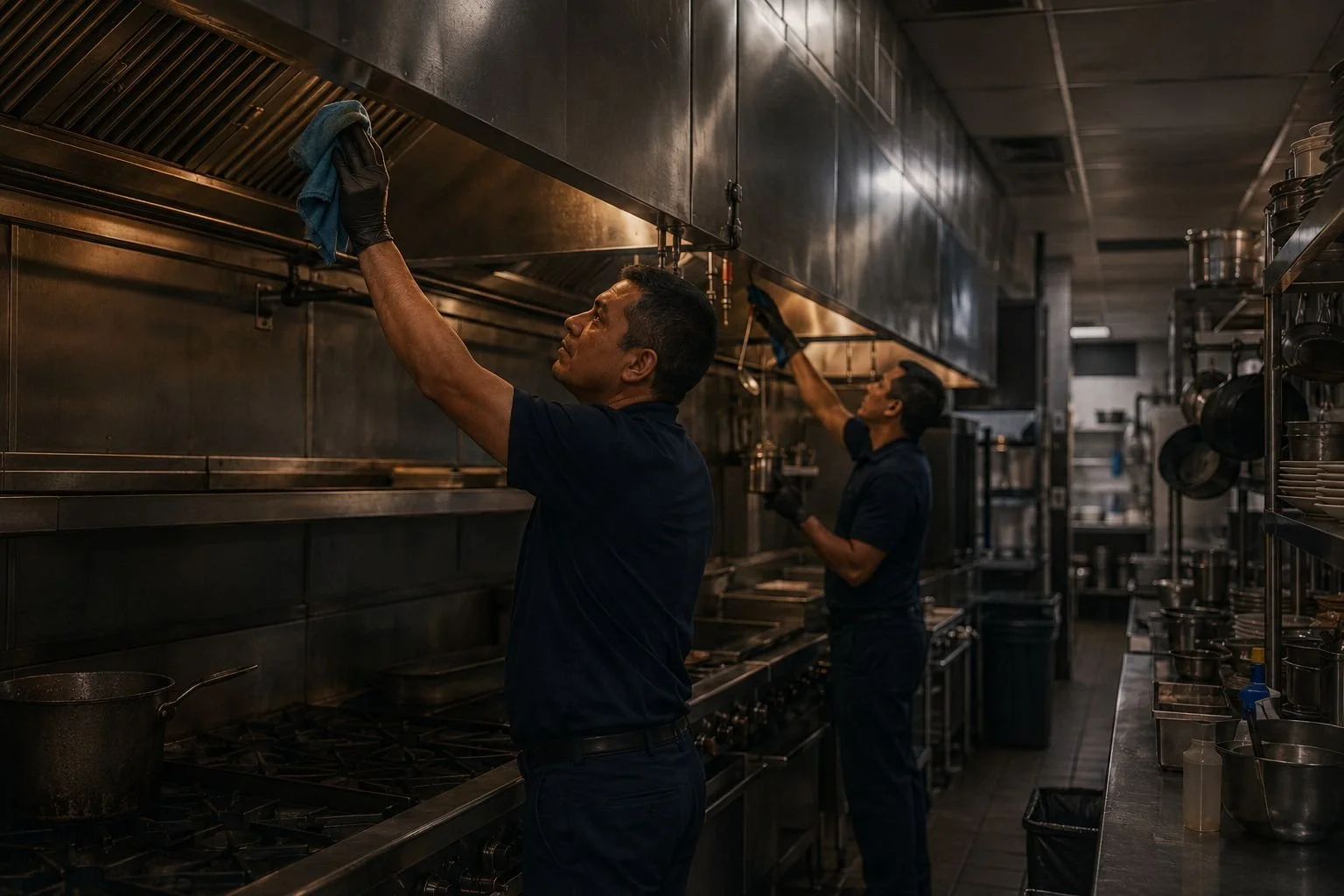
Hood cleaning is a route business — it stacks along a territory, on buildings you are already visiting after close — and it has the tightest pairing logic among the fifty.
It pairs with fire protection and extinguisher service: the same customer, the same building, the same night, the same fire marshal, and the same two NFPA standards sitting side by side in the same code book. You are already on the roof. The suppression system is eight feet below you.
From there it opens into commercial cleaning, pressure washing, and pest control — every one of them sold to a restaurant owner who already lets you into the building after close and already trusts you to keep the inspector happy.
That is the difference between owning a truck and owning a portfolio. You are not building a hood cleaning company. You are building the compliance vendor for every commercial kitchen in your county. A portfolio like that, with a documented customer list running on a code clock, sells to a buyer as one asset — which is how it ends up worth over a million dollars at sale, instead of a job you do at two in the morning.
Frequently asked questions
Is a hood cleaning business profitable? At scale, yes — measured honestly, after paying the crew and a supervisor to replace the owner's labor. The structural advantage is that the revenue recurs on a fire-code clock rather than a sales cycle, which is what makes the cash flow predictable enough to lend against.
How much does it cost to start a hood cleaning business? Roughly $15,000–$50,000 for a startup with training, a pressure washer, degreasers, a truck and insurance; $80,000–$250,000 to buy an existing customer list; or $80,000–$200,000 for a franchise.
How often does NFPA 96 require hood cleaning? Quarterly for high-volume cooking such as charbroiling and wok operations, semi-annually for moderate volume, and annually for low volume. That schedule is your revenue model. [S2]
Do I need IKECA certification? NFPA 96 requires the work be done by trained, qualified personnel acceptable to the local authority having jurisdiction. IKECA is the credential most widely accepted for meeting that, and its standards are ANSI-accredited. In practice it is what facilities managers and insurers look for — and what gets you onto the fire marshal's list. [S3]
Where to go from here
Download the free guide.50 Boring Businesses That Make Millionaires is the full result of the research: fifty categories run against the four tests, what each one costs to enter by all three paths, what has to line up for it to work, and how they pair into a portfolio. Free at microbusinessmillionaire.com.
Read the book.The Microbusiness Millionaire: How Ordinary People Build Extraordinary Wealth One Microbusiness at a Time follows four people who each reached a portfolio worth more than a million dollars by a different path. One keeps a hospital job and uses CDFI financing to acquire one stable service business, then another, then a third. One saves on a single income for three years, leaves a master plumber's wage, and stacks trade service lines starting with an SBA microloan. One uses an SBA Community Advantage loan to open a franchise, then opens three more. One starts with about $5,000 on the side and keeps a W-2 for years, building the slowest and most patient version of the same result. Four starting points, four amounts of money, four portfolios worth over a million dollars at sale. The book is coming soon — join the email list at microbusinessmillionaire.com to hear when it lands.
Join the next cohort — Microbusiness Millionaire: Operating System. The book gives you clear examples of how it's done. The course is the step-by-step system for doing it yourself: screening a real company against the four tests, running the owner-replacement cash-flow math on a seller's actual numbers, knowing when to walk, knowing which lenders fund deals this size, and installing the operator who runs the business without you. Eight weeks online, five seats a cohort, waitlist first — at microbusinessmillionaire.com.
About the author
Chris Scott has spent more than twenty-five years in the small-business arena. As the director of a Community Development Financial Institution (CDFI) and as management at the U.S. Small Business Administration (SBA), he saw thousands of business plans and loan applications cross his desk. His research into which microbusinesses build wealth — and which quietly build a job — became The Microbusiness Millionaire and the free companion guide, 50 Boring Businesses That Make Millionaires.
Sources & references
[S1] National Restaurant Association, 2024 State of the Restaurant Industry (749,404 U.S. restaurant locations, derived from BLS Quarterly Census of Employment and Wages, NAICS 722); National Restaurant Association industry statistics (more than 1 million restaurant and foodservice outlets; 15.7 million employees). restaurant.org
[S2] National Fire Protection Association, NFPA 96, Standard for Ventilation Control and Fire Protection of Commercial Cooking Operations — cleaning frequency by cooking volume; cleaning by trained, qualified, certified personnel acceptable to the authority having jurisdiction. nfpa.org
[S3] International Kitchen Exhaust Cleaning Association — ANSI-accredited standards developer since 2009; ANSI/IKECA C10, I10, and M10 standards; CECS and CECT certification programs; certified membership in the low hundreds per IKECA's own published materials. ikeca.org
[S4] U.S. Federal Trade Commission, Franchise Rule / FDD Items 7 and 19. ftc.gov
[S5] Opportunity Finance Network CDFI Locator (ofn.org); SBA Lender Match (sba.gov).
[S6] U.S. Bureau of Labor Statistics, OEWS, First-Line Supervisors of Housekeeping and Janitorial Workers (SOC 37-1011), May 2025 — used as the closest available proxy; BLS publishes no dedicated occupation for kitchen exhaust cleaning technicians. bls.gov/oes
[S7] U.S. Small Business Administration, Apply for licenses and permits (sba.gov); local fire marshal offices; municipal grease-waste discharge rules.
[S6] HOODZ franchise disclosure data as reported by franchise-filing aggregators reading recent FDDs: estimated initial investment variously reported at $151,000–$219,000, $169,000–$244,000, $183,838–$231,992 and $199,038–$244,307, on an initial franchise fee of $59,900–$89,900 and a 10% royalty; approximately 137 locations across the United States and Canada. Reported figures vary between aggregators and filing years; verify the current FDD directly.
[Internal] 50 Boring Businesses That Make Millionaires — Commercial Kitchen Hood Cleaning entry (tag, three-path entry-cost table, portfolio pairings, framework note), drawn from the author's research and filtered through the underwriting criteria he applied as a CDFI lender.
This article is for general information only and is not legal, financial, tax, or investment advice. Category-level figures are reference points, not a specific-deal projection; individual businesses vary. Consult a CPA, attorney, business broker, franchise consultant, or CDFI loan officer before acting.
Last updated: 8/21/2026.