

How to Start a Garage Door Business
A broken torsion spring means the car is inside the garage and not coming out, which gives this category pricing power almost nothing else on the list can match. Here is what a garage door business costs, what it pays after you replace yourself, and why $15,000 and no state license makes it the most open entry of any trade among the fifty.
Chris Scott — former CDFI director and SBA management
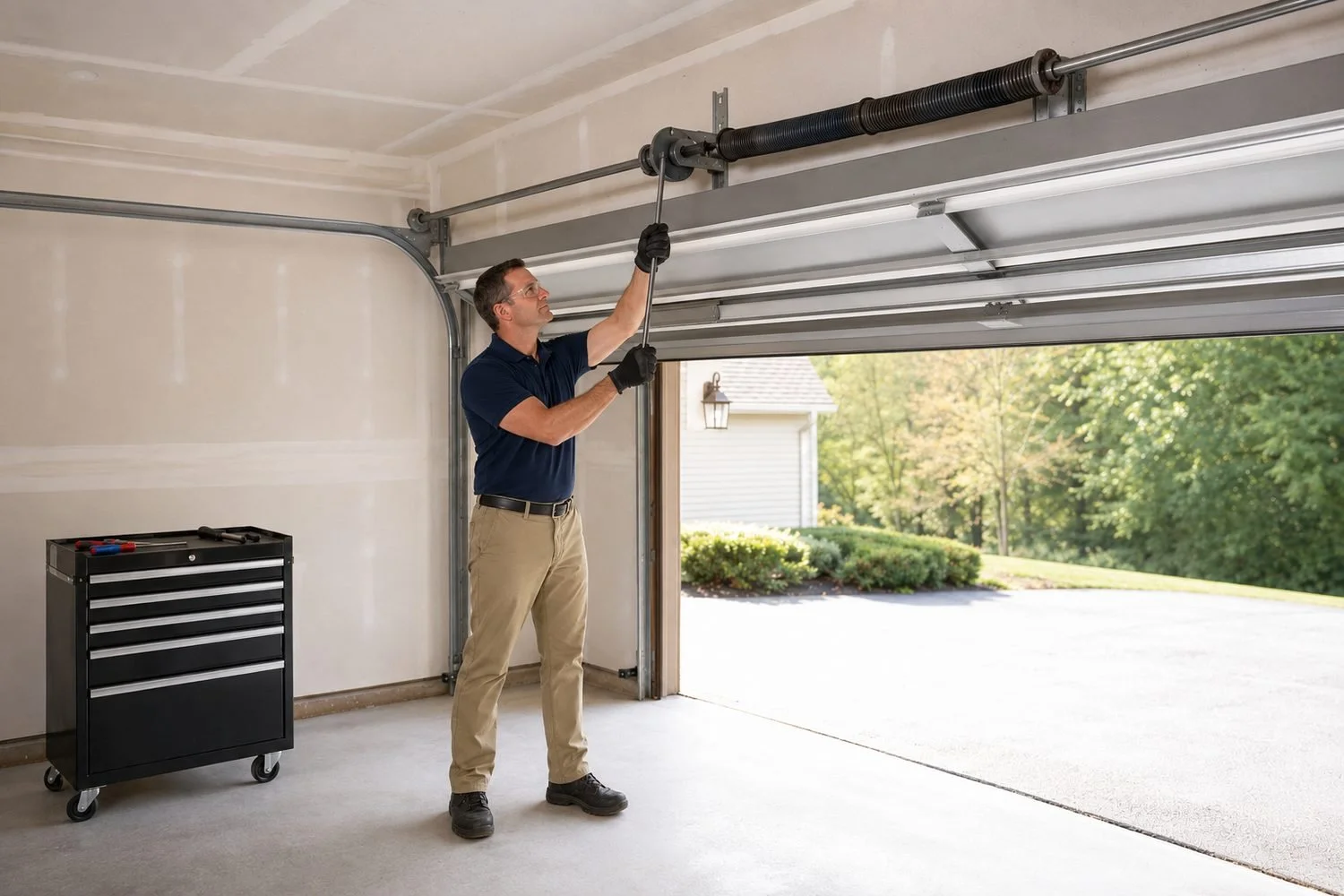
As the director of a Community Development Financial Institution (CDFI), and as management at the U.S. Small Business Administration (SBA), I saw thousands of business plans and loan applications cross my desk. That work is where I learned what a durable business looks like on paper, and what a business that only looks durable looks like on paper.
It is not, however, where the list of fifty came from. That came from years of research, running category after category through the same four questions: Is it profitable? Does it have recurring revenue? Is it recession resistant? Is it AI resistant? Those four questions are the framework behind the book, The Microbusiness Millionaire, and they are what separated the categories that built real wealth from the ones that quietly built a job with a P&L attached. Fifty survived the screen. Far more never made it through.
Garage door service is one of the fifty, and it is the one people are most surprised to find there. It is also one of only nine that carry no structural condition at all — nothing has to line up first, no season to cover, no partner category needed to fill half the calendar. What follows is the market, the four questions, the three ways in and what each costs, how people fund it, and where the money actually ends up.
The industry: small-sounding, and highly fragmented

A note on the numbers first, because this category is easy to misread. Garage door work sits inside the broader door installation and repair services industry, which runs about $7.7 billion and which IBISWorld describes as highly fragmented, with no company holding more than 5% market share. [S1]
You will find narrower figures elsewhere that count only a few hundred specialist firms. Those measure a sliver of the market rather than the trade. The honest picture is a multi-billion-dollar, deeply fragmented category with no dominant player in it.
That fragmentation is the opportunity. There is no national brand whose pricing you have to match and no consolidator taking the market, and there are thousands of small operators — a great many of them run by owners nearing retirement with a service area and a phone number to sell.
There is no dedicated Bureau of Labor Statistics occupation for garage door technicians. The work sits within construction and extraction occupations, and that group's median wage is the closest benchmark you have. [S2] It is the price of replacing yourself — the wage a hired installer would command for the work you are doing now. The figure that matters is your metro's, not the country's. Every profit number later in this article has to survive it, and the real cost runs higher once payroll taxes and insurance go on top.
Why garage door made the list
Every category in the research had to clear four tests. Clear three and you usually have a self-employed job in disguise.
Does it pay after you replace yourself? It does, and it is one of the most reliable cash flow profiles among the fifty — measured after paying technicians and after paying someone to do the job you have been doing for free.
Does the revenue recur? Through replacement cycles and an installed base rather than contracts. Springs fail on a duty cycle. Openers die. Panels get backed into. Every door you touch is a customer for the next repair, and commercial overhead-door accounts add genuine repeat volume.
Does it survive a recession? This is where the category quietly shines. A broken torsion spring means the car is inside the garage and not coming out. Nobody defers that to next quarter because the economy softened. New-construction door installs move with the builders; emergency repair does not — and the repair work leaves more on each job anyway.
Will it still need humans in ten years? Someone has to be there with the spring, the ladder and enough experience not to get hurt. Software can book the call. It cannot wind a torsion spring. Very low AI exposure.
Four for four.
The research on this category kept finding the same gap between good revenue and thin profit, and it almost always traced back to one line on the price list: what the business charges for a Saturday emergency spring replacement. A striking number of operators charge exactly what they charge on a Tuesday, often because it does not feel right to charge more when someone is stuck. What that does is take the single most valuable service in the business — a trapped car and a customer who needs it solved today — and price it like a scheduled maintenance call. From the lending side of the desk the effect is easy to read, because it lands in the one number that decides whether a deal can be financed at all: what is left after everyone, including a replacement for the owner, has been paid. The generosity is real. It is also being funded out of the owner's weekends.
What it takes to make this one work
A note on the tags. Every category in the fifty cleared the same four tests; far more never made it through. The tags do not grade a business — they tell you what has to line up for it to work in your hands. Garage door carries the Works anywhere tag, one of only nine categories on the list with no structural condition at all: no season to cover, no partner category needed, and no geography that makes or breaks it. Doors fail on the same duty cycle in every market.
What does matter is entirely inside your control, and it is the subject of the rest of this article: how you price the emergency call, and how fast you answer the phone.
What it costs to get in — the three paths
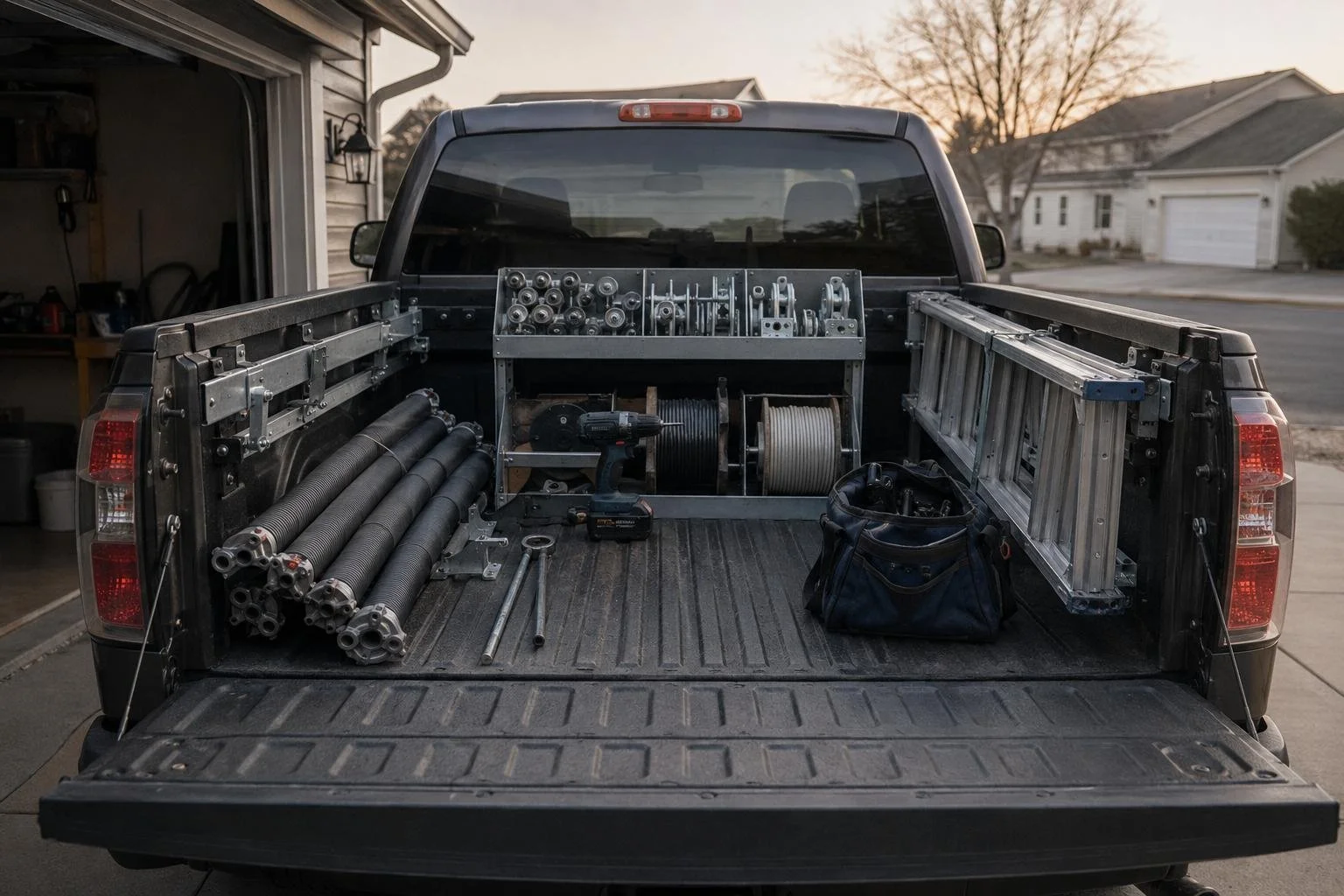
| Path | Typical cost range | Best for |
|---|---|---|
| Startup | $15,000 – $40,000 | Truck + tools + insurance |
| Acquisition | $130,000 – $250,000 | Inherited service area + customer list |
| Franchise | $160,000 – $360,000 | Brand + lead flow + territory. Examples: Precision Garage Door, ProLift Garage Doors. |
Franchise brands are named as examples, not endorsements, and the range shown is a category estimate rather than any single brand's published figure. Franchise investment figures reflect a franchisor's most recent Franchise Disclosure Document (FDD) and change annually — verify each brand's current FDD (Item 7 for the initial-investment range; Item 19 for any financial-performance representation) before pursuing one. [S3]
The franchise row here works in a way worth understanding, because it is unlike any other category on the list. Precision Garage Door prices its initial franchise fee per household — a set amount for every single-family detached home inside the territory granted — so a typical territory of 150,000 to 300,000 homes produces a fee somewhere between $75,000 and $150,000, and a total estimated investment of roughly $164,000 to $360,000 before real estate. [S6] ProLift Garage Doors sits nearer the bottom of that band.
Which means the number on the page is not really a price, it is a function of how many doors are in your territory. Bigger territory, bigger fee, more doors to service. Read Item 7 against the specific territory being offered, and note that the upper half of that range sits above the $350,000 Community Advantage ceiling discussed below.
Here is what makes this category unusual among the nine with no structural condition: the startup path is genuinely open. Plumbing, HVAC and electrical all gate you behind a license that takes years to earn. Garage door does not, in most jurisdictions. Fifteen thousand dollars buys a truck, tools and insurance, and you can be working. That is an unusually light barrier for a trade among the fifty.
The trade-off is worth stating plainly: no license gate for you also means no license gate for the next person. Your moat is not a credential. It is response time, reputation, and the phone number people already have saved.
How people actually fund it

The three paths are three different funding conversations.
A $15,000–$40,000 startup is SBA Microloan territory, or savings. This is one of the more accessible entries among the fifty, and worth taking seriously as a way to acquire the skill before you buy anything larger.
A $130,000–$250,000 acquisition or a $110,000–$170,000 franchise lands in CDFI direct lending and SBA Community Advantage territory — the community-lender tiers most first-time buyers have never heard of.
One pattern I watched from the lending chair, across every industry that came through: a qualified buyer walks into a big national bank, gets declined, and concludes he cannot be funded. He never learns that a CDFI across town, or a Community Advantage lender, specializes in exactly this size of deal. Two free national directories will show you the ones near you — the Opportunity Finance Network CDFI locator and SBA Lender Match. [S4]
Finding the lender is the easy half. A garage door business also has a specific tell an underwriter looks for: the emergency-versus-scheduled revenue mix. A company earning a real premium on urgent calls has a different profile from one charging Tuesday rates on a Saturday, and that difference lands in exactly the line a lender reads first. Start recording the split before anyone asks for it.
The profit reality: owner-replacement cash flow

Here is the calculation that separates a business from a job.
A garage door company looks profitable because the owner is running calls, quoting doors, answering the emergency line at 8 p.m., and doing the books — none of it priced. The honest test: after you pay the technicians, and after you pay a supervisor a market wage to run the day-to-day the way you run it, is there anything left for you as the owner?
Real numbers. Two wages come out before you count anything: a field technician, priced off the construction-occupation median [S2], and a first-line supervisor of construction trades [S5]. Both are local figures, so pull them for your own market. Whatever the company shows as profit has to survive paying both.
If it survives, you own a business. If it only works because you are the one taking the Saturday spring call, you own a job with a P&L attached — and it will show up in exactly the line a lender reads first.
The category-level math is easy — you just did it. Running it on a specific company, where the seller's profit quietly includes his own after-hours labor and the emergency premium may or may not be priced correctly, is where people freeze. That is the job of the course, Microbusiness Millionaire: Operating System — the four tests turned into a repeatable screen you run on a real deal.
The benefits of owning a garage door business
Urgency pricing. A broken spring means a trapped car. That is genuine pricing power, and it's the category's defining economic feature.
A light license barrier for a trade. In most jurisdictions there is no multi-year credential standing between you and the work.
A $15,000 startup. One of the most accessible entries among the fifty.
A fragmented market with no dominant player. No national brand setting your ceiling. [S1]
Recession resistance. Emergency repair demand does not check the economy first.
AI resistance. Someone has to be on the ladder with the spring, and that is not changing.
One of the most reliable cash flow profiles among the fifty.
What separates the strong operators from the struggling ones
The emergency premium, priced. This is the defining decision in the category. The Saturday call is worth more because it is worth more, and pricing it that way is what funds everything else.
The owner-replacement math, done first. Put a supervisor's wage into the numbers before counting anything as profit, and the day you hire one changes nothing about your cash flow.
Service before new construction. Builder work arrives unevenly, moves with the cycle and pays slowly. Service and repair is steady, and it leaves more on each job.
Response time treated as the moat. In a trade with no license gate, how fast you answer is the advantage. The company that picks up at seven in the evening takes the job.
Compete on showing up, not on price. There is always someone cheaper. There is rarely someone faster, and speed is what this customer is actually buying.
Safety training funded properly. Torsion springs under load are genuinely dangerous. Trained technicians are cheaper than the injury and the insurance that follows one.
Licenses, permits, and regulations
This is the lightest regulatory footprint of any trade among the fifty. Most jurisdictions do not require a specific garage door license — though some require a general contractor or specialty contractor registration, and rules vary meaningfully by state and city. What you will need regardless: a registered business entity, general liability insurance and workers' comp (non-negotiable in a trade with real injury exposure), and permits on some structural or commercial installs. Verify what applies locally using the free SBA "Apply for licenses and permits" tool and your state's contractor licensing board before you take your first call. [S6] (General information, not legal advice — confirm your local requirements.)
Build a portfolio, not a job
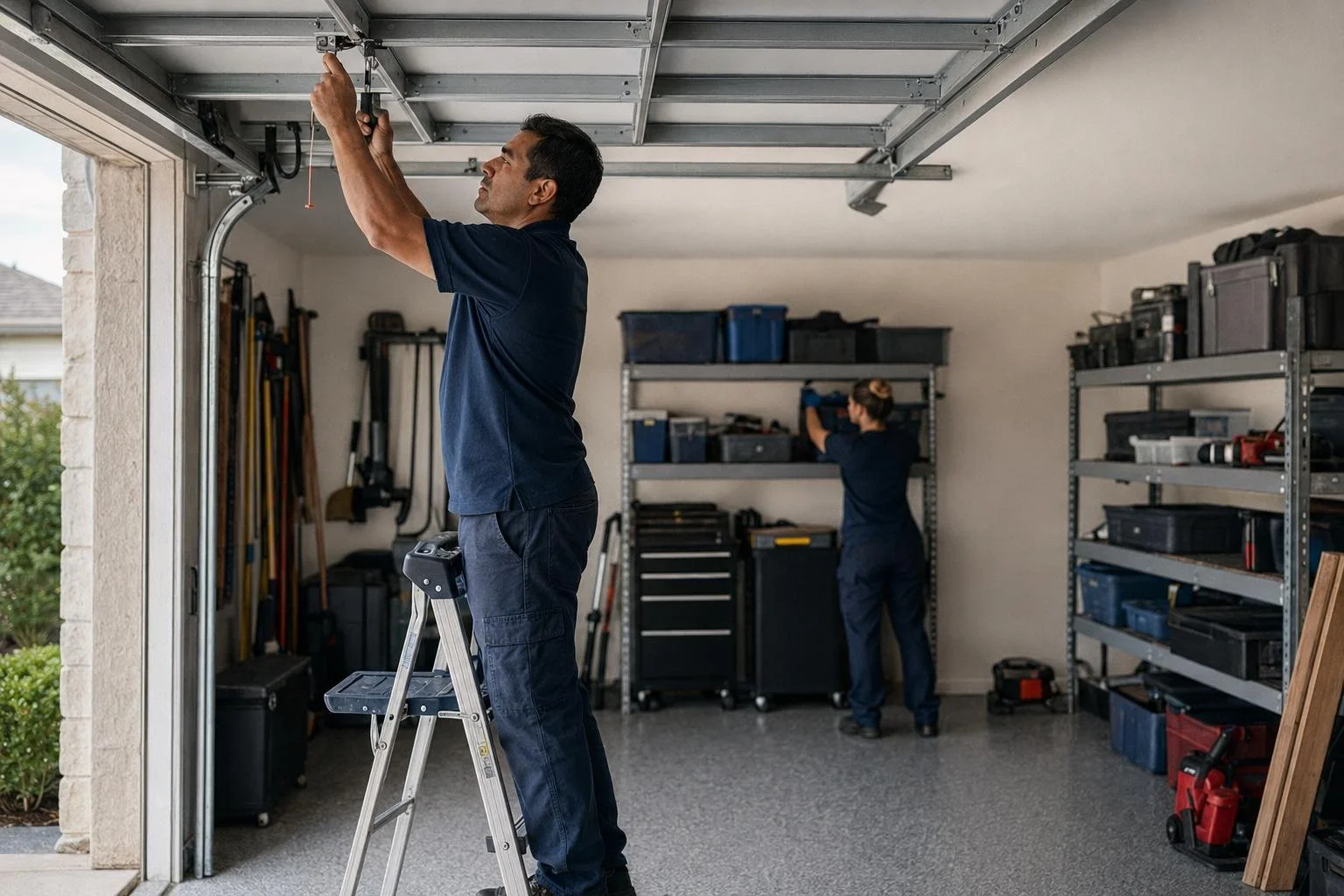
Garage door is a route business: it stacks along a territory, on homes you are already driving to, rather than at a single location. It pairs naturally with handyman services, garage organization, and exterior home services — same customer, same truck, often the same visit.
The pairing logic here is unusually clean, because you are already standing in someone's open garage holding a drill, with their trust. Garage organization may be the most natural addition anywhere among the fifty: the customer is looking at the clutter while you work. Handyman work fills the schedule between door calls. Exterior services reach the same homeowner list you are already building. Start with the door customers, then sell the next service to the people already on that list.
That is the difference between owning a truck and owning a portfolio. You are not building a garage door company. You are building the home-services vendor a few hundred households call first, anchored by urgent work nobody postpones. A portfolio like that, with a documented customer list and a real emergency premium in the pricing, sells to a buyer as one asset — which is how it ends up worth over a million dollars at sale, instead of a truck and a phone number.
Frequently asked questions
Is a garage door business profitable? It carries one of the most reliable cash flow profiles among the fifty, measured honestly — after paying technicians and after paying a supervisor to replace the owner's labor. What counts is the dollars left after that, not the percentage on the way there. Pricing the emergency premium is what decides it.
How much does it cost to start a garage door business? Roughly $15,000 to $40,000 to start, about $130,000 to $250,000 to buy an established service area, or roughly $160,000 to $360,000 for a franchise.
Do I need a license for garage door repair? Usually not a dedicated one, though some states require contractor registration. You will need a registered business, liability insurance, and workers' comp. Verify locally. [S6]
Can I start a garage door business part-time? Yes. It is one of the more workable part-time entries among the fifty, since the capital cost is low and repair calls can be scheduled around a W-2. The one thing to plan for is that emergency work — which is the profitable work — does not wait for your evenings.
Where to go from here
Download the free guide.50 Boring Businesses That Make Millionaires is the full result of the research: fifty categories run against the four tests, what each one costs to enter by all three paths, what has to line up for it to work, and how they pair into a portfolio. Free at microbusinessmillionaire.com.
Read the book.The Microbusiness Millionaire: How Ordinary People Build Extraordinary Wealth One Microbusiness at a Time follows four people who each reached a portfolio worth more than a million dollars by a different path. One keeps a hospital job and uses CDFI financing to acquire one stable service business, then another, then a third. One saves on a single income for three years, leaves a master plumber's wage, and stacks trade service lines starting with an SBA microloan. One uses an SBA Community Advantage loan to open a franchise, then opens three more. One starts with about $5,000 on the side and keeps a W-2 for years, building the slowest and most patient version of the same result. Four starting points, four amounts of money, four portfolios worth over a million dollars at sale. The book is coming soon — join the email list at microbusinessmillionaire.com to hear when it lands.
Join the next cohort — Microbusiness Millionaire: Operating System. The book gives you clear examples of how it's done. The course is the step-by-step system for doing it yourself: screening a real company against the four tests, running the owner-replacement cash-flow math on a seller's actual numbers, knowing when to walk, knowing which lenders fund deals this size, and installing the operator who runs the business without you. Eight weeks online, five seats a cohort, waitlist first — at microbusinessmillionaire.com.
About the author
Chris Scott has spent more than twenty-five years in the small-business arena. As the director of a Community Development Financial Institution (CDFI) and as management at the U.S. Small Business Administration (SBA), he saw thousands of business plans and loan applications cross his desk. His research into which microbusinesses build wealth — and which quietly build a job — became The Microbusiness Millionaire and the free companion guide, 50 Boring Businesses That Make Millionaires.
Sources & references
[S1] IBISWorld, Door Installation & Repair Services in the US — Industry Analysis / Market Size ($7.7bn, 2024; highly fragmented, no company above 5% market share). Garage door service is a segment within this industry. ibisworld.com
[S2] U.S. Bureau of Labor Statistics, Occupational Outlook Handbook: Construction and Extraction Occupations (May 2024). No dedicated BLS occupation exists for garage door technicians. bls.gov/ooh
[S3] U.S. Federal Trade Commission, Franchise Rule / FDD Items 7 and 19. ftc.gov
[S4] Opportunity Finance Network CDFI Locator (ofn.org); SBA Lender Match (sba.gov).
[S5] U.S. Bureau of Labor Statistics, OEWS, First-Line Supervisors of Construction Trades and Extraction Workers (SOC 47-1011). bls.gov/oes
[S6] U.S. Small Business Administration, Apply for licenses and permits (sba.gov); state contractor licensing boards.
[S6] Precision Garage Door Service franchise disclosure data: the franchisor states an estimated initial investment of $164,285–$360,294 excluding real estate, including an initial franchise fee of $75,000–$150,000 priced at $0.50 per single-family detached home in the territory, per Item 7 of the 2026 Precision Garage Door SPV LLC FDD. ProLift Garage Doors is reported by industry sources at approximately $159,100–$224,000. Reported figures vary between aggregators and filing years; verify the current FDD directly.
[Internal] 50 Boring Businesses That Make Millionaires — Garage Door Service entry (tag, three-path entry-cost table, portfolio pairings, framework note), drawn from the author's research and filtered through the underwriting criteria he applied as a CDFI lender.
This article is for general information only and is not legal, financial, tax, or investment advice. Category-level figures are reference points, not a specific-deal projection; individual businesses vary. Consult a CPA, attorney, business broker, franchise consultant, or CDFI loan officer before acting.
Last updated: 8/20/2026.