

How to Start a Fitness Studio Business
Membership revenue arrives monthly whether the member trains or not, which makes this about as close to a subscription as a physical, local business gets. Here is what a boutique fitness studio costs, what it pays after you replace yourself, and why roughly the same money buys either an empty room or one with members already paying.
Chris Scott — former CDFI director and SBA management

As the director of a Community Development Financial Institution (CDFI), and as management at the U.S. Small Business Administration (SBA), I saw thousands of business plans and loan applications cross my desk. That work is where I learned what a durable business looks like on paper, and what a business that only looks durable looks like on paper.
It is not, however, where the list of fifty came from. That came from years of research, running category after category through the same four questions: Is it profitable? Does it have recurring revenue? Is it recession resistant? Is it AI resistant? Those four questions are the framework behind the book, The Microbusiness Millionaire, and they are what separated the categories that built real wealth from the ones that quietly built a job with a P&L attached. Fifty survived the screen. Far more never made it through.
Boutique fitness is one of the fifty, and it is the most capital-intensive entry among them — it sits right at the top of what the framework's financing lane will carry.
It earns its place on one line. Membership revenue arrives monthly whether the member trains or not, which is about as close to a subscription as a physical, local business gets. The whole discipline of this category is protecting that line.
A word on how this differs from personal training, since both are on the list and both sell fitness. A studio sells a membership: it is a facility, billed monthly whether the member trains or not, and it lives or dies on churn and on how many bodies the room holds. Personal training sells a person's time and attention: it is a route, priced per session or per package, and it lives on retention — the client who stays for years because you are their trainer. A studio is built on occupancy. Training is built on relationships. They pair well and many operators end up running both, but the money behaves differently, and the mistake is starting one while pricing it like the other.
The industry: large, fragmented, and studio-led

Gyms, health clubs, and fitness centers in the United States are a $47.0 billion industry in 2026, growing at roughly a 3.6% compound rate across approximately 114,370 facilities — a field where no operator holds a commanding share. [S1] The boutique end is the interesting part: Pilates and yoga studios alone reached $19.2 billion in 2025 after expanding at an 11.1% compound rate over five years, though revenue dipped 2.0% that year as higher rents and wages pressed on studios that could not fully pass costs through. [S1]
That last detail is the category in one sentence. Demand is strong and growing; the cost side is where studios get decided.
The labor benchmark is what a fitness trainer or instructor is paid — the wage it takes to put someone else on the floor you are standing on now. That is set locally and moves a long way between markets. Plan against your own, and the Resource Directory in the free tools shows where to find it. The demand behind it is not in dispute. The Bureau of Labor Statistics projects employment growth of 12% from 2024 to 2034, much faster than the 3% average across all occupations. That is about 74,200 openings annually. [S2] The wage is the price of replacing yourself. Every profit number later in this article has to survive it, and the real cost runs higher once payroll taxes and insurance go on top.
Instructors are your main cost and your product at the same time. That is unusual, and it is worth planning around from the first hire.
Why boutique fitness made the list
Every category in the research had to clear four tests. Clear three and you usually have a self-employed job in disguise.
Does it pay after you replace yourself? It can, and the structure helps: memberships are billed monthly regardless of attendance, so revenue does not stop when the owner steps back from teaching. The arithmetic works when the membership list is long enough that a studio manager's salary spreads across it — which is precisely why buying an existing base matters more here than in almost any other category among the fifty.
Does the revenue recur? As cleanly as almost anything among the fifty. A membership is a standing monthly charge rather than a sale you remake every month. What decides it is not the billing but the churn, which is why retention is the number that runs this business.
Does it survive a recession? Reasonably, with the right positioning. Fitness spending held up better than most discretionary categories through recent tightening, and boutique members tend to be committed rather than casual. Demographics do the work here: a market whose incomes support the price point behaves very differently from one where the membership is the first line cut.
Will it still need humans in ten years? Yes, and this category has already run the experiment. Apps and streaming have existed for years and the studios kept growing, because what members are buying is a room, a schedule, and a person who notices when they stop coming. An app can count your reps. It cannot correct your form or wonder where you have been. Low AI exposure.
Four for four — with the truest recurring revenue line in this batch, and the highest cost of admission to reach it.
The research on this category kept coming back to one number most operators have never calculated: monthly churn. Two versions of the same ambition show up repeatedly. One builds from scratch in a market chosen for personal reasons — careful buildout plans, no members, and a lease signed before a single dollar of revenue exists. The other buys an established studio with several hundred paying members and a churn rate in the low teens, pays more up front, and opens on day one with revenue already arriving. From the lending side of the desk the distinction is simple and it decides the file: in a membership business you are either buying retention or hoping for it, and only one of those can be underwritten. A churn rate is evidence. A buildout plan is an intention.
What it takes to make this one work
A note on the tags. Every category in the fifty cleared the same four tests; far more never made it through. The tags do not grade a business — they tell you what has to line up for it to work in your hands. Boutique fitness carries one: Right geography. That is the instruction manual.
The condition: capital and a retention plan. This sits at the top of the framework's cost range — there is a lease, a buildout and equipment before a single member joins — and the model lives on churn.
The move that meets it:buy an existing studio with its members rather than build a list from nothing. You are acquiring the retention instead of hoping for it, and in a membership business that distinction is everything — an established base gives you revenue from day one and a real churn number to underwrite against.
Then run it in a market whose demographics genuinely support the price point: household income, population density, and the age profile that fills your particular format. That is what the Right geography tag is telling you to settle before anything else, because programming cannot fix a market that was never going to carry the price.
The upside: get those two right and membership revenue is one of the truest recurring lines you can own among the fifty. It arrives monthly whether anyone shows up or not, it compounds as the base grows, and it sells cleanly, because a membership list with a documented churn rate is exactly the asset an acquirer knows how to value.
What it costs to get in — the three paths
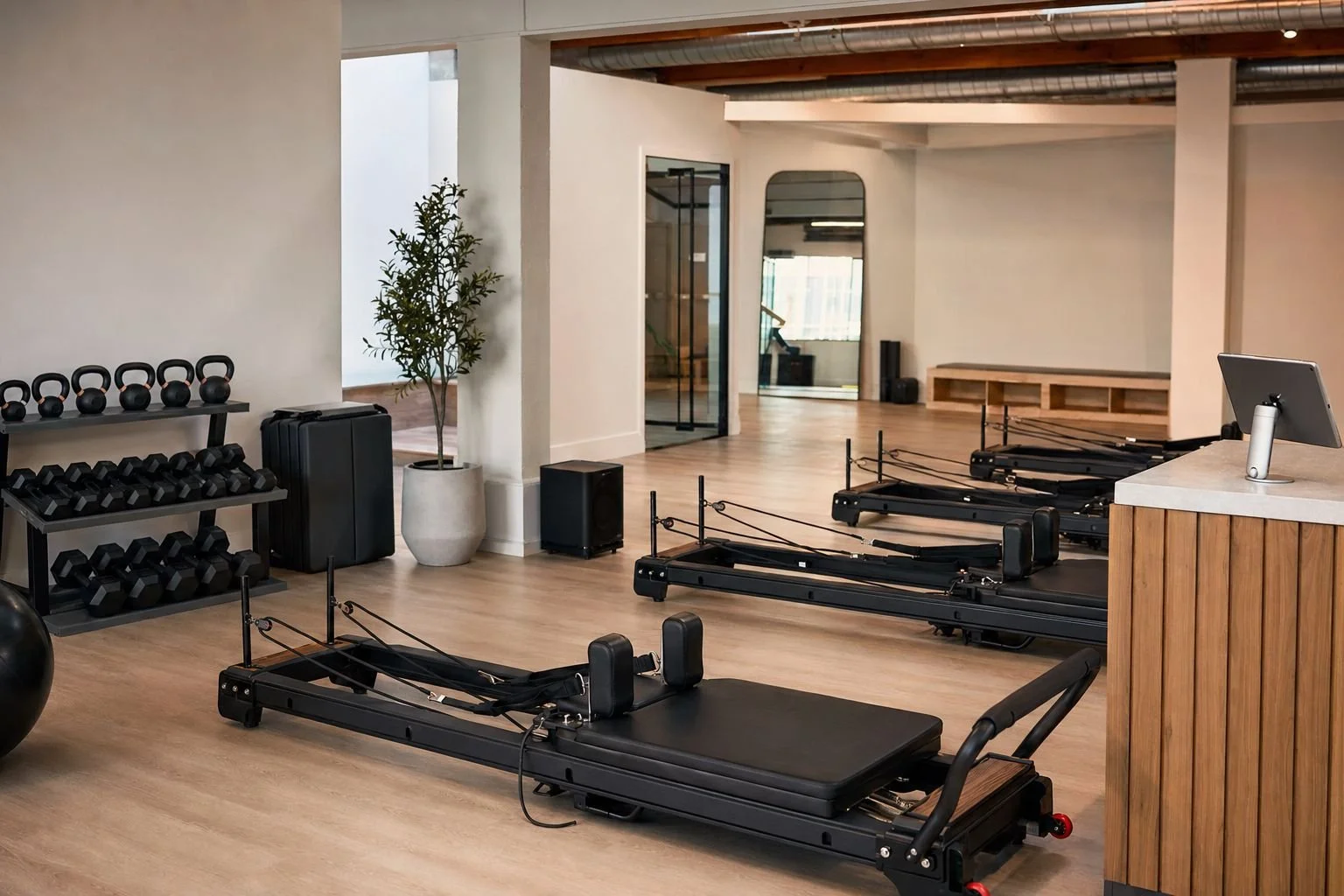
| Path | Typical cost range | Best for |
|---|---|---|
| Startup | $80,000 – $200,000 | Lease + buildout + equipment |
| Acquisition | $150,000 – $350,000 | Existing members + churn history |
| Franchise | $290,000 – $1,400,000 | Brand + class systems + build-out. Examples: Pure Barre at the boutique end, Orangetheory at the large-format end. |
Franchise brands are named as examples, not endorsements. Franchise investment figures reflect a franchisor's most recent Franchise Disclosure Document (FDD) and change annually — verify each brand's current FDD (Item 7 for the initial-investment range; Item 19 for any financial-performance representation) before pursuing one. [S3]
That franchise row is the widest in the fifty, and the width is not a rounding problem — it is two different businesses sharing a column. Boutique studio brands cluster somewhere around $290,000 to $910,000. Orangetheory, a large-format concept with heart-rate technology and a substantial build-out, discloses an estimated initial investment of roughly $822,000 to $1,377,000 in its 2026 FDD, on a franchise fee near $60,000. [S6]
Which is worth stopping on, because it changes what the rest of this article applies to. A studio at the top of that range is not a mid-market studio at all — it is a several-hundred-thousand-dollar real-estate and equipment commitment with a franchise agreement attached, well beyond the $350,000 SBA Community Advantage ceiling and outside what a community lender writes. The deals that fit this framework are the startup and acquisition rows above, and the boutique end of the franchise column. Read Item 7 for the specific format being offered before assuming a category number covers it.
Look closely at the startup and acquisition ranges: they overlap substantially. Roughly the same money either builds an empty room or buys one with members already paying.
In a business whose entire value is the recurring customer list, that comparison should settle the question. The startup path buys a lease, a buildout and equipment. The acquisition path buys those same things plus the membership list and its churn history — which is the only part a lender, or an eventual buyer, is really underwriting.
How people actually fund it

A $150,000–$350,000 acquisition sits in CDFI direct lending and, at the top of the range, SBA Community Advantage territory, which carries up to $350,000. That is above the microloan range, which makes the equity you bring matter a great deal.
It is also the reason the book's trades path spends three years saving on a single income before buying anything. In a category this capital-hungry, that patience is what converts a deal you cannot fund into one you can.
One pattern I watched from the lending chair, across every industry that came through: a qualified buyer walks into a national bank, gets declined, and concludes he cannot be funded. He never learns that a CDFI across town, or a Community Advantage lender, exists precisely for deals this size. Two free national directories will show you the ones near you — the Opportunity Finance Network CDFI locator and SBA Lender Match. [S4]
Finding the lender is the easy half. A studio also has a specific tell an underwriter looks for: active membership count, monthly churn, and average revenue per member, alongside the remaining lease term. A studio with a stable membership and a retention record it can show is far more bankable than one with impressive class attendance and no retention history. Start recording those numbers before anyone asks for them.
The profit reality: owner-replacement cash flow

Here is the calculation that decides more of these deals than anything else in them. A studio looks profitable because the owner is teaching half the classes, covering the front desk, handling the schedule, chasing lapsed members, and keeping the books — none of it priced. The honest test: after you pay your instructors, and after you pay a studio manager a market wage to run the floor the way you run it, is there enough left for you to own the thing?
The answer turns on two numbers, and both sit in the membership file. Rent is fixed and instructor pay scales with the class schedule, so the base has to be large enough to carry a manager's salary on top of both — and churn decides whether that base holds or leaks away underneath you.
A studio with several hundred members and low churn covers the manager comfortably. A studio with a thin customer list and high churn is one where the owner's unpaid hours are the only thing closing the gap. Same equipment, same format, very different ability to replace the owner.
The category-level math is easy — you just did it. Running it on a specific studio, where the seller's "profit" hides his own unpriced teaching and desk hours, and the real question is what the churn rate has actually been across twenty-four months, is where people freeze. That is the job of the course, Microbusiness Millionaire: Operating System — the four tests turned into a repeatable screen you run on a real deal.
The benefits of owning a fitness studio
Monthly membership revenue. Billed whether the member attends — the truest recurring line here.
A base that compounds. Each retained member adds revenue without proportional cost.
A growing occupation. BLS projects 12% instructor growth through 2034, four times the average.
A sellable asset. A customer list with a retention history behind it is something buyers know how to value.
Committed customers. Boutique members tend to be loyal rather than casual, steadying the base.
What separates the strong operators from the struggling ones
Buying before building. Similar money buys an empty room or one with members already paying. In a membership business the second is a different asset entirely, and it is the one a lender can underwrite.
The market settled before the lease. Demographics have to support the price point — income, density and the age profile that fills your format. That is what the tag is telling you, and it is the one decision programming cannot revisit.
Churn measured from month one. It is the number that runs this business and the first one a lender or a buyer asks for. Track it before you need it and you will always be able to answer.
The owner off the teaching schedule. A studio where you teach most of the classes is a job you own. Getting yourself off the timetable is what turns it into something you can sell.
Licenses, permits, and regulations
Studio requirements are mostly about the space and the contracts, and they are worth confirming rather than assuming. Expect a general business license and sales-tax registration, plus zoning approval and a certificate of occupancy for the space — build-outs commonly trigger permits, ADA accessibility obligations, and occupancy-load and fire-code review. Many states regulate health club membership contracts specifically, with rules on cancellation rights, prepaid terms, and sometimes a bond or registration requirement, so check yours before you write a membership agreement. Instructors are typically expected to hold current certification and CPR, and worker classification deserves attention if you plan to treat instructors as contractors. Carry general liability and, where applicable, workers' compensation, and use participant waivers. Start with your city or county and the free SBA "Apply for licenses and permits" tool. [S5] (General information, not legal advice — confirm your local zoning and building requirements and your state's health club contract rules before you sell memberships.)
Build a portfolio, not a job

A studio is a facility, and it stacks the way facilities do: by adding services that run inside the same walls, to people already walking through the door. That is a real advantage here, because the members are in the building three times a week already.
Personal training is the natural first addition, sold at a premium to people who already trust your instructors. Nutrition services attach to the same goal the member joined for. Recovery services — stretch, compression, soft-tissue work — fill the hours between classes and use square footage you are already paying rent on. Every one of them is sold to an existing member rather than a stranger, which is the cheapest way to win a customer in any business.
Worth naming what does not belong here: mobile and in-home personal training is a strong business on the same list, but it is a route — a trainer travelling between houses, where density is the asset. Running a studio and a mobile operation at once means running two unrelated businesses, one paying rent and one burning drive time. Stack inside the walls you already have.
That is the difference between owning a room and owning a portfolio. You are not building a class schedule. You are building the wellness relationship a few hundred members keep on monthly autopay, anchored by a line that arrives whether they show up or not. A portfolio like that, with a documented customer list and low churn, sells to a buyer as one asset — which is how it ends up worth over a million dollars at sale, instead of a lease and a rack of equipment.
Frequently asked questions
Is a fitness studio profitable? It can be, because membership revenue is billed monthly regardless of attendance. The honest test is whether the base is large enough and the churn low enough that a studio manager's market wage is covered with real cash flow left for the owner — which is why buying an existing membership list matters so much in this category.
How much does it cost to start a fitness studio? Roughly $80,000–$200,000 for a lease, buildout, and equipment — the top of the framework's cost range. About $150,000 to $350,000 to acquire a studio with its members already in place. Franchising runs far higher and far wider than most people expect — roughly $290,000 to $1.4 million depending on the format. [S6] It buys brand and class systems.
Should I buy an existing studio or open a new one? The ranges overlap, so similar money buys an empty room or one with members already paying. In a membership business the customer list and its churn history are the asset, which is why acquisition is generally the stronger path here.
What is the most important number in a fitness studio? Churn. Membership revenue recurs by design, so the business is decided by how much of the base you keep each month — and it's the first figure a lender or an eventual buyer will ask for.
Where to go from here
Download the free guide.50 Boring Businesses That Make Millionaires is the full result of the research: fifty categories run against the four tests, what each one costs to enter by all three paths, what has to line up for it to work, and how they pair into a portfolio. Free at microbusinessmillionaire.com.
Read the book.The Microbusiness Millionaire: How Ordinary People Build Extraordinary Wealth One Microbusiness at a Time follows four people who each reached a portfolio worth more than a million dollars by a different path. One keeps a hospital job and uses CDFI financing to acquire one stable service business, then another, then a third. One saves on a single income for three years, leaves a master plumber's wage, and stacks trade service lines starting with an SBA microloan. One uses an SBA Community Advantage loan to open a franchise, then opens three more. One starts with about $5,000 on the side and keeps a W-2 for years, building the slowest and most patient version of the same result. Four starting points, four amounts of money, four portfolios worth over a million dollars at sale. The book is coming soon — join the email list at microbusinessmillionaire.com to hear when it lands.
Join the next cohort — Microbusiness Millionaire: Operating System. The book gives you clear examples of how it's done. The course is the step-by-step system for doing it yourself: screening a real company against the four tests, running the owner-replacement cash-flow math on a seller's actual numbers, knowing when to walk, knowing which lenders fund deals this size, and installing the operator who runs the business without you. Eight weeks online, five seats a cohort, waitlist first — at microbusinessmillionaire.com.
About the author
Chris Scott has spent more than twenty-five years in the small-business arena. As the director of a Community Development Financial Institution (CDFI) and as management at the U.S. Small Business Administration (SBA), he saw thousands of business plans and loan applications cross his desk. His research into which microbusinesses build wealth — and which quietly build a job — became The Microbusiness Millionaire and the free companion guide, 50 Boring Businesses That Make Millionaires.
Sources & references
[S1] IBISWorld, Gym, Health & Fitness Clubs in the US — market size $47.0bn in 2026, ~3.6% CAGR, approximately 114,370 facilities; and Pilates & Yoga Studios in the US — $19.2bn in 2025 after an ~11.1% five-year CAGR, including a 2.0% dip in 2025 amid higher rents and wages. ibisworld.com
[S2] U.S. Bureau of Labor Statistics, Occupational Outlook Handbook / Occupational Employment and Wage Statistics, Fitness Trainers and Instructors (SOC 39-9031) — employment projected to grow 12% from 2024 to 2034 against a 3% average for all occupations, with about 74,200 openings per year. bls.gov/ooh
[S3] U.S. Federal Trade Commission, Franchise Rule / FDD Items 7 and 19. ftc.gov
[S4] Opportunity Finance Network CDFI Locator (ofn.org); SBA Lender Match (sba.gov).
[S5] U.S. Small Business Administration, Apply for licenses and permits (sba.gov); local zoning, building permit, certificate of occupancy and ADA accessibility requirements; state health club membership contract statutes; worker-classification considerations for instructors.
[S6] Boutique and large-format fitness franchise disclosure data as reported by franchise-filing aggregators and 2026 FDD analyses: boutique studio brands clustering roughly $289,000–$910,000 in estimated initial investment; Orangetheory Fitness disclosing approximately $821,622–$1,377,160 on an initial franchise fee of $59,950. Reported figures vary between aggregators and filing years; verify the current FDD directly for any brand.
[Internal]50 Boring Businesses That Make Millionaires — Mid-Market Studio Fitness entry (tag, three-path entry-cost table, portfolio pairings, framework note, "what it takes to make this one work"), drawn from the author's research and filtered through the underwriting criteria he applied as a CDFI lender.
This article is for general information only and is not legal, financial, tax, or investment advice. Category-level figures are reference points, not a specific-deal projection; individual businesses vary. Consult a CPA, attorney, business broker, franchise consultant, or CDFI loan officer before acting.
Last updated: 8/20/2026.