

How to Start a Handyman Business
A truck, a set of tools and about $2,000 puts this near the bottom of the entry ladder in the fifty, and the work starts producing cash quickly. Here is what a handyman business costs, what it pays after you replace yourself, and why the order you do things in matters more here than in any other category on the list.
Chris Scott — former CDFI director and SBA management
As the director of a Community Development Financial Institution (CDFI), and as management at the U.S. Small Business Administration (SBA), I saw thousands of business plans and loan applications cross my desk. That work is where I learned what a durable business looks like on paper, and what a business that only looks durable looks like on paper.
It is not, however, where the list of fifty came from. That came from years of research, running category after category through the same four questions: Is it profitable? Does it have recurring revenue? Is it recession resistant? Is it AI resistant? Those four questions are the framework behind the book, The Microbusiness Millionaire, and they are what separated the categories that built real wealth from the ones that quietly built a job with a P&L attached. Fifty survived the screen. Far more never made it through.
Handyman services is one of the fifty, and it is the one where the order you do things in matters more than anything else. Almost nobody plans that sequence in advance, and the sequence is the whole game.
The industry: enormous, aging, and impossible to consolidate
U.S. handyman services are about $365.4 billion in 2026, spread across roughly 529,000 businesses, having grown at a 1.1% compound rate over the past five years. [S1]
Do the arithmetic on those two numbers and the average operator turns out to be very small: under three employees per business. [S1] This is a market made almost entirely of one- and two-person shops, and it stays that way for a structural reason worth understanding before you enter.
The labor benchmark comes from the broad installation, maintenance and repair group, which pays above the median for all occupations. How far above depends on where you are standing, so plan against the figure for your own market. Demand is not the constraint: the group is projected to grow faster than average, with about 608,100 openings a year across it. [S2] That wage is the price of replacing yourself — what a supervisor would have to be paid to do the work you would otherwise be doing. Every profit number later in this article has to survive it, and the real cost runs higher once payroll taxes and insurance go on top.
Demand under this category is not in question. The American housing stock is old and getting older, and someone has to keep it standing.
Why handyman services made the list
Every category in the research had to clear four tests. Clear three and you usually have a self-employed job in disguise.
Does it pay after you replace yourself? It does, with a sequence attached — which is what this category's one tag is about, and the thing worth the most attention below.
Does the revenue recur? Not as a subscription, but as a relationship, and that is nearly as good. The household that trusts you to mount a television calls you for the leaking faucet, the sticking door and the fence next spring. A good handyman does not win a customer. He becomes a number that keeps getting dialed.
Does it survive a recession? As well as almost anything among the fifty. The leak, the broken step, the door that will not lock — none of those wait for conditions to improve. And when money is tight people repair instead of replace, which puts them on your side of the ledger.
Will it still need humans in ten years? A person has to be in the house, with hands and tools, solving something physical that is different in every home. Software can book the visit. It cannot find the stud. Low AI exposure.
Four for four, on a $2,000 entry.
The research on this category kept arriving at the same piece of arithmetic, and it is the one most operators never do before they scale. A solo handyman turning over something like $180,000 keeps a striking share of it, because the labor line is zero — he is the labor, unpaid. Work out what the same person earns running three trucks and three crews and the answer is often close to the same number, for two reasons that compound. He stops swinging a hammer and starts managing, so his own most profitable hours disappear. And there is no license in this trade protecting his prices, so he cannot simply charge more to cover the overhead the crews bring with them. From the lending side of the desk, an applicant who has done that calculation before asking for money is a different borrower from one who has not. The good version of this conversation happens before anyone borrows a dime.
What it takes to make this one work
A note on the tags. Every category in the fifty cleared the same four tests; far more never made it through. The tags do not grade a business — they tell you what has to line up for it to work in your hands. Handyman services carries one: Solo first. That is the operating manual.
The condition: cash flow is richest when it is just you, and it settles toward the industry average the moment you are paying crews. That shift is sharper here than in the licensed trades, for one specific reason: no license is protecting your pricing.
A master plumber's credential is a wall competitors have to climb. A handyman's skill is not gated the same way, so when you add crews and overhead you cannot simply raise prices to cover them — the operator working out of his own truck will always be cheaper than your third crew.
The move that meets it: treat it as a sequence rather than a ceiling. Stay solo longer than feels natural. Bank the difference while your only real costs are fuel and your own time. Then hire only when call volume genuinely outruns you — not when you are ambitious, not when a competitor scales, but when you are turning away good work every week. Taken in that order, the crew is funded by demand you have already proven rather than demand you are hoping for.
The upside: taken in that order, few categories among the fifty start producing cash faster or ask less to begin — a truck, a set of tools and a phone that rings. You can be profitable in the first month, learn on your own money with no lender in the room, and decide from a position of cash and knowledge whether you even want to scale. Plenty of the strongest operators in this category never hired anyone and cleared a very comfortable living. Solo first is not a limitation here. It is the entire approach.
What it costs to get in — the three paths
| Path | Typical cost range | Best for |
|---|---|---|
| Startup | $2,000 – $5,000 | Truck + tools + insurance |
| Acquisition | $80,000 – $150,000 | Customer list + tools |
| Franchise | $95,000 – $230,000 | Brand + dispatch + leads + territory. Examples: Mr. Handyman, Ace Handyman Services. |
Franchise brands are named as examples, not endorsements, and the range shown is a category estimate rather than any single brand's published figure. Franchise examples: Mr. Handyman, Ace Handyman. Franchise investment figures reflect a franchisor's most recent Franchise Disclosure Document (FDD) and change annually — verify each brand's current FDD (Item 7 for the initial-investment range; Item 19 for any financial-performance representation) before pursuing one. [S3]
The franchise column here is crowded and the brands sit closer together than in most categories, which makes the comparison unusually honest. Recent filings put Mr. Handyman in the region of $143,000 to $215,000, Ace Handyman Services around $97,000 to $224,000, Handyman Connection near $111,000 to $231,000, and House Doctors nearer $96,000 to $145,000. [S6]
Set those against the first row and the trade-off in this category is starker than in almost any other on the list: $2,000 to start on your own, or something over $100,000 to start with a brand and a phone that already rings. That is a genuine choice rather than a formality, and it is worth being clear about what the money buys. The franchise is not selling you the skill — none of these brands trains you in the trade. It is selling lead flow, which in a category where the customer finds you by searching is the thing that takes longest to build alone.
That $2,000 startup figure is the honest headline, and it puts this near the bottom of the entry ladder in the fifty. What it tells you is that the barrier here is not money. It is the discipline to run the sequence. Almost anyone can afford to start; the operators who build something worth selling are the ones who wait to scale until the numbers earn it.
How people actually fund it

Mostly, at the start, they do not — and that is the point. A $2,000–$5,000 startup funded from savings is the first rung in the book, The Microbusiness Millionaire: the tier where the side-hustle path keeps a W-2 in place and builds on weekends, because the entry price allows it.
Where a lender does enter is the $80,000–$150,000 acquisition of an established business — a retiring operator with a good customer list and a truck full of tools. That sits in SBA Microloan and CDFI direct lending territory.
One pattern I watched from the lending chair, across every industry that came through: a qualified buyer walks into a national bank, gets declined, and concludes he cannot be funded. He never learns that a CDFI across town, or a Community Advantage lender, exists precisely for deals this size. Two free national directories will show you the ones near you — the Opportunity Finance Network CDFI locator and SBA Lender Match. [S4]
Finding the lender is the easy half. A handyman business also has a specific tell an underwriter looks for: what share of revenue comes from repeat customers rather than one-off jobs. A customer list of loyal repeat clients is an asset; a string of one-time jobs is a busy month. Start recording that repeat rate before anyone asks for it.
The profit reality: owner-replacement cash flow

Here is the calculation that decides more of these deals than anything else in them. A handyman business looks profitable because the owner is doing the jobs, quoting the work, scheduling, and running the books — none of it priced. The honest test: after you pay any help, and after you pay someone a market wage to do the jobs you'd otherwise do yourself, is there enough left for you to own the thing?
Real numbers. A skilled repair worker in the broad maintenance group commands a real wage, and what that wage is depends on your metro rather than the national average. Pull the number for your area before you model anything. [S2] Whatever the business reports as profit has to survive paying it.
This is exactly where the Solo-first tag stops being a label and becomes arithmetic. A solo handyman's profit looks spectacular because the labor line is zero — he is the labor, unpaid. The day he hires, that line appears, and because no license lets him raise prices to cover it, the profit does not so much shrink as get measured honestly for the first time.
Operators who plan for that build real companies deliberately. Operators surprised by it buy a second truck and spend two years wondering where the money went.
The category-level math is easy — you just did it. Running it on a specific business, where the seller's "profit" is mostly his own unpriced labor and the repeat-customer share is buried in the job history, is where people freeze. That is the job of the course, Microbusiness Millionaire: Operating System — the four tests turned into a repeatable screen you run on a real deal.
The benefits of owning a handyman business
A very small entry for a trade. A truck, tools and a phone.
Cash flow that starts early. Profitable in the first month is realistic.
A customer who keeps calling. Not a subscription, but a relationship that pays for years.
Recession-resistant demand. Repairs get more common, not less, when money is tight.
It anchors the home-services portfolio. Painting, garage door, and gutters bolt onto trust you have built.
What separates the strong operators from the struggling ones
Demand before headcount. The defining decision in this category. Hire when you are turning away good work every week, and the crew is funded by proven demand rather than optimism.
Priced by the job, not the hour. Quote the outcome. Hourly billing charges the customer less as you get faster and better, which is precisely backwards.
Insurance in place from the first job. This is work inside people's homes with power tools. General liability costs a few hundred dollars and it is what keeps one incident from ending the business.
A tight radius before a wide one. Windshield time is unpaid time. A dense circle of repeat customers earns more than a scattered map of one-off jobs across the metro.
The trades line known exactly. Know where handyman work ends and a licensed electrician or plumber begins. Staying on the right side of it protects both the business and your reputation.
Licenses, permits, and regulations
Handyman licensing is genuinely local and worth confirming rather than assuming: many states require no license for general repair work under a certain dollar threshold per job, some require a handyman or home-improvement registration, and a few require a contractor's license above a set project value. The bright line that matters everywhere is the trades — electrical, plumbing, HVAC, and gas work are reserved for licensed professionals almost universally. Beyond that: a registered entity, general liability at the limits your work demands, commercial auto, and workers' comp once you hire. Start with your state and municipal offices and the free SBA "Apply for licenses and permits" tool. [S5] (General information, not legal advice — confirm your local requirements before you take paid work.)
Build a portfolio, not a job
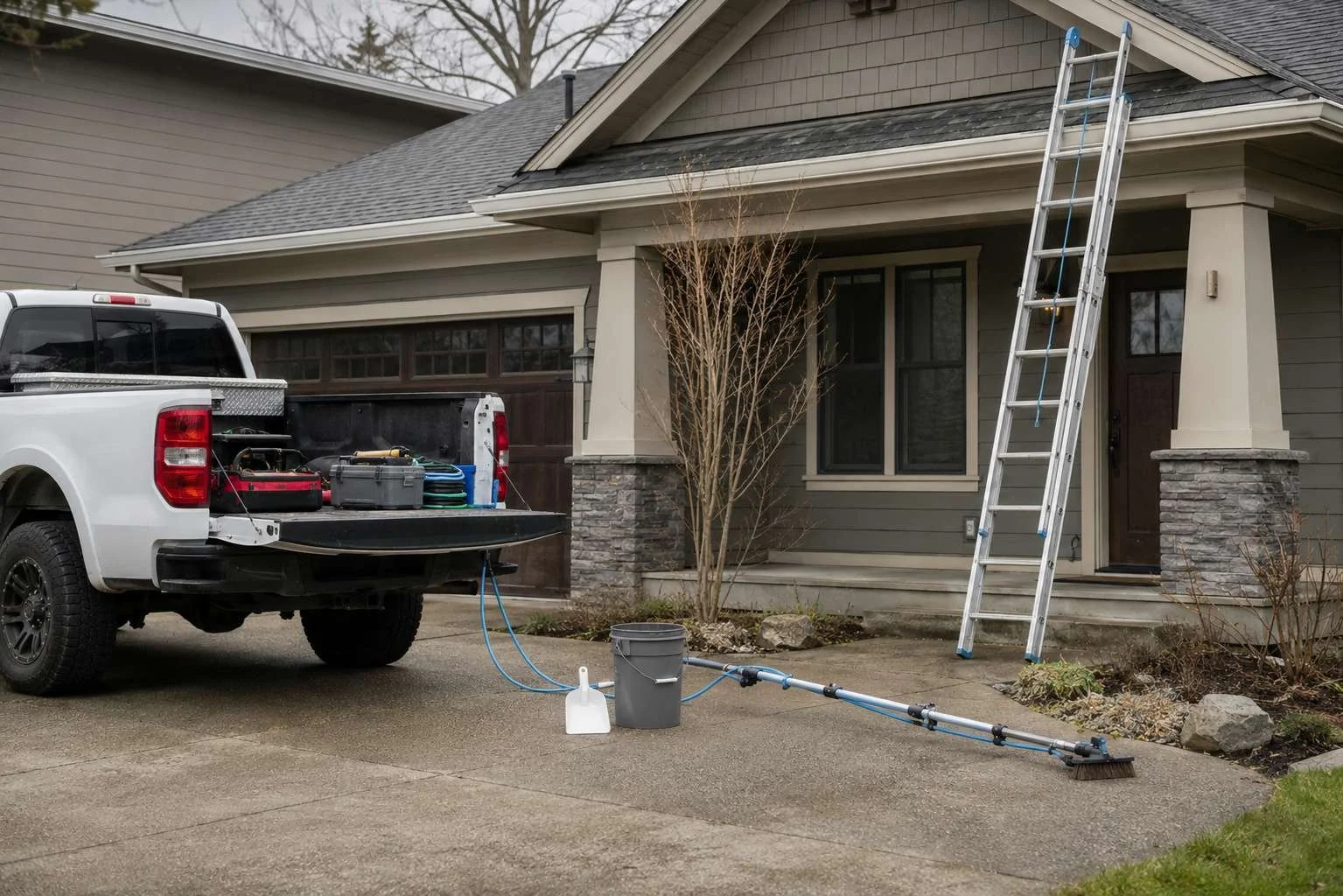
Handyman work is the anchor of the home-services portfolio, and it may be the easiest anchor among the fifty to build from, because you are already inside the customer's home holding a drill. It is a route business: it stacks along a territory, on households you are already visiting, rather than at a single location.
It pairs naturally with painting, garage door service, appliance repair, and window and gutter cleaning — same customer, same truck, often the same visit. The household that trusts you with the leaking faucet will trust you with the exterior repaint and the autumn gutter clean-out, and every one of those is sold to someone who already knows your name.
That is the difference between owning a job and owning a portfolio. You are not building a handyman round. You are building the home-services vendor a few hundred households call first. A portfolio like that, with a documented customer list and a real repeat rate behind it, sells to a buyer as one asset — which is how it ends up worth over a million dollars at sale, instead of a truck you happen to drive.
Frequently asked questions
Is a handyman business profitable? Yes, but the honest answer is not a percentage. A solo handyman's profit looks enormous because he is not paying for labor; he is the labor. The real test is whether the business still produces cash after paying someone to do the jobs — and run in sequence, solo first and hiring only against proven demand, it clears that test comfortably.
How much does it cost to start a handyman business? Roughly $2,000 to $5,000 for a truck, tools and insurance, with no premises, no inventory and no license fee in most states. About $80,000–$150,000 to buy an established customer list, or $110,000–$160,000 for a franchise.
Do I need a license to be a handyman? It depends heavily on your state and the size of the jobs — many allow general repair work under a dollar threshold with no license, while larger projects may need a home-improvement or contractor registration. The universal rule is that electrical, plumbing, and HVAC work is reserved for licensed trades. Confirm your local requirements first. [S5]
Where to go from here
Download the free guide.50 Boring Businesses That Make Millionaires is the full result of the research: fifty categories run against the four tests, what each one costs to enter by all three paths, what has to line up for it to work, and how they pair into a portfolio. Free at microbusinessmillionaire.com.
Read the book.The Microbusiness Millionaire: How Ordinary People Build Extraordinary Wealth One Microbusiness at a Time follows four people who each reached a portfolio worth more than a million dollars by a different path. One keeps a hospital job and uses CDFI financing to acquire one stable service business, then another, then a third. One saves on a single income for three years, leaves a master plumber's wage, and stacks trade service lines starting with an SBA microloan. One uses an SBA Community Advantage loan to open a franchise, then opens three more. One starts with about $5,000 on the side and keeps a W-2 for years, building the slowest and most patient version of the same result. Four starting points, four amounts of money, four portfolios worth over a million dollars at sale. The book is coming soon — join the email list at microbusinessmillionaire.com to hear when it lands.
Join the next cohort — Microbusiness Millionaire: Operating System. The book gives you clear examples of how it's done. The course is the step-by-step system for doing it yourself: screening a real company against the four tests, running the owner-replacement cash-flow math on a seller's actual numbers, knowing when to walk, knowing which lenders fund deals this size, and installing the operator who runs the business without you. Eight weeks online, five seats a cohort, waitlist first — at microbusinessmillionaire.com.
About the author
Chris Scott has spent more than twenty-five years in the small-business arena. As the director of a Community Development Financial Institution (CDFI) and as management at the U.S. Small Business Administration (SBA), he saw thousands of business plans and loan applications cross his desk. His research into which microbusinesses build wealth — and which quietly build a job — became The Microbusiness Millionaire and the free companion guide, 50 Boring Businesses That Make Millionaires.
Sources & references
[S1] IBISWorld, Handyman Services in the US (NAICS OD4069), 2026 — market size $365.4bn; ~528,900 businesses; 1.1% CAGR 2021–2026; average business under 3 employees. ibisworld.com
[S2] U.S. Bureau of Labor Statistics, Occupational Outlook Handbook: Installation, Maintenance, and Repair Occupations (~608,100 annual openings across the group; group projected to grow faster than average 2024–34). bls.gov/ooh
[S3] U.S. Federal Trade Commission, Franchise Rule / FDD Items 7 and 19. ftc.gov
[S4] Opportunity Finance Network CDFI Locator (ofn.org); SBA Lender Match (sba.gov).
[S5] U.S. Small Business Administration, Apply for licenses and permits (sba.gov); state and municipal home-improvement/contractor licensing.
[S6] Handyman franchise disclosure data as reported by franchise-filing aggregators and 2026 industry analyses of current FDDs: Mr. Handyman approximately $143,150–$215,000 on an initial fee near $65,000, with some readings at $113,000–$160,000; Ace Handyman Services approximately $97,000–$224,000; Handyman Connection approximately $110,722–$231,114; House Doctors approximately $96,350–$145,000. Reported figures vary between aggregators and filing years; verify the current FDD directly for any brand.
[Internal]50 Boring Businesses That Make Millionaires — Handyman Services entry (tag, three-path entry-cost table, portfolio pairings, framework note, "what it takes to make this one work"), drawn from the author's research and filtered through the underwriting criteria he applied as a CDFI lender.
This article is for general information only and is not legal, financial, tax, or investment advice. Category-level figures are reference points, not a specific-deal projection; individual businesses vary. Consult a CPA, attorney, business broker, franchise consultant, or CDFI loan officer before acting.
Last updated: 8/20/2026.