

How to Start a Fire Protection Business
Every commercial building in America is required by code to have its fire equipment inspected every year, and almost nobody has heard of the business that does it. Here is what a fire protection inspection business costs, what it pays after you replace yourself, and why the customer list is worth more than everything else you would buy.
Chris Scott — former CDFI director and SBA management

As the director of a Community Development Financial Institution (CDFI), and as management at the U.S. Small Business Administration (SBA), I saw thousands of business plans and loan applications cross my desk. That work is where I learned what a durable business looks like on paper, and what a business that only looks durable looks like on paper.
It is not, however, where the list of fifty came from. That came from years of research, running category after category through the same four questions: Is it profitable? Does it have recurring revenue? Is it recession resistant? Is it AI resistant? Those four questions are the framework behind the book, The Microbusiness Millionaire, and they are what separated the categories that built real wealth from the ones that quietly built a job with a P&L attached. Fifty survived the screen. Far more never made it through.
Fire protection inspection is one of the fifty, and of all of them it is the one nobody sees coming. Ask a room of would-be owners to name a recurring business-to-business service and not one of them says fire extinguishers.
Which is precisely the point. The work is invisible, unglamorous, mandated by law, and it renews every twelve months whether anyone thought about it or not — and that combination is exactly why it is still available to buy at a sensible price, while the businesses with a better story get bid up by people chasing the story.
A word on the neighbor.Commercial kitchen hood cleaning is also one of the fifty, and the two are easy to run together and easy to confuse. They serve the same restaurant kitchens on the same code-driven schedules, and a single kitchen carries both a suppression system and an exhaust hood. The difference is what the customer is buying. Fire protection is paid to sign the tag. Hood cleaning is paid to remove the grease. One is a licensed inspection where the deliverable is a certification an inspector will accept; the other is physical work where the deliverable is a clean duct. They pair beautifully — the last section explains how — but the license, the insurance and the crew are different in each, and the operator who assumes one qualifies him for the other finds out at the wrong moment.
The industry: mandated, fragmented, and quietly consolidating
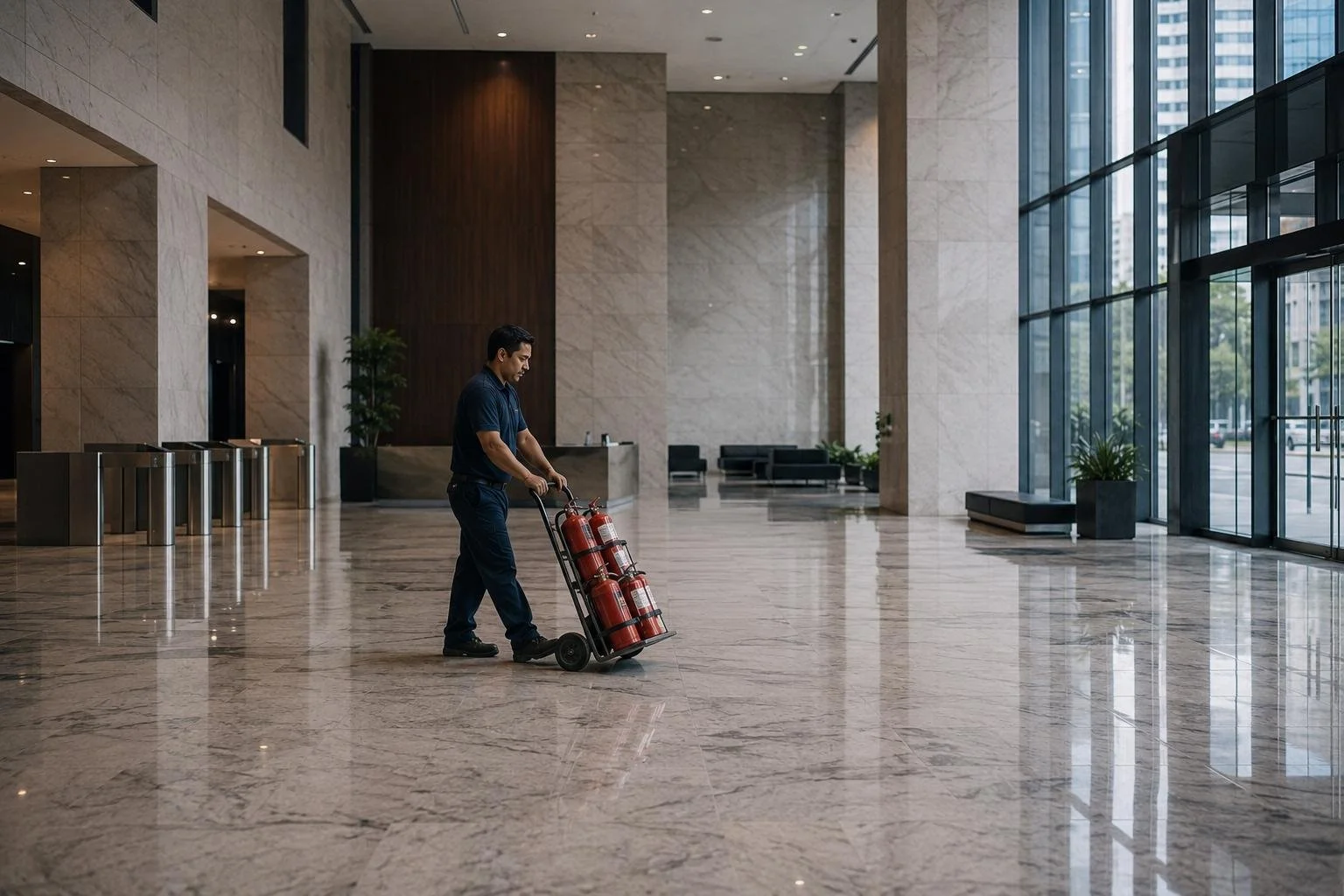
Fire protection and security system contractors are about $22.1 billion in 2026, spread across roughly 19,800 businesses, having grown at about a 3.2% compound rate over the past five years — and no single firm holds even 5% of the market. [S1]
That last clause is the whole opportunity, and it is worth sitting with. A $22 billion market, code-mandated demand, and not one company has managed to take a twentieth of it. What that describes is thousands of small operators holding local customer lists, a great many of them owned by someone who has been doing the work for thirty years and has nobody to hand it to.
There is no dedicated federal occupation for extinguisher and inspection technicians, so the closest labor benchmark is security and fire alarm systems installers. [S2] What that occupation pays is the price of replacing yourself — what you would owe a supervisor to run the inspections you are running now. It is a local number. The same installer costs very different money in different metros, so look up the figure for your own market. Every profit number later in this article has to survive it, and the real cost runs higher once payroll taxes and insurance go on top.
What that benchmark understates is the structure. This is a trained-technician business rather than a licensed-trade business, which means you are not waiting years on an apprenticeship to hire your second person — and that difference is what makes replacing yourself realistic here.
Why fire protection made the list
Every category in the research had to clear four tests. Clear three and you usually have a self-employed job in disguise.
Does it pay after you replace yourself? It does, and this category earns it in an unusually clean way. The work is route-based: a technician drives a planned list of buildings, performs a defined task at each, and drives to the next. Route businesses replace their owners more easily than trades do, because the work is standardized and the schedule is set by a code cycle rather than by emergencies.
Does the revenue recur? Better than almost anything among the fifty, and not because you sold well. NFPA 10 requires monthly visual checks and annual maintenance on every portable fire extinguisher in the country. NFPA 96 governs the suppression systems in every commercial kitchen. [S3] Your customer is not renewing because they like you. They are renewing because the fire marshal will be back.
Does it survive a recession? Compliance does not have a business cycle. A restaurant cutting every discretionary dollar still gets its suppression system serviced, because the alternative is not opening the doors.
Will it still need humans in ten years? Someone has to put hands on every extinguisher in the building, check the gauge, weigh the cylinder and sign the tag. Software can route the truck. It cannot walk the corridor. Very low AI exposure.
Four for four — compliance-driven, recurring, B2B, physical, and route-based, which is about as clean a sweep as the framework produces.
The research on this category kept turning up the same disconnect between how these businesses are described and how they perform. Operators servicing extinguishers for two and three decades tend to open by apologizing for the business — it is not, they will tell you, a very impressive thing to own. Then the numbers arrive: customer lists where the average account has been in place for a decade and annual attrition runs in the low single digits. From the lending side of the desk that is a striking thing to read, because a customer who renews on a code cycle rather than a purchasing decision is the closest a small business gets to contracted revenue. The operators think they are boring. What they are holding is the thing every buyer is looking for and almost nobody can produce: revenue that arrives whether anyone sells or not.
What it takes to make this one work
A note on the tags. Every category in the fifty cleared the same four tests; far more never made it through. The tags do not grade a business — they tell you what has to line up for it to work in your hands. Fire protection carries the Works anywhere tag, one of only nine categories on the list with no structural condition at all: no season to cover, no partner category needed to fill half the calendar, and no geography that makes or breaks it. Every commercial building in every market is on the same code cycle.
What does matter is inside your control: the state license, the technician certifications that let you sign a tag, and the density of the customer list you build or buy. Get those right and the category asks nothing else of you.
What it costs to get in — the three paths
| Path | Typical cost range | Best for |
|---|---|---|
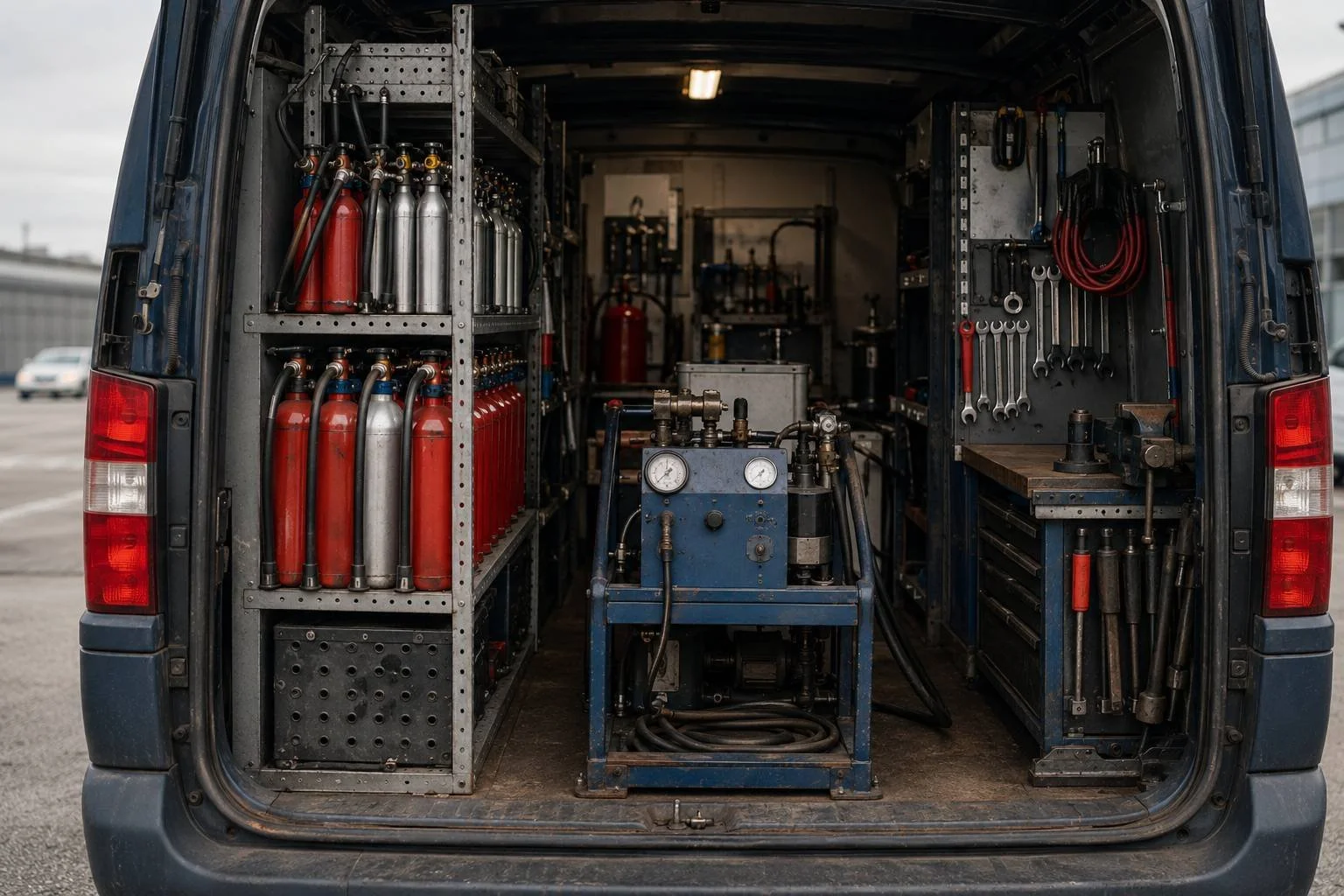
| Startup (inspection only) | $32,000 – $55,000 | State license + truck + tools + insurance + initial inventory |
| Acquisition | $100,000 – $300,000 | Existing service contracts + customer list + equipment |
| Franchise | $50,000 – $150,000 | Brand + technical training + lead generation. Examples: FireMaster, Fire Safety Division. |
Franchise brands are named as examples, not endorsements, and the range shown is a category estimate rather than any single brand's published figure. Franchise investment figures reflect a franchisor's most recent Franchise Disclosure Document (FDD) and change annually — verify each brand's current FDD (Item 7 for the initial-investment range; Item 19 for any financial-performance representation) before pursuing one. [S4]
Two things make the franchise path in this category different from most, and both are worth knowing before you enquire. Neither of the brands above publishes an Item 7 range you can look up, unlike almost every franchise in the other categories on the list — so ask for the FDD early rather than expecting to compare numbers from a website. [S6]
And the FireMaster model is unusual in a way that bears directly on the section above. A franchise there is granted for one or more specific service categories inside a zip-code territory — portable extinguishers, kitchen system service, kitchen exhaust cleaning, emergency lighting — rather than for the whole trade. Which is the neighbor distinction showing up in a contract: even the franchisor treats fire protection and hood cleaning as separate things you buy separately. Establish which categories your agreement actually covers before you sign it.
Look hard at the acquisition row, because in this category it buys something the other two paths cannot manufacture. A startup buys you a truck and a license. An acquisition buys you the customer list, and the customer list is the entire asset.
Pricing runs roughly $8–$15 per extinguisher inspected plus a service-call minimum, which sounds like nothing until you multiply it by every extinguisher in four hundred buildings, every year, indefinitely.
How people actually fund it

A $32,000–$55,000 startup sits squarely in the SBA Microloan tier — the rung the book's trades path starts on. A $100,000–$300,000 acquisition of an established customer list moves you up to CDFI direct lending or an SBA Community Advantage loan.
One pattern I watched from the lending chair, across every industry that came through: a qualified buyer walks into a national bank, gets declined, and concludes he cannot be funded. He never learns that a CDFI across town, or a Community Advantage lender, exists precisely for deals this size. Two free national directories will show you the ones near you — the Opportunity Finance Network CDFI locator and SBA Lender Match. [S5]
Finding the lender is the easy half. This category also has a specific advantage most do not, and it sits in the customer list: account count, average tenure, annual attrition, and revenue per account. An underwriter reading a decade of average tenure against low single-digit attrition is reading something that behaves like an annuity. Most buyers never think to present it that way. Start recording those four numbers before anyone asks for them.
The profit reality: owner-replacement cash flow

Here is the calculation that decides more of these deals than anything else in them.
A fire protection company looks profitable because the owner is running the route, quoting the recharges, handling the fire marshal's questions, and doing the books — none of it priced. The honest test: after you pay the technicians, and after you pay a service manager a market wage to run the route the way you run it, is there enough left for you to own the thing?
Real numbers. Price a technician at whatever the closest comparable occupation pays where you operate, which will not be the national average. [S2] Whatever the company reports as profit has to survive paying that, plus the manager above it.
If the profit only exists because you are the one in the corridor with the gauge, it was never profit. It was a job with a route attached, and you find that out the day you try to add a second truck.
The encouraging part is that this category replaces its owner more cleanly than most among the fifty. The work is defined by code, the schedule is set by a calendar, and the customer is not calling at two in the morning with an emergency. That is the structural reason a route business of this kind sells well: a buyer can picture themselves not doing the work.
The category-level math is easy — you just did it. Running it on a specific company, where the seller's "profit" includes his own route hours and the attrition rate is buried in decades of handwritten tags, is where people freeze. That is the job of the course, Microbusiness Millionaire: Operating System — the four tests turned into a repeatable screen you run on a real deal.
The benefits of owning a fire protection business
Demand written into law. NFPA 10 and NFPA 96 do not care about your marketing. [S3]
A customer list that behaves like an annuity. Recurring by code rather than by relationship.
A fragmented market with no giant in it. Nobody holds even 5% of $22 billion. [S1]
It replaces its owner cleanly. Standardized work on a set schedule is what makes a business sellable.
A commercial-compliance anchor. It opens the door to every other code-mandated service the same building needs.
What separates the strong operators from the struggling ones
The tags audited before the deal closes. Account count is the easiest number to inflate. Ask for tenure and attrition by account and spot-check the service records against the buildings — the answer is the price.
Both lines priced on purpose. The inspection gets you in the door and the service work is where the money is. Price each deliberately rather than treating one as the cost of winning the other.
Certifications kept current. Your ability to sign a tag is the business. Diary the renewal dates the way you diary the route, and the route never stops.
Concentration watched. A single hospital or school district feels like the win of the year until it is thirty percent of revenue and goes to bid. Grow the base underneath it.
Density before headcount. Four hundred extinguishers in one office park is a far better business than four hundred spread across a county. Windshield time is the silent cost, and tightening the map is the cheapest cash flow you will ever find.
Licenses, permits, and regulations
Fire protection is licensed at the state and sometimes municipal level, and requirements vary considerably — some states license extinguisher servicing companies and individual technicians separately, some fold it into a fire-equipment or fire-protection contractor license, and hydrostatic testing carries its own requirements. Beyond that: a registered entity, general liability, commercial auto, workers' comp, and manufacturer training for the suppression systems you intend to service. The governing standards are NFPA 10 (portable fire extinguishers) and NFPA 96 (commercial cooking ventilation and suppression). [S3] Start with your state fire marshal's office and the free SBA "Apply for licenses and permits" tool. [S6] (General information, not legal advice — confirm your local requirements.)
Build a portfolio, not a job

This is the anchor of the commercial-compliance portfolio, and it has the tightest pairing logic among the fifty. Fire protection is a route business — it stacks along a territory, on buildings you are already driving to — and the services that belong with it are the ones performed in the same buildings on the same visit cycle.
It pairs first with commercial kitchen hood cleaning: same customer, same building, same regulator, same code. From there it extends into commercial cleaning, electrical, security cameras, and emergency lighting, all of it sold to a facilities manager who already has your number and already trusts you to keep the fire marshal satisfied.
That is the difference between owning a route and owning a portfolio. You are not building an extinguisher company. You are building the compliance vendor for every commercial kitchen in your county. A portfolio like that, with a documented customer list renewing on a code cycle, sells to a buyer as one asset — which is how it ends up worth over a million dollars at sale, instead of a truck you happen to drive.
Frequently asked questions
Is a fire protection business profitable? At scale, yes, measured honestly — after paying the technicians and a service manager to replace the owner's labor. The structural advantage is that the revenue recurs by code rather than by relationship, which is what makes the cash flow predictable enough to lend against.
How much does it cost to start a fire protection business? Roughly $32,000–$55,000 for an inspection-only startup with a license, truck, tools, insurance and initial inventory; $100,000–$300,000 to buy an existing customer list; or $50,000–$150,000 for a franchise.
Do I need to be a firefighter to own a fire protection business? No. This is a trained-and-certified technician business rather than a firefighting one. State licensing for extinguisher servicing is real and varies considerably, and it is the first thing to confirm. [S6]
What makes fire extinguisher service recur? NFPA 10 requires monthly visual inspections and annual maintenance on portable extinguishers, and NFPA 96 governs commercial kitchen suppression systems. Your customer renews because the code says so. [S3]
Where to go from here
Download the free guide.50 Boring Businesses That Make Millionaires is the full result of the research: fifty categories run against the four tests, what each one costs to enter by all three paths, what has to line up for it to work, and how they pair into a portfolio. Free at microbusinessmillionaire.com.
Read the book.The Microbusiness Millionaire: How Ordinary People Build Extraordinary Wealth One Microbusiness at a Time follows four people who each reached a portfolio worth more than a million dollars by a different path. One keeps a hospital job and uses CDFI financing to acquire one stable service business, then another, then a third. One saves on a single income for three years, leaves a master plumber's wage, and stacks trade service lines starting with an SBA microloan. One uses an SBA Community Advantage loan to open a franchise, then opens three more. One starts with about $5,000 on the side and keeps a W-2 for years, building the slowest and most patient version of the same result. Four starting points, four amounts of money, four portfolios worth over a million dollars at sale. The book is coming soon — join the email list at microbusinessmillionaire.com to hear when it lands.
Join the next cohort — Microbusiness Millionaire: Operating System. The book gives you clear examples of how it's done. The course is the step-by-step system for doing it yourself: screening a real company against the four tests, running the owner-replacement cash-flow math on a seller's actual numbers, knowing when to walk, knowing which lenders fund deals this size, and installing the operator who runs the business without you. Eight weeks online, five seats a cohort, waitlist first — at microbusinessmillionaire.com.
About the author
Chris Scott has spent more than twenty-five years in the small-business arena. As the director of a Community Development Financial Institution (CDFI) and as management at the U.S. Small Business Administration (SBA), he saw thousands of business plans and loan applications cross his desk. His research into which microbusinesses build wealth — and which quietly build a job — became The Microbusiness Millionaire and the free companion guide, 50 Boring Businesses That Make Millionaires.
Sources & references
[S1] IBISWorld, Fire Protection and Security System Installation Contractors in the US, 2026 — market size $22.1bn; ~19,845 businesses; ~3.2% CAGR 2020–2025; no single firm holds 5% market share. ibisworld.com
[S2] U.S. Bureau of Labor Statistics, OEWS, Security and Fire Alarm Systems Installers (SOC 49-2098), May 2023 — used as the closest available proxy; BLS publishes no dedicated occupation for fire extinguisher and inspection technicians. bls.gov/oes
[S3] National Fire Protection Association — NFPA 10 (Standard for Portable Fire Extinguishers) and NFPA 96 (Standard for Ventilation Control and Fire Protection of Commercial Cooking Operations). nfpa.org
[S4] U.S. Federal Trade Commission, Franchise Rule / FDD Items 7 and 19. ftc.gov
[S5] Opportunity Finance Network CDFI Locator (ofn.org); SBA Lender Match (sba.gov).
[S6] U.S. Small Business Administration, Apply for licenses and permits (sba.gov); state fire marshal offices.
[S6] FireMaster franchise materials (franchise.firemasterweb.com), which describe a franchise granted for one or more specific service categories — portable extinguishers, kitchen system service, kitchen exhaust cleaning, exit and emergency lighting, extinguisher training, industrial and mining vehicle systems — within an exclusive zip-code territory, and confirm an FDD is issued to qualified candidates; and Fire Safety Division franchising materials (firesafetydivision.com), reporting a national network of franchise units in fire extinguisher, suppression and emergency lighting inspection. Neither brand publishes an Item 7 initial-investment range publicly; request the current FDD directly.
[Internal]50 Boring Businesses That Make Millionaires — Fire Protection Inspection & Extinguisher Service entry (tag, three-path entry-cost table, portfolio pairings, framework note), drawn from the author's research and filtered through the underwriting criteria he applied as a CDFI lender.
This article is for general information only and is not legal, financial, tax, or investment advice. Category-level figures are reference points, not a specific-deal projection; individual businesses vary. Consult a CPA, attorney, business broker, franchise consultant, or CDFI loan officer before acting.
Last updated: 8/20/2026.