
How to Start a Cleaning Business
More than 1.2 million cleaning businesses share a $110 billion market, almost all of them small and owner-run, which makes this one of the most fragmented industries in the country. Here is what a cleaning business costs, what it pays after you replace yourself, and why it is the one category on the list where all three ways in genuinely work.
Chris Scott — former CDFI director and SBA management
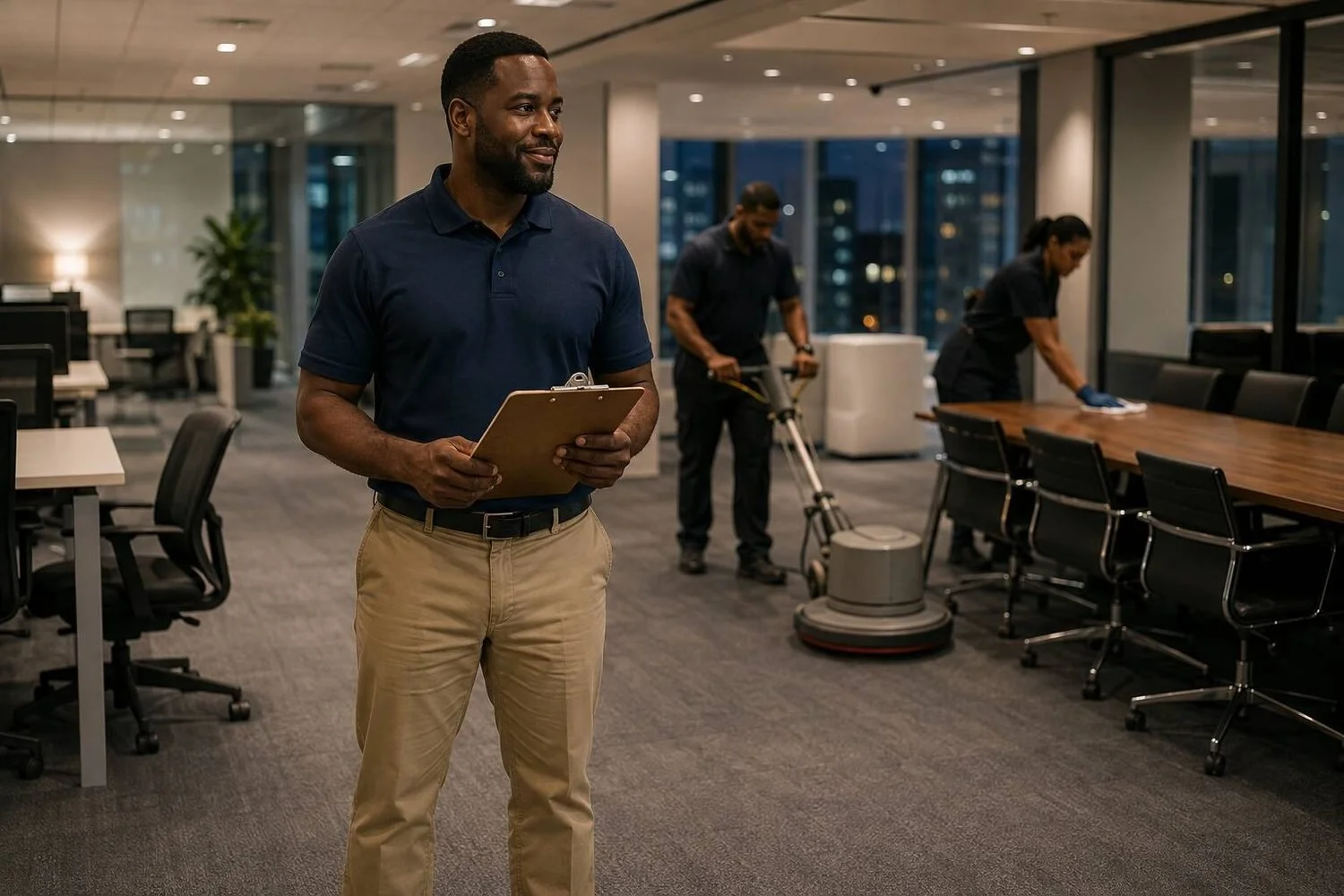
As the director of a Community Development Financial Institution (CDFI), and as management at the U.S. Small Business Administration (SBA), I saw thousands of business plans and loan applications cross my desk. That work is where I learned what a durable business looks like on paper, and what a business that only looks durable looks like on paper.
It is not, however, where the list of fifty came from. That came from years of research, running category after category through the same four questions: Is it profitable? Does it have recurring revenue? Is it recession resistant? Is it AI resistant? Those four questions are the framework behind the book, The Microbusiness Millionaire, and they are what separated the categories that built real wealth from the ones that quietly built a job with a P&L attached. Fifty survived the screen. Far more never made it through.
Cleaning is one of the fifty, and it is the category the research kept returning to. Nobody brags about owning a cleaning company at a dinner party. That is exactly why it is still available to buy at a sensible price, while the businesses with a better story get bid up by people chasing the story.
A word on the neighbor.Specialty cleaning — water damage restoration, mold remediation, biohazard, post-construction — is also one of the fifty, and the two share a word on the business card and almost nothing else. This one is a route: the same building, on a schedule, paid by the customer out of an operating budget. Specialty cleaning is dispatch work: a different damaged building every time, paid by an insurance claim. Ordinary cleaning is sold to a customer on a schedule. Specialty cleaning is sold to a referral source on call. They belong in the same portfolio and the last section of this article explains how they feed each other — but they are bought, priced and staffed differently, and running one on the assumptions of the other is the expensive way to learn the difference.
The industry: quietly enormous
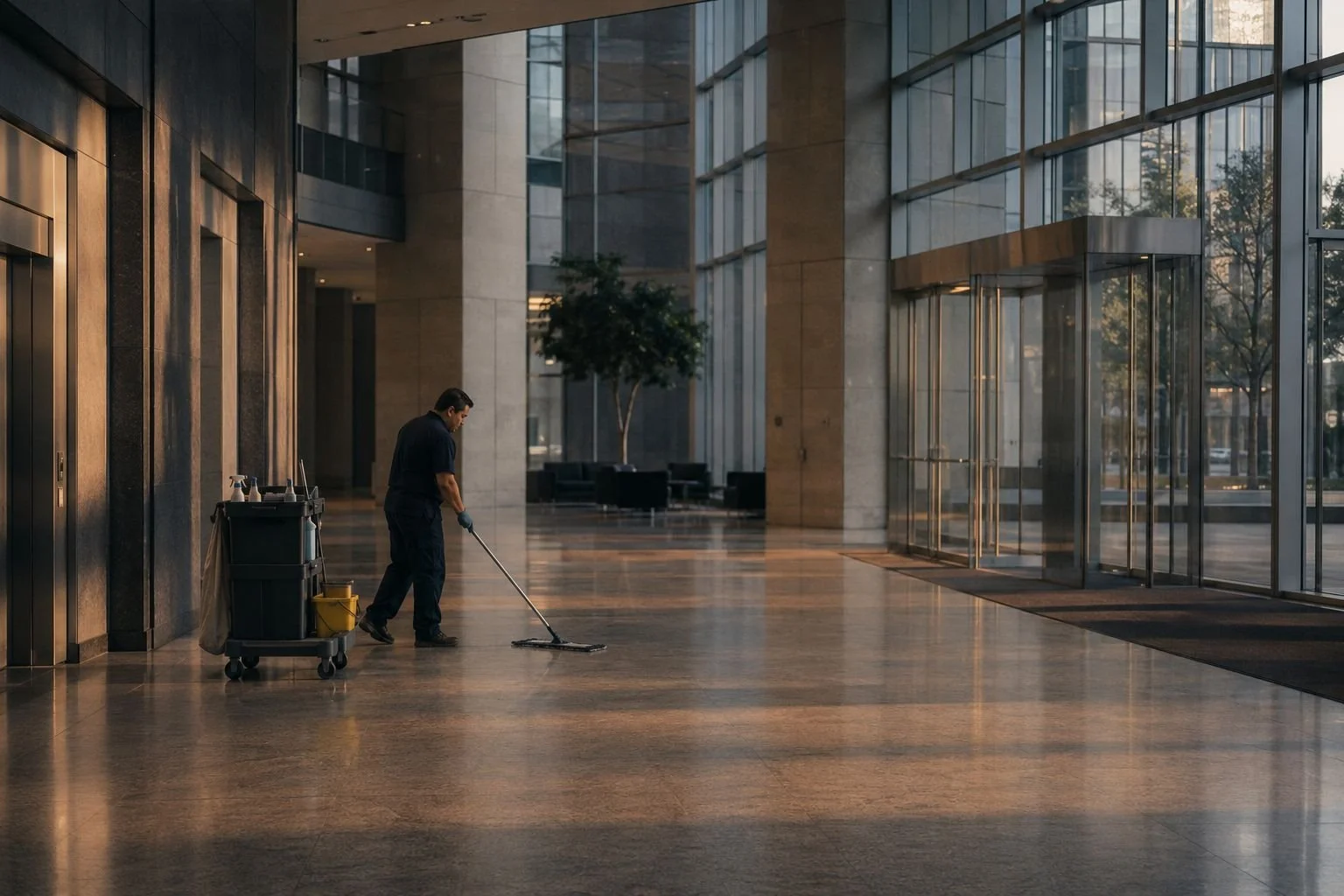
Cleaning is not a small or shrinking market. The U.S. janitorial services industry — commercial, residential, and restoration cleaning combined — was about $110 billion in 2025, growing at roughly 2% a year over the previous five. [S1] It is also one of the most fragmented industries in the country: more than 1.2 million cleaning businesses operate nationwide, most of them small and owner-run, with no dominant player. [S2]
That fragmentation is the opportunity, and it works in two directions. An independent operator competes against companies its own size rather than against a national chain. And a market of a million owner-run businesses is a market where thousands of owners reach retirement each year with something to sell and nobody in the family to sell it to.
On the labor side, about 2.4 million janitors and building cleaners were working in 2024. The work is stable rather than fast-growing — the Bureau of Labor Statistics projects 2% employment growth from 2024 to 2034 — yet it generates roughly 351,000 openings a year as people cycle in and out. [S3] For an owner, that tells you two things. Demand is durable. And staffing is the thing you will manage every week for as long as you own it.
Why cleaning made the list
Every category in the research had to clear four tests. Clear three and you usually have a self-employed job in disguise: income while the owner works, nothing left when the owner stops.
Cleaning clears all four. It is also one of only nine categories on the list carrying no structural condition at all — nothing has to line up first, no credential to earn before you can hire, no season to cover, no partner category to carry half the year. In a list where most categories ask something of you before they work, this one asks the least.
Does it pay after you replace yourself? It does, at real scale, after paying the crews and after paying a supervisor to do the job you would otherwise do for free. That is the only honest way to measure it, and the math is below.
Does the revenue recur? This is cleaning's real strength. Office and facility contracts are signed, scheduled, and renewed. Sixty recurring accounts tell you what next month looks like before it arrives, and that predictability is exactly what a buyer pays a premium for when you eventually sell.
Does it survive a recession? Commercial cleaning holds up well. Offices, medical buildings, and schools still have to be cleaned when money is tight. Residential softens perhaps 10–15% in a downturn but rarely disappears, because households that have outsourced cleaning tend to keep it.
Will it still need humans in ten years? Someone has to be physically inside the building, moving furniture, cleaning surfaces, and trusted with a key to a private space. Software can schedule the route. It cannot mop the floor or earn a client's trust. About as AI-resistant as work gets.
Four for four, with no condition attached — which is why it is the strongest category on the list for someone starting from nothing in particular.
The research on this category kept separating operators on one number that never appears in a marketing brochure: what a supervisor costs. One group prices a contract around the work itself and treats their own bidding, scheduling, and complaint-handling as free. The other group prices a supervisor's wage into every contract they quote, from the first one. Both can look profitable in year one. Only the second can hire a supervisor in year three without the business falling over, because only the second ever charged for that person's time. From the lending side of the desk this is the difference between an applicant who can answer "who runs this when you buy the next one" and one who cannot. It is the single line most first-time owners leave off.
What it costs to get in — the three paths
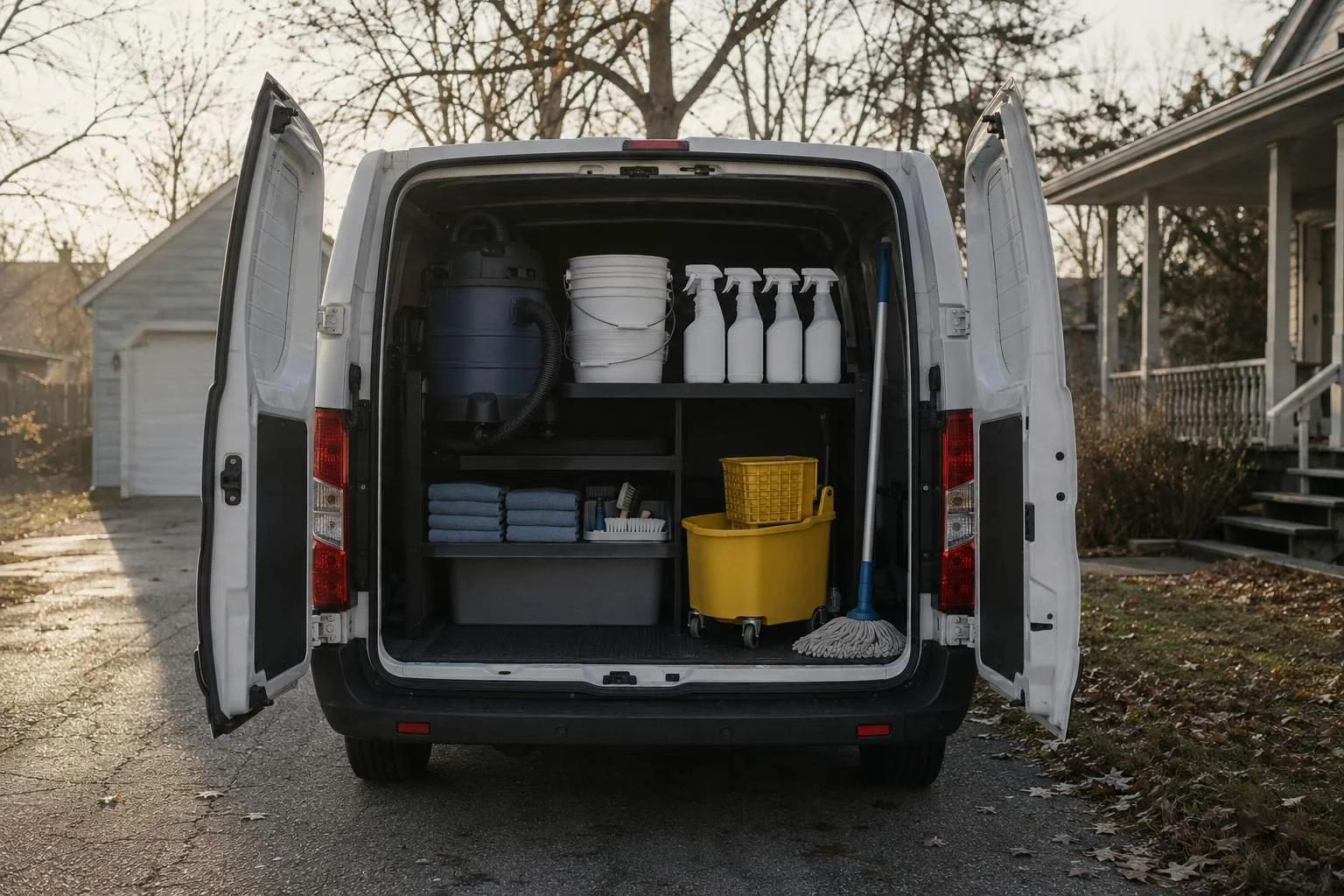
There is no single price to start a cleaning business, because there are three genuinely different ways in.
| Path | Typical cost range | Best for |
|---|---|---|
| Startup (lean residential) | $500 – $3,000 | The classic no-capital entry — supplies, insurance and a few hours of setup |
| Acquisition | around $129,000 | Immediate cash flow and an existing customer list |
| Franchise | $50,000 – $205,000 | Brand and system without building a name. Examples: MaidThis, Molly Maid. |
The ranges above are my category estimate from the lending chair, not any brand's published figure. Brands are named as real examples so you can check them yourself, not as endorsements, and their actual investment ranges may differ from the range above. Each franchisor's Franchise Disclosure Document (FDD) is the authoritative source and refiles annually: check Item 7 for the initial-investment range and Item 19 for any financial-performance representation before pursuing one. [S4]
Cleaning franchising splits into two genuinely different models, and the gap between them is why that row is so wide. The lean, remote systems run without premises or a fleet — MaidThis puts a new franchisee somewhere around $60,000 to $80,000 by its own account. The traditional territory systems come with vehicles, a territory fee and a larger footprint: Molly Maid discloses roughly $144,000 to $204,000 in its 2026 FDD. [S7]
Those are not the same purchase, and comparing them on price alone tells you very little. Read Item 7 on the specific model being offered, and be clear which of the two businesses you are actually buying.
The startup number is not a typo. A lean residential cleaning business can begin for the price of supplies, insurance and a few hours of setup, which puts it alongside lawn care at the very bottom of the entry ladder in the fifty. The trade-off is real, though: you build the customer list one account at a time, and that takes the time the money did not.
Acquisition skips that entirely: you buy the accounts. It is the path the book follows most closely — a W-2 job kept in place while CDFI financing buys an existing cleaning business with its customer list already there, then a second, then a third.
How people actually fund it

The three paths lead to three different funding conversations, and this is the part I spent a decade watching people get wrong.
A lean residential startup needs no lender at all. It sits in the first tier — under $5,000, funded from savings. The only real cost is your time, and you can begin on a Saturday without leaving your job.
An acquisition around $129,000, or a franchise in the $47,600–$66,600 range, sits squarely in the community-lender tiers most first-time buyers have never heard of: CDFI direct lending, and SBA Community Advantage at the larger end. CDFI loans are how the acquisitions in the book get funded.
One pattern I watched from the lending chair, across every industry that came through: a qualified buyer walks into a big national bank, gets declined, and concludes they cannot be funded. They never learn that a CDFI across town, or a Community Advantage lender, exists precisely for deals this size. Two free national directories will show you the ones in your area — the Opportunity Finance Network CDFI locator and SBA Lender Match. [S5]
Finding the lender is the easy half. A cleaning business also has a specific tell an underwriter looks for: the share of revenue under signed recurring contracts, and how long the accounts have been on the books. Sixty accounts on annual commercial contracts is a very different application from sixty residential customers who could cancel this week. Start recording that split before anyone asks for it.
The profit reality: owner-replacement cash flow

Here is the one calculation that separates a business from a job.
A cleaning company often looks more profitable than it is, because the owner is doing three jobs for free — bidding, scheduling, supervising, handling complaints — and never subtracting the cost of that labor. The honest test: after you pay the crews, and after you pay a supervisor a market wage to run the day-to-day the way you have been running it, is there still enough left for you to own the thing?
Put real numbers on it. Two wages come out before you count anything: what a first-line cleaning supervisor earns, and what a front-line cleaner earns. Neither one holds still — the same job pays differently in two cities a state apart — so use the figures for your own market rather than a national average. The Resource Directory in the free tools shows where to look both up. [S6] [S3] Whatever profit the business shows has to survive paying both.
Notice what the test is not. It is not a percentage. The percentage is the most-quoted number in small business and the least useful one. What matters is the dollars still standing once everyone, including your replacement, has been paid. If dollars are left, you own a business. If the math only works because you are doing the supervisor's job for free, you own a job with a P&L attached — and you will discover that the day you try to buy a second one.
I watched a borrower discover this in real time once. It was a small retail shop rather than a cleaning company, but the arithmetic is identical in any category. Her business looked like it produced ninety thousand dollars a year. I asked who would run it after she bought the next one. She said she would. I asked what she would pay someone to do what she was doing fourteen hours a day. She named a number, and it was most of what the business made. The math came apart between us, on the desk, in about four seconds.
Running that calculation on a category is easy — you just did it. Running it on a specific business in front of you, with a real seller's real numbers, is where most people either freeze or talk themselves into something. That is the job of the course, Microbusiness Millionaire: Operating System — the four tests turned into a repeatable screen you run on an actual deal before you sign anything.
None of which is a reason to hesitate on cleaning. It is the reason to price and staff it correctly from day one.
The benefits of owning a cleaning business
Recurring, predictable revenue. Signed contracts mean you know roughly what next month looks like, which is the foundation of everything else.
Recession resistance. Commercial demand is need-based rather than discretionary, so it holds when other categories wobble.
AI resistance. The work requires physical presence and trust, neither of which transfers to software.
An entry almost anyone can clear. No occupational license on general cleaning in most places, and a startup cost measured in hundreds of dollars.
A real portfolio path. Cleaning anchors a commercial services portfolio, which is how one business becomes several.
A liquid exit. Recurring-revenue service businesses command a real multiple, and there is an active market of buyers for a clean customer list on signed contracts. That enterprise value, not the monthly income, is where the wealth actually shows up.
What separates the strong operators from the struggling ones
The owner-replacement math, done first. Price the work with a supervisor's wage already in the bid, and the day you hire one changes nothing about your cash flow.
Density before volume. A route earns its money when the accounts sit close together. Build one neighbourhood or one office park tight, then expand outward from it.
Systems before hiring. Staffing turns over constantly in this industry. Put the training and the checklists on paper before the first hire, and quality survives every departure after that.
Commercial when predictability is the goal. Residential is the easiest way in and a fine way to learn. Commercial contracts are the more durable revenue, so sequence accordingly.
Labor cost built into the bid. Cleaner wages have been climbing steadily. A contract with an annual escalator stays profitable; one priced on today's wages quietly stops being.
Licenses, permits, and the basics
General cleaning carries an unusually light regulatory load — most jurisdictions do not require an occupational license to clean. What you do need: a registered business entity, liability insurance, which is not optional when you hold keys to client buildings, and any local business permit. Specialty work is the exception, since restoration, mold, and biohazard cleaning carry certification requirements. Confirm what applies using the free SBA "Apply for licenses and permits" tool and your state's business-licensing site before you sign your first contract. [S7] (General information, not legal advice — confirm your local requirements.)
Build a portfolio, not a job
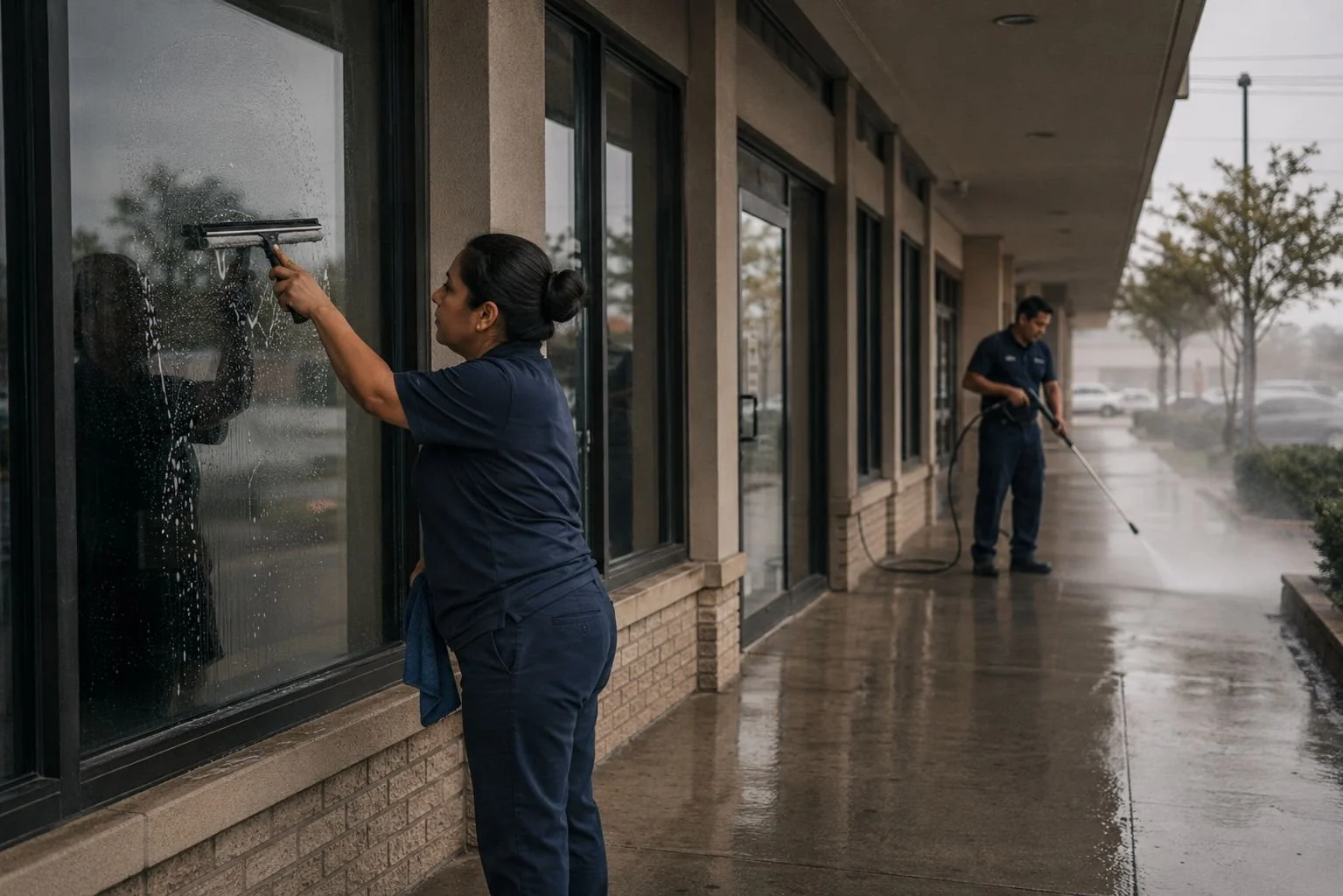
Cleaning is not just a business. It is an anchor, and it stacks the way route businesses do — along a territory, on customers you are already visiting, rather than at a single location.
It pairs naturally with window cleaning, power washing, pool service, pest control, and lawn care, because those services reach the same customers and, on the commercial side, ride the same contracts and the same buying decision. A commercial cleaning customer list plus window cleaning plus power washing is three recurring revenue streams from one customer list. That is exactly how the portfolio in the book is structured: start with cleaning, add the next service to customers you already have, and compound rather than starting over.
That is the difference between owning a crew and owning a portfolio. You are not building a cleaning company. You are building the recurring services vendor a few hundred buildings depend on, anchored by the cleaning contracts that renew without a sale. A portfolio like that, on signed contracts with a documented customer list, sells to a buyer as one asset — which is how it ends up worth over a million dollars at sale, instead of a van and a supply closet.
Frequently asked questions
Is a cleaning business profitable? At real scale, yes — but the honest answer is not a percentage. It is whether the business still produces cash after paying the crews and paying a supervisor to replace the owner's labor. Cleaning clears that test, provided you price and staff for it from the beginning.
How much does it cost to start a cleaning business? Three ranges, by path: roughly $500–$3,000 for a lean residential startup, about $47,600–$60,000 for a lean remote franchise and up to about $205,000 for a traditional territory system, and around $129,000 for an acquisition with a customer list already in place.
Do I need a license to start a cleaning business? General cleaning usually does not require an occupational license, but you will need a registered business, insurance, and any local permit. Specialty work — restoration, mold, biohazard — does require certification. Verify locally. [S7]
Can I start a cleaning business part-time? Yes. The lean residential startup is one of the best side-hustle entries among the fifty, because the capital cost is minimal and you can build the customer list on evenings and weekends before replacing your salary.
Should I start with residential or commercial? Residential is easier to begin and teaches you the work. Commercial is where the recurring contracts, the recession resistance, and the eventual sale value concentrate. Many operators start residential and migrate, which is a sequence rather than a reversal.
Where to go from here
Download the free guide.50 Boring Businesses That Make Millionaires is the full result of the research: fifty categories run against the four tests, what each one costs to enter by all three paths, what has to line up for it to work, and how they pair into a portfolio. Free at microbusinessmillionaire.com.
Read the book.The Microbusiness Millionaire: How Ordinary People Build Extraordinary Wealth One Microbusiness at a Time follows four people who each reached a portfolio worth more than a million dollars by a different path. One keeps a hospital job and uses CDFI financing to acquire one stable service business, then another, then a third. One saves on a single income for three years, leaves a master plumber's wage, and stacks trade service lines starting with an SBA microloan. One uses an SBA Community Advantage loan to open a franchise, then opens three more. One starts with about $5,000 on the side and keeps a W-2 for years, building the slowest and most patient version of the same result. Four starting points, four amounts of money, four portfolios worth over a million dollars at sale. The book is coming soon — join the email list at microbusinessmillionaire.com to hear when it lands.
Join the next cohort — Microbusiness Millionaire: Operating System. The book gives you clear examples of how it's done. The course is the step-by-step system for doing it yourself: screening a real company against the four tests, running the owner-replacement cash-flow math on a seller's actual numbers, knowing when to walk, knowing which lenders fund deals this size, and installing the operator who runs the business without you. Eight weeks online, five seats a cohort, waitlist first — at microbusinessmillionaire.com.
About the author
Chris Scott has spent more than twenty-five years in the small-business arena. As the director of a Community Development Financial Institution (CDFI) and as management at the U.S. Small Business Administration (SBA), he saw thousands of business plans and loan applications cross his desk. His research into which microbusinesses build wealth — and which quietly build a job — became The Microbusiness Millionaire and the free companion guide, 50 Boring Businesses That Make Millionaires.
Sources & references
[S1] IBISWorld, Janitorial Services in the US — Market Size, 2025 ($110.0bn). ibisworld.com
[S2] IBISWorld, Janitorial Services in the US — Number of Businesses, 2026 (1,254,202 businesses). ibisworld.com
[S3] U.S. Bureau of Labor Statistics, Occupational Outlook Handbook: Janitors and Building Cleaners — 2.4 million employed; 2% projected growth 2024–2034; approximately 351,300 annual openings. bls.gov/ooh
[S4] U.S. Federal Trade Commission, Franchise Rule / Franchise Disclosure Document (FDD) Items 7 and 19. ftc.gov
[S5] Opportunity Finance Network CDFI Locator (ofn.org); SBA Lender Match (sba.gov).
[S6] U.S. Bureau of Labor Statistics, OEWS, First-Line Supervisors of Housekeeping and Janitorial Workers (SOC 37-1011). bls.gov/oes
[S7] U.S. Small Business Administration, Apply for licenses and permits. sba.gov
[S7] Cleaning franchise disclosure data: MaidThis states an estimated initial investment of $60,000–$80,000 on its own franchising site, with aggregator readings of 2026 FDD filings ranging from about $50,400 to $79,900; Molly Maid's 2026 FDD Item 7 discloses $144,150–$203,950 on an initial franchise fee of $14,900 plus a territory fee. Reported figures vary between aggregators and filing years; verify the current FDD directly for any brand.
[Internal]50 Boring Businesses That Make Millionaires — Cleaning & Janitorial entry (tag, three-path entry-cost table, portfolio pairings, framework note), drawn from the author's research and filtered through the underwriting criteria he applied as a CDFI lender.
This article is for general information only and is not legal, financial, tax, or investment advice. Category-level figures are reference points, not a specific-deal projection; individual businesses vary. Consult a CPA, attorney, business broker, franchise consultant, or CDFI loan officer before acting.
Last updated: 8/19/2026.