

How to Start a Dog Training Business
Mobile trainers charge $60 to $100 an hour and carry almost no variable cost, which gives this category some of the strongest solo cash flow on the list. Here is what a mobile dog training business costs, what it pays after you replace yourself, and the one decision — stay solo or build a team — that settles almost everything else.
Chris Scott — former CDFI director and SBA management

As the director of a Community Development Financial Institution (CDFI), and as management at the U.S. Small Business Administration (SBA), I saw thousands of business plans and loan applications cross my desk. That work is where I learned what a durable business looks like on paper, and what a business that only looks durable looks like on paper.
It is not, however, where the list of fifty came from. That came from years of research, running category after category through the same four questions: Is it profitable? Does it have recurring revenue? Is it recession resistant? Is it AI resistant? Those four questions are the framework behind the book, The Microbusiness Millionaire, and they are what separated the categories that built real wealth from the ones that quietly built a job with a P&L attached. Fifty survived the screen. Far more never made it through.
Mobile dog training is one of the fifty, and it is one you can start for a couple of thousand dollars while keeping your paycheck. In-home obedience training, behavior modification, board-and-train, and group classes all share the same unusual economics: almost no variable cost, which makes the solo cash flow exceptional. The one real decision is what you do with that — build a team, or keep it as the high-cash-flow anchor of a pet portfolio.
The industry: small-ticket, high cash flow, and shifting mobile

The U.S. dog training services market runs about $294 million in 2025, up 2.3% on the year, and the mobile, in-home segment is a growing share of it — an estimated 30% of the market, where trainers charge roughly $60 to $100 an hour for coming to the client. [S1] Pet ownership keeps climbing and owners increasingly treat training as essential to living well with a dog, especially the wave of dogs adopted in recent years.
The labor benchmark is what an employed animal trainer earns (BLS 39-2011) — the wage you would have to pay someone to do the training you are doing now. What that comes to depends on where you work, so plan on your own market's figure. [S2] The benchmark undersells the trade badly. A solo owner sets their own rates and carries almost no variable cost, so he keeps far more than a wage. Mobile specialists charging by the hour do better still. It is still the price of replacing yourself. Every profit number later in this article has to survive it, and the real cost runs higher once payroll taxes and insurance go on top.
One number matters more than any of those when you think about growth: skilled, certified trainers are in limited supply. That single fact shapes the whole decision this category asks you to make.
Why mobile dog training made the list
Every category in the research had to clear four tests. Clear three and you usually have a self-employed job in disguise.
Does it pay after you replace yourself? It does, and this is a "Solo first" category, so the honest picture has two halves. Solo economics are excellent: strong cash flow, almost no variable cost. Scaling brings that back toward the middle of the list, because you are then paying certified trainers who are scarce. Both models work. The category simply rewards you for choosing deliberately rather than drifting.
Does the revenue recur? Through the relationship and the referral. Training is usually a program first, then ongoing tune-ups and advanced work, and it pairs with the other pet services so the same household keeps buying. Results drive the referrals too: a well-behaved dog is a walking advertisement on every street where it is walked.
Does it survive a recession? It holds up well, because behaviour issues do not pause for the economy. An unmanageable dog is something owners pay to fix in any year, and the low overhead of a solo operation rides out soft patches that would sink a business carrying rent.
Will it still need humans in ten years? Reading a live animal and coaching its owner in real time is hands-on skill. An app can explain a technique. It cannot see the dog stiffen a half-second before it lunges. Very low AI exposure.
Four for four — with solo economics among the best on the list.
The research on this category kept arriving at a choice rather than a condition. The solo economics are genuinely excellent — high cash flow, almost no cost of goods, a trainer keeping most of every dollar — so the question was never whether it works. It was what the owner wanted it to become. One kind of operator stays solo on purpose and uses that steady cash flow as the anchor of a growing pet portfolio. Another builds a training company deliberately, hiring certified trainers on temperament rather than in a panic, protecting the reputation individual results had earned. Both work. The pattern that struggles is the one that scales fast, hires whoever is available, and watches the reputation erode — which in this category is the whole asset. From the lending side of the desk, an applicant who can say which of those two businesses they are building is describing a plan; one who cannot is describing a hope.
What it takes to make this one work
A note on the tags. Every category in the fifty cleared the same four tests; far more never made it through. The tags do not grade a business — they tell you what has to line up for it to work in your hands. Mobile dog training carries one: Solo first. That is the instruction manual.
The condition: solo economics are excellent — strong cash flow, almost no variable cost — while scaling means recruiting certified trainers who are in limited supply, and protecting a reputation that lives on individual results.
The move that meets it: decide which business you are building, early and on purpose. Either grow slowly and hire on temperament rather than urgency, because one poorly chosen trainer costs you the reputation that is your entire asset — or stay solo and let this be the high-cash-flow anchor of a pet portfolio. Both are good outcomes. What the category asks is that you pick one rather than drift into the other.
The upside: both paths are strong. Kept solo, this produces exceptional cash flow with almost no overhead, which is ideal fuel for building something around it. Grown carefully, it becomes a reputable training company with a name that carries. And it pairs cleanly with mobile grooming and waste removal along the same streets: one household, three recurring services, a single relationship. Low entry, high cash flow, and a clear fork in the road is a good position to be in.
What it costs to get in — the three paths

| Path | Typical cost range | Best for |
|---|---|---|
| Startup (solo) | $2,000 – $8,000 | Certification + insurance + supplies |
| Acquisition | $40,000 – $100,000 | Customer list + reputation |
| Franchise | $25,000 – $130,000 | Brand + training method + territory. Examples: Bark Busters, Sit Means Sit. |
Franchise brands are named as examples, not endorsements. Franchise investment figures reflect a franchisor's most recent Franchise Disclosure Document (FDD) and change annually — verify each brand's current FDD (Item 7 for the initial-investment range; Item 19 for any financial-performance representation) before pursuing one. [S3]
One thing about that row is worth knowing before you shop it, and it is unusual in the fifty: the range is set by whether you stay mobile. A mobile-only territory can start near the bottom of it, while adding a facility carries the number toward the top. Facility-based dog training brands are a different business again and run several times higher. [S6] Since this article is about the come-to-you model, read Item 7 for the mobile version of whatever brand you are considering, not the headline figure.
The solo startup sits near the bottom of the entry ladder in the fifty, alongside lawn care and window cleaning — a certification, insurance, and basic supplies. That low entry plus near-zero variable cost is exactly why the solo cash flow is so strong. The acquisition path buys a customer list and, more importantly, a reputation — the thing that takes years to earn in a business where word-of-mouth from real results is everything.
How people actually fund it

Most people start this one out of pocket. A couple of thousand dollars is within reach without a loan, which is why it is such a strong side entry — the same tier the book's side-hustle path starts in, where about $5,000 and a W-2 kept in place let each business fund the next.
When you do want capital — to acquire a customer list or buy into a franchise — a $40,000–$120,000 deal sits in the SBA Microloan and CDFI direct lending range.
One pattern I watched from the lending chair, across every industry that came through: a qualified buyer walks into a national bank, gets declined, and concludes he cannot be funded. He never learns that a CDFI across town, or an SBA Community Advantage lender, exists precisely for deals this size. Two free national directories will show you the ones near you — the Opportunity Finance Network CDFI locator and SBA Lender Match. [S4]
Finding the lender is the easy half. A dog training business also has a specific tell an underwriter looks for: whether the revenue leans on the owner's own hands or on a repeatable program with trained staff. A customer list on recurring programs is far more bankable than a founder's personal calendar of lessons, because one of those transfers to a buyer and the other does not. Start recording that split before anyone asks for it.
The profit reality: owner-replacement cash flow

Here is the calculation that decides more of these deals than anything else in them. A dog training business looks profitable because the owner is running every session, coaching every owner, handling the bookings, and keeping the books — none of it priced. The honest test: after you pay any trainers you employ, and after you pay a lead trainer a market wage to run sessions the way you run them, is there enough left for you to own the thing?
This is where the "Solo first" tag becomes arithmetic. Kept solo, the owner-replacement math is unusually strong: almost no variable cost means you keep most of every dollar, and mobile rates of $60 to $100 an hour protect it.
Staffed up, the same business settles toward the middle of the list, because you are paying certified trainers who are scarce, and the reputation that commands premium rates now depends on their individual results rather than yours. Neither version is wrong. They are different businesses, and the number you are solving for changes with the path you chose — which is why choosing on purpose matters as much as it does here.
The category-level math is easy — you just did it. Running it on a specific company, where the seller's "profit" is really his own unpriced training hours and the real question is whether the reputation transfers, is where people freeze. That is the job of the course, Microbusiness Millionaire: Operating System — the four tests turned into a repeatable screen you run on a real deal.
The benefits of owning a dog training business
A very low, side-hustle entry. A couple thousand dollars for certification and supplies.
Exceptional solo cash flow. Almost no variable cost means you keep most of every dollar.
A clear fork in the road. Stay solo as a portfolio anchor, or build a training company on purpose.
A natural pet-portfolio pairing. One household, three recurring services alongside mobile grooming and waste removal.
Very low AI exposure. Reading a live dog and coaching its owner needs a person in the room.
What separates the strong operators from the struggling ones
The decision made early. Solo anchor or training company — pick one deliberately in year one, and every hiring and pricing choice after it becomes obvious.
Programs before single sessions. A six-week program with tune-ups afterwards produces revenue that returns; a one-off lesson has to be re-sold every time.
Certification before premium pricing. A recognised credential is what lets you charge at the top of the $60–$100 range and what makes a referral easy for a vet to give.
Temperament before urgency, when hiring. Grow slowly enough that every trainer you add protects the reputation the last one built.
The pairing taken. Mobile grooming and waste removal turn one training client into a household relationship that lasts the life of the dog.
Licenses, permits, and regulations
Dog training is lightly regulated, but a few things are worth confirming rather than assuming: a general business license and sales-tax registration are typical, and while certification (through organizations like the CCPDT or IAABC) is rarely legally required, it's the practical standard of trust and the basis for premium pricing. Liability insurance, including coverage for working with animals and in clients' homes, is essential, and board-and-train services may trigger additional kennel or animal-boarding rules. Making health or behavioral claims can carry added responsibility. Start with your city or county and the free SBA "Apply for licenses and permits" tool. [S5] (General information, not legal advice — confirm your local business and any boarding rules, and carry appropriate liability coverage, before you take paid clients.)
Build a portfolio, not a job
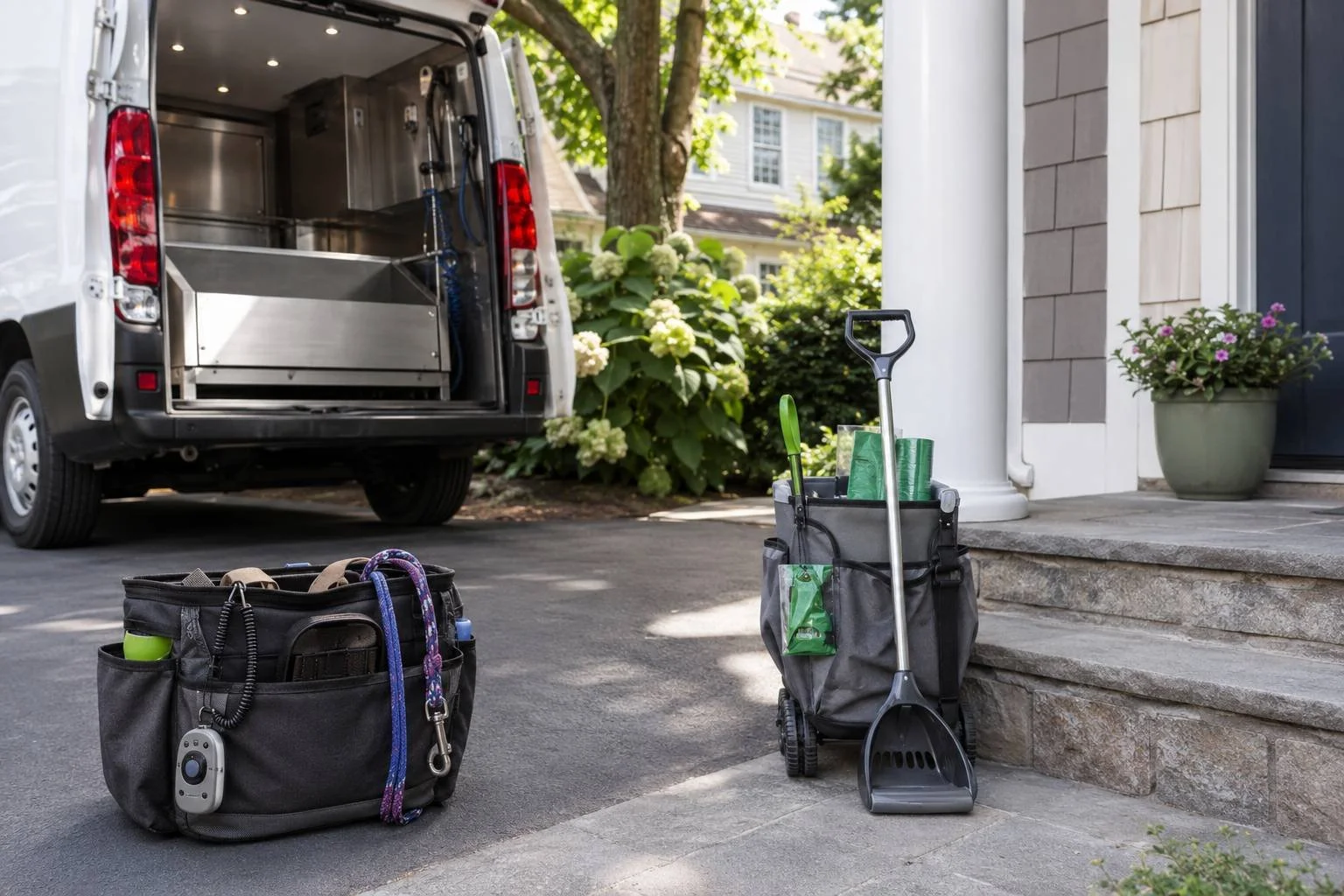
Mobile dog training pairs into a pet-services cluster around the same household, and because the solo cash flow is so strong, it is often the business that funds the rest. But which services belong with it is decided by how it operates, not just by who the customer is.
Come-to-you training is a route business: a vehicle moving between homes, where the asset is density — how many clients sit close enough together to serve in one day. The services that stack with it are the other route businesses on the list: mobile pet grooming, pet waste removal on the same streets, and pet taxi work. Each is a vehicle covering a territory, each gets cheaper to run as the territory tightens, and all of them serve the same households you are already visiting.
Pet boarding and daycare is a strong business on the same list, and a natural referral partner — but it is a facility. It stacks at one address with daycare and in-facility grooming, on a different logic entirely. Running a route and a building at the same time means running two unrelated operations, each competing for your attention and neither getting what it needs. Refer to a boarding facility gladly. Build alongside the routes.
The operator who trained the puppy, grooms the dog every month, and keeps the yard clean becomes the single pet-care relationship a family keeps for the life of the animal.
That is the difference between owning a job and owning a portfolio. You are not selling training sessions one at a time. You are building the pet-care relationship a few hundred households depend on, anchored by the high-cash-flow training work and widened by the services around it. A portfolio like that, with a documented customer list on recurring programs, sells to a buyer as one asset — which is how it ends up worth over a million dollars at sale, instead of a founder's personal calendar of lessons.
Frequently asked questions
Is a dog training business profitable? Kept solo, it is among the strongest starts on the list, because there is almost no variable cost and mobile rates run $60 to $100 an hour. Staffed up, the cash left on each job settles toward the middle in exchange for scale. The honest test is whether it still produces cash after paying a lead trainer, and the answer depends heavily on which path you chose.
How much does it cost to start a dog training business? As little as $2,000–$8,000 to start solo with certification, insurance, and supplies, which is about as small an entry as the fifty offers. About $40,000 to $100,000 to acquire a customer list and a reputation, or roughly $25,000 to $130,000 for a franchise with an established method.
Do I need certification to be a dog trainer? It is rarely legally required, but certification (through organizations like the CCPDT or IAABC) is the practical standard of trust and the basis for premium pricing. Liability insurance is essential, and board-and-train may trigger boarding rules. Confirm your local requirements first. [S5]
Should I stay solo or build a team? Both work — that is the "Solo first" point. Solo gives you exceptional cash flow and an ideal portfolio anchor. A team gives you scale, settles the cash left on each job toward the middle, and depends on hiring scarce trainers carefully. Choose deliberately rather than scaling by accident.
Where to go from here
Download the free guide.50 Boring Businesses That Make Millionaires is the full result of the research: fifty categories run against the four tests, what each one costs to enter by all three paths, what has to line up for it to work, and how they pair into a portfolio. Free at microbusinessmillionaire.com.
Read the book.The Microbusiness Millionaire: How Ordinary People Build Extraordinary Wealth One Microbusiness at a Time follows four people who each reached a portfolio worth more than a million dollars by a different path. One keeps a hospital job and uses CDFI financing to acquire one stable service business, then another, then a third. One saves on a single income for three years, leaves a master plumber's wage, and stacks trade service lines starting with an SBA microloan. One uses an SBA Community Advantage loan to open a franchise, then opens three more. One starts with about $5,000 on the side and keeps a W-2 for years, building the slowest and most patient version of the same result. Four starting points, four amounts of money, four portfolios worth over a million dollars at sale. The book is coming soon — join the email list at microbusinessmillionaire.com to hear when it lands.
Join the next cohort — Microbusiness Millionaire: Operating System. The book gives you clear examples of how it's done. The course is the step-by-step system for doing it yourself: screening a real company against the four tests, running the owner-replacement cash-flow math on a seller's actual numbers, knowing when to walk, knowing which lenders fund deals this size, and installing the operator who runs the business without you. Eight weeks online, five seats a cohort, waitlist first — at microbusinessmillionaire.com.
About the author
Chris Scott has spent more than twenty-five years in the small-business arena. As the director of a Community Development Financial Institution (CDFI) and as management at the U.S. Small Business Administration (SBA), he saw thousands of business plans and loan applications cross his desk. His research into which microbusinesses build wealth — and which quietly build a job — became The Microbusiness Millionaire and the free companion guide, 50 Boring Businesses That Make Millionaires.
Sources & references
[S1] IBISWorld, Dog Training Services in the US — market size ~$294 million (2025), up ~2.3% year over year; the mobile/in-home segment is an estimated ~30% of the market, with typical rates of $60–$100 per hour. ibisworld.com
[S2] U.S. Bureau of Labor Statistics, Occupational Employment and Wage Statistics, Animal Trainers (SOC 39-2011), May 2024; solo owner-operators and mobile specialists typically earn well above a wage. bls.gov/oes
[S3] U.S. Federal Trade Commission, Franchise Rule / FDD Items 7 and 19. ftc.gov
[S4] Opportunity Finance Network CDFI Locator (ofn.org); SBA Lender Match (sba.gov).
[S5] U.S. Small Business Administration, Apply for licenses and permits (sba.gov); state/local business licensing; recognized certifications (CCPDT, IAABC); liability insurance and any kennel/animal-boarding rules for board-and-train.
[S6] Dog training franchise disclosure data as reported by franchise-filing aggregators: Sit Means Sit's 2024 FDD Item 7 discloses approximately $24,275–$121,350, with 2026 readings around $25,000–$130,000 depending on mobile-only or facility operation; Bark Busters is reported in the $50,000–$100,000 region on a 2026 initial fee of $49,500. Facility-based dog training brands sit substantially higher and represent a different model. Reported figures vary between aggregators and filing years; verify the current FDD directly.
[Internal]50 Boring Businesses That Make Millionaires — Mobile Dog Training entry (tag, three-path entry-cost table, portfolio pairings, framework note, "what it takes to make this one work"), drawn from the author's research and filtered through the underwriting criteria he applied as a CDFI lender.
This article is for general information only and is not legal, financial, tax, or investment advice. Category-level figures are reference points, not a specific-deal projection; individual businesses vary. Consult a CPA, attorney, business broker, franchise consultant, or CDFI loan officer before acting.
Last updated: 8/18/2026.