
How to Start a Solar Panel Cleaning Business
Every solar array that goes up is a future cleaning customer, and the installed base only grows. Here is what a solar panel cleaning business costs, what it pays after you replace yourself, and why the strongest version of it rides on a route you already run.
Chris Scott — former CDFI director, SBA manager
As the director of a Community Development Financial Institution (CDFI), I reviewed loan applications and made the approve-or-decline decisions. Later, at the U.S. Small Business Administration (SBA), I monitored lending programs and saw which loans were approved and which were denied. Across those two roles, thousands of business plans and loan applications crossed my desk. I still work at the SBA, now in its venture capital division. That work is where I learned what a durable business looks like on paper, and what a business that only looks durable looks like on paper.
It is not, however, where the list of fifty came from. That came from years of research, running category after category through the same four questions: Is it profitable? Does it have recurring revenue? Is it recession resistant? Is it AI resistant? Those four questions are the framework behind the book, The Microbusiness Millionaire, and they are what separated the categories that built real wealth from the ones that quietly built a job with a P&L attached. Fifty survived the screen. Far more never made it through.
Solar panel cleaning is one of the fifty and a young category — one that grows every time an array goes up.
It carries two tags, so two things have to line up rather than one: the market has to have solar in it, and the service pays best attached to a route rather than sold alone. Both are readable before you spend a dollar.
A word on the neighbor.Window and gutter cleaning is also one of the fifty, and the two run together so naturally they are easy to confuse — same ladder, same exterior, often the same house. They are different businesses. Window cleaning is bought: the customer knows they need it and calls for it. Solar cleaning has to be shown: somebody must point out that the array is quietly costing them output. Window cleaning is a route you can build. Solar cleaning is a service you attach to one.
The industry: new, growing, and tied to solar adoption
Solar panel cleaning is a young category defined entirely by its installed base. Every array collects dust, pollen and grime that measurably reduces output, and every one is a recurring-cleaning customer waiting to be asked.
That installed base expands as adoption grows, and spreads unevenly — concentrated where sun and incentive programs are strong, thin where solar has yet to take hold.
There is no dedicated federal occupation for solar cleaning, so the labor benchmark comes from the closest neighbor: grounds maintenance workers. [S1] What that work pays is the price of replacing yourself — the cost of the person who takes the panels off your hands. It is a local number. Find the rate for your own market. Every profit number later in this article has to survive it, and the real cost runs higher once payroll taxes and insurance go on top.
That is a trainable crew running specialty equipment, with no scarce credential between you and the work — which is why the entry is small, and why the two structural moves decide the outcome rather than the skill.
Why solar panel cleaning made the list
Every category in the research had to clear four tests. Clear three and you usually have a self-employed job in disguise.
Does it pay after you replace yourself? It does, most cleanly when it rides on a route already out on the street. Sold on its own it works harder for the same dollar; attached, it is close to pure cash flow.
Does the revenue recur? Panels re-soil on a seasonal cycle, and an array left dirty loses output the owner is already paying for. That gives the cleaning a return the customer can read on a power bill, which makes the next visit an easy sale rather than a fresh one.
Does it survive a recession? A solar owner has already paid for the system, and cleaning protects the output they are counting on to earn it back. Maintenance of an asset the customer already bought holds up better than discretionary spending — particularly when the visit pays for itself in recovered generation.
Will it still need humans in ten years? Robotic cleaning exists for utility-scale arrays in flat, uniform rows. Residential and most commercial rooftop work is still a person with a pole. Software can read the output drop and flag the array; it cannot reach the panel.
Four for four, on an entry cheap enough to fund out of an existing route's cash flow — in a market where the map and the route cooperate.
The most instructive version of this category the research kept turning up was not a solar cleaning business at all. It was a window-cleaning company in a high-adoption state running solar cleaning as a line item. The trucks were already on the street, a good share of customers had rooftop arrays, and panel cleaning went onto the route. Acquisition cost nothing, because the customer was already there and trusted that company with the outside of the house — and the panels re-soiled on roughly the cycle the windows did. Where solar had taken hold, that is close to pure cash flow on a stop already being made. In a state where it has not, the same idea has nowhere to land. From the lending side of the desk that is the whole read: the underwriting question is never whether someone can clean a panel, but whether the arrays are dense enough and the route is already there.
What it takes to make this one work
A note on the tags. Every category in the fifty cleared the same four tests; far more never made it through. The tags do not grade a business — they tell you what has to line up for it to work in your hands. Solar panel cleaning carries two: Right geography and Best paired. A category with two tags in the right hands beats a category with none in the wrong ones.
Right geography: the map is the market
The condition: this category tracks residential solar adoption, which varies enormously by state and by incentive program. A market with high penetration has a dense installed base that all needs cleaning; a market where solar has yet to take hold has the arrays still ahead of it. The map decides this one before any operating skill gets a say.
The move that meets it: read your state before you enter, with numbers rather than impressions. Residential solar-adoption rates and the incentive programs driving them are published, current and free to look up — much of the Southwest, California and a growing list of others carry the installed base today.
What you are looking for is density, not enthusiasm: arrays close enough together that a technician cleans several in an afternoon. Enter where they already sit that way.
The upside: where solar has taken hold, the installed base only grows. Every new installation is a future cleaning customer, and adoption trends point one direction. You are entering a market that is still expanding, so the customer list compounds underneath you. Pick the right map and time is working for you rather than against you.
Best paired: an attachment, not a standalone
The condition: sold cold and on its own, solar panel cleaning carries the acquisition cost of any young category — you are introducing a service many homeowners have not yet thought about, one array at a time. Every customer has to be found and then taught before they can be sold.
The move that meets it: run it as an attachment. Bolt it onto a window and gutter cleaning route, where the truck is already on the street and the customer already knows your name. You are on the exterior of the house, the panels are right there, and the customer who lets you clean their windows and gutters is the natural yes for their array. Power washing routes carry it the same way.
The upside: attached to an existing route in the right market, solar cleaning is close to pure cash flow on a visit you were making anyway — acquisition cost near zero, trust already built, and a re-soiling cycle that lines up with the window and gutter schedule.
What it costs to get in — the three paths
| Path | Typical cost range | Best for |
|---|---|---|
| Startup | $5,000 – $15,000 | Specialty equipment + insurance |
| Acquisition (estimate) | $20,000 – $60,000 | Established route |
| Franchise | $142,000 – $203,000 | Brand + bundled exterior services (example: Shine) |
Look at how far the franchise row sits above the other two, because the reason is this article's own argument restated as a price. Nobody franchises solar panel cleaning on its own. The brands that offer it sell a bundled exterior-services system — windows, gutters, soft washing, holiday lighting — with panel cleaning as one line among several. You are not being quoted for a solar business; you are being quoted for the route you were told to attach it to, with the attachment already made. A legitimate shortcut at roughly ten times the equipment cost, and building or buying the route yourself is the cheaper path.
Brands are named as real examples so you can check them yourself, not as endorsements. Each franchisor's Franchise Disclosure Document (FDD) is the authoritative source and refiles annually — check Item 7 for the initial-investment range and Item 19 for any financial-performance representation before pursuing one. [S2]
That $5,000 startup tells you something useful: the barrier here is not money. It is the map and the route.
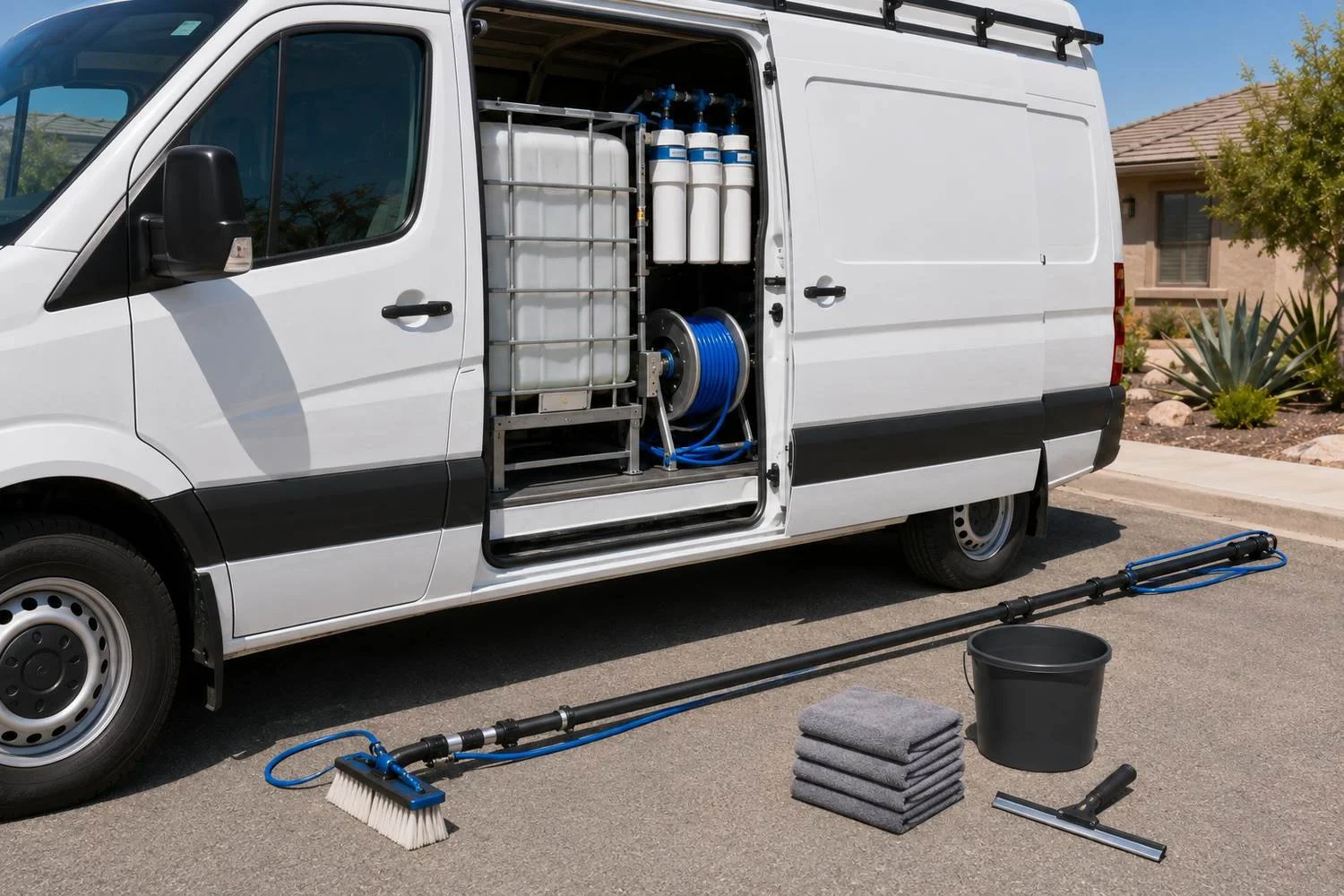
Almost anyone can afford the brushes and the purified-water equipment. The owners who build something worth owning enter a high-adoption market and attach the service to a route already running — decided before the first dollar is spent.
How people actually fund it

At $5,000 to $15,000, this rarely needs a lender at all. It comes out of savings, or out of the cash flow of the route you are attaching it to — the tier where a business gets built onto something already running.
A lender enters at the $20,000 to $60,000 acquisition of an established route — SBA Microloan and CDFI direct lending territory, the add-on purchase that deepens a portfolio rather than starting one.
One pattern I watched from the lending chair: a qualified borrower walks into a national bank, gets declined, and concludes they cannot be funded. They never learn that a CDFI across town exists precisely for deals this size. Two free national directories will show you the ones near you — the Opportunity Finance Network CDFI locator and SBA Lender Match. [S3]
Finding the lender is the easy half. Solar cleaning has two specific tells an underwriter looks for: the solar-adoption rate of the market being served, and how much of the revenue is attached to an existing customer list versus sold cold. A customer list in a high-adoption market, riding a proven route, prices very differently from the same revenue assembled one cold call at a time. Bring both before anyone asks.
The profit reality: owner-replacement cash flow

Here is the calculation that decides more of these deals than anything else in them. A solar cleaning business looks profitable because the owner is on the pole, quoting, scheduling and doing the books — none of it priced. The honest test: after the crew, and after someone paid a market wage to run the route the way you run it, is there enough left for you to own the thing?
Real numbers. Begin with what crew labor costs where you work. [S1] But the crew wage is not the number this test turns on, because a technician replaces your hands on the pole, not your judgment on the route.
The number that decides it is the person who runs the route. Using the same grounds-services family the crew figure comes from, look up what a first-line supervisor earns in your area. Then load payroll taxes and insurance on top — that loaded figure is what the route has to cover. [S5] That is who schedules the stops, quotes the arrays, handles the customer who says the panels still look dirty, and keeps the re-soiling cycle on the calendar. Whatever the business reports as profit has to survive paying the crew and that.
This is where both tags stop being advice and become arithmetic. In a high-adoption market a technician cleans several arrays in an afternoon inside a tight radius and those wages spread across a lot of billable stops; where the arrays are scattered they spread across windshield time instead. The pairing works the same way: attached to a route already running, acquisition costs close to nothing. Same cleaning, same wages, same equipment — the map and the route decide what is left.
The category-level math is easy — you just did it. Running it on a specific route, where the seller's "profit" quietly contains his own unpaid hours on the pole and the real solar density is buried three layers down, is where people freeze. That is the job of the course, Microbusiness Millionaire: Operating System — the four tests turned into a repeatable screen you run on a real deal.
The benefits of owning a solar panel cleaning business
A very small entry cost. Specialty equipment and a policy, in the right market.
A return the customer can read. A clean array generates more power, and the value shows up on a bill they already get.
A recurring cycle that sells itself. Panels re-soil on schedule, and the recovered output makes the next visit an easy yes.
Close to pure cash flow when attached. On a route already running, acquisition costs near nothing.
An installed base that keeps growing. Every array that goes up in your market is a future customer.
What separates the strong owners from the struggling ones
The market read before the equipment order. The defining decision in this category, and it is made before anything is bought. Strong owners pull their state's residential solar-adoption numbers and enter where the arrays already sit in density.
Revenue attached to a route that already exists. Riding a window, gutter or power-washing customer list where the trust is built takes acquisition close to zero, and that is what turns a service into cash flow.
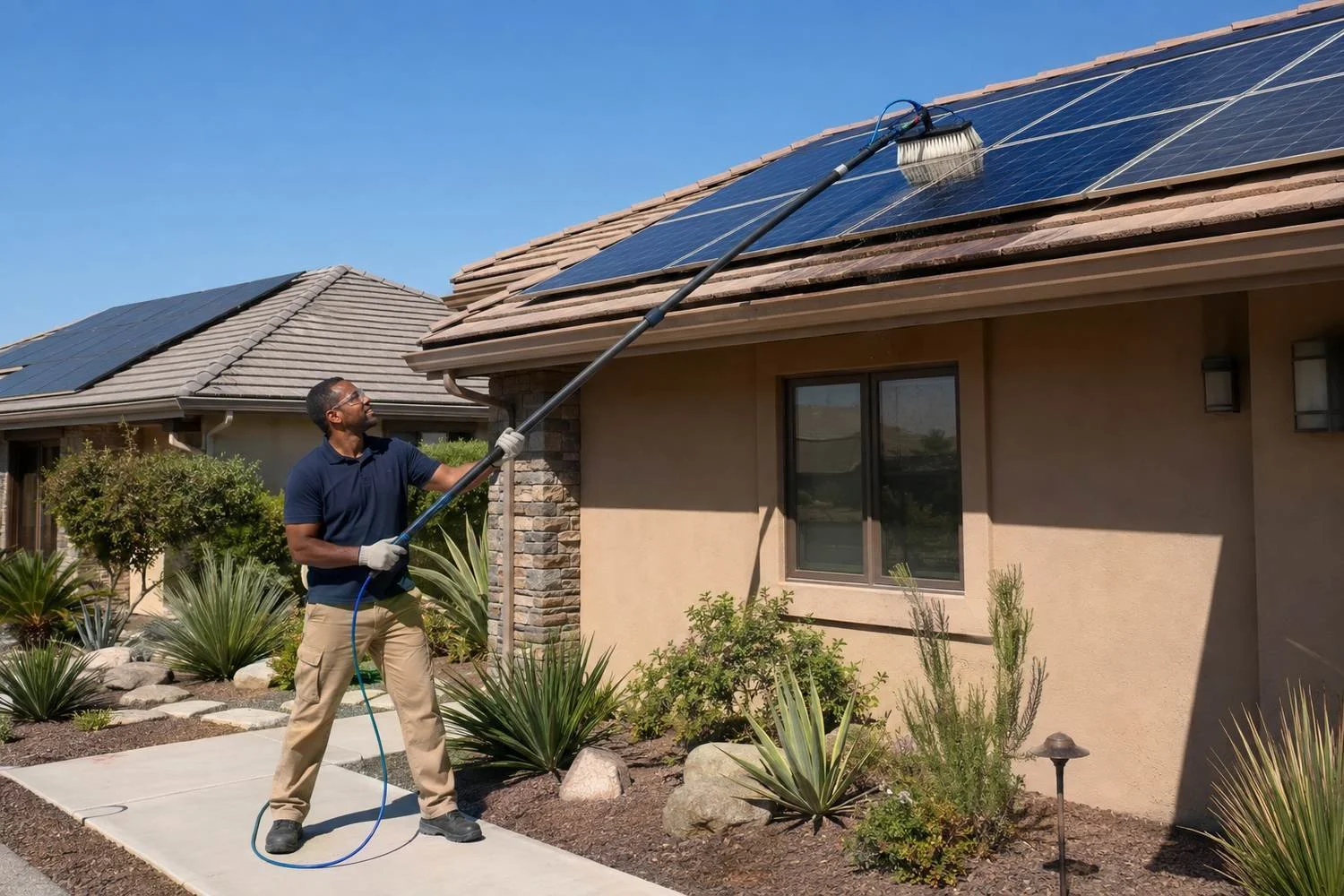
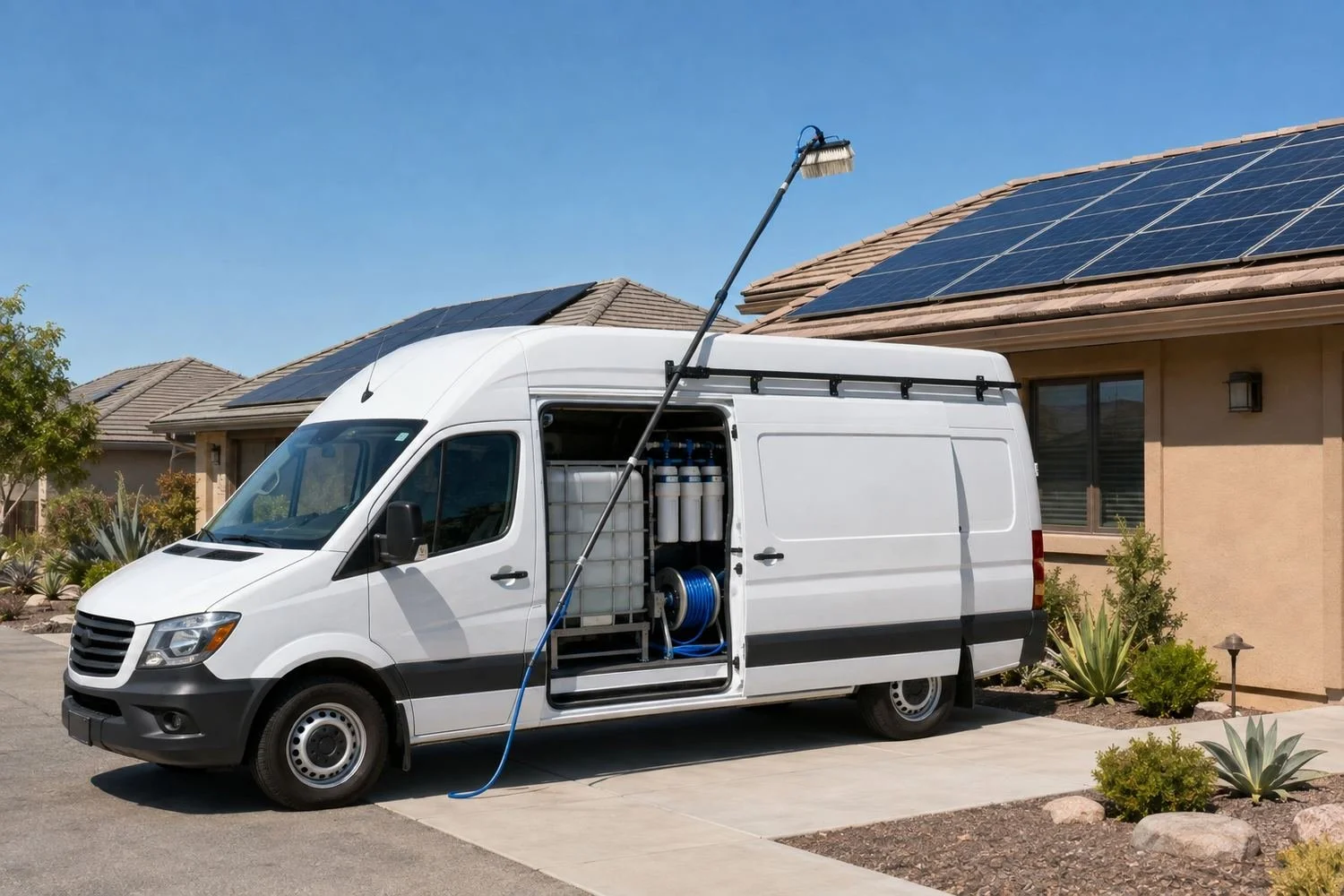
Solar-safe method, and both feet accounted for. Purified water and a soft solar-rated brush protect the panel coating and the manufacturer's warranty; disciplined fall protection protects the owner. Reaching from the ground with a water-fed pole is often both the safer answer and the faster one.
The recovered output quantified on every visit. The customer re-books for the generation they get back, so measure it and show it. Put a number on the return and the conversation stays about value; leave it off and it becomes about price.
Licenses, permits, and regulations
Solar panel cleaning carries no federal occupational license, which sounds simple and mostly is. It also means the real requirements sit in insurance and safety rather than in an exam, and there are two exposures that genuinely matter.
Work at height. Roof and fall-protection practice is where the claims in this trade come from, and it is the strongest argument for the ground-based method: a water-fed pole removes the exposure rather than managing it.
The electrical context. You are working around a live generating system, so the boundary between cleaning and any electrical or panel-handling work is worth knowing precisely — the far side of it belongs to a licensed professional, and crossing it turns a cleaning invoice into a liability claim.
Alongside both: a registered entity, general liability, commercial auto and workers' compensation once you hire. Local water-discharge rules may apply to the wash water. Start with your state and municipal offices and the free SBA "Apply for licenses and permits" tool. [S4] (General information, not legal advice — confirm your local requirements.)
Build a portfolio, not a job
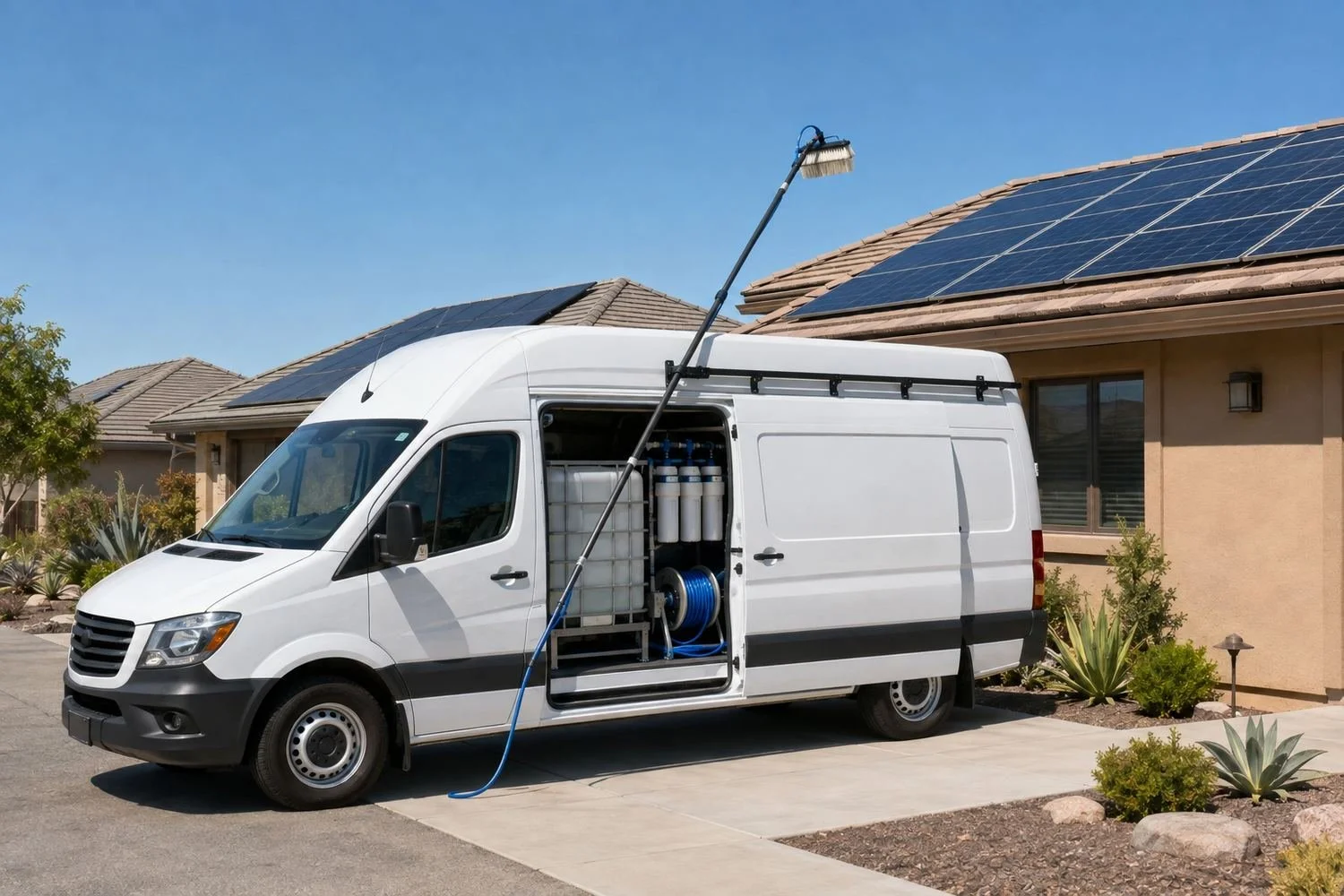
Solar panel cleaning is a route business: it stacks along a territory, on houses you are already visiting for something else. Its natural home is the exterior-services portfolio.
It pairs first with window & gutter cleaning — the anchor route it bolts onto, same customer, same visit, same ladder — then with power washing, another exterior service on the same territory and a different cycle. Roofing sits alongside as a referral relationship rather than a pairing: a roofer works project by project, not on a route, but every panel he steps around belongs to somebody who needs it cleaned. Referrals travel both ways there.
That is the difference between owning a service and owning a portfolio. The strong version of this is never a solar-cleaning operation standing by itself — it is a recurring, high-cash-flow layer added to an exterior route you already run, in a market where solar has taken hold. A portfolio like that, with a documented customer list and a recurring service schedule, sells to a buyer as one asset. That is how it ends up worth over a million dollars at sale, rather than a van full of brushes.
Frequently asked questions
Is a solar panel cleaning business profitable? It can be close to pure cash flow, measured honestly — after paying the crew and after paying someone a market wage to run the route. Dense solar adoption plus attachment to an existing exterior route is what makes that number work. Line both up and the return on the money and effort is strong.
How much does it cost to start a solar panel cleaning business? Roughly $5,000 to $15,000 for equipment and insurance. About $20,000 to $60,000 to buy an established route. A franchise is a different proposition — roughly $142,000 to $203,000 — because no one franchises panel cleaning alone; you are buying a bundled exterior-services system with the route attached.
Where does solar panel cleaning work best? In states with high residential solar adoption and strong incentive programs — much of the Southwest, California, and a growing list of others — where the installed base is dense enough to support a recurring route. That is what the geography tag is pointing at: the demand map is the solar-adoption map, and it is published.
Should I run it as a standalone business? It is built to be an attachment. Sold cold it carries the full cost of finding and educating every customer; attached to a window, gutter, or power-washing route where the trust already exists, it sells for almost nothing and returns almost pure cash flow. Buy or build the route first, then add the panels to it.
Where to go from here
Download the free guide.50 Boring Businesses That Make Millionaires is the full result of the research: fifty categories run against the four tests, what each one costs to enter by all three paths, what has to line up for it to work, and how they pair into a portfolio. Free at microbusinessmillionaire.com.
Read the book.The Microbusiness Millionaire: How Ordinary People Build Extraordinary Wealth One Microbusiness at a Time follows four people who each reached a portfolio worth more than a million dollars by a different path. One keeps a hospital job and uses CDFI financing to acquire one stable service business, then another, then a third. One saves on a single income for three years, leaves a master plumber's wage, and stacks trade service lines starting with an SBA microloan. One uses an SBA Community Advantage loan to open a franchise, then opens three more. One starts with about $5,000 on the side and keeps a W-2 for years, building the slowest and most patient version of the same result. Four starting points, four amounts of money, four portfolios worth over a million dollars at sale. The book is coming soon — join the email list at microbusinessmillionaire.com to hear when it lands.
Join the next cohort — Microbusiness Millionaire: Operating System. The book gives you clear examples of how it's done. The course is the step-by-step system for doing it yourself: screening a real company against the four tests, running the owner-replacement cash-flow math on a seller's actual numbers, knowing when to walk, knowing which lenders fund deals this size, and installing the manager who runs the business without you. Eight weeks online, five seats a cohort, waitlist first — at microbusinessmillionaire.com.
About the author
Chris Scott has spent more than twenty-five years in the small-business arena. As the director of a Community Development Financial Institution (CDFI), he reviewed loan applications and made the approve-or-decline decisions. Later, at the U.S. Small Business Administration (SBA), he monitored lending programs. Across those two roles, thousands of business plans and loan applications crossed his desk. He still works at the SBA, now in its venture capital division. His research into which microbusinesses build wealth — and which quietly build a job — became The Microbusiness Millionaire and the free companion guide, 50 Boring Businesses That Make Millionaires.
Sources & references
[S1] U.S. Bureau of Labor Statistics, Occupational Outlook Handbook: Grounds Maintenance Workers — used as the closest available labor proxy for exterior cleaning crews. bls.gov/ooh
[S2] U.S. Federal Trade Commission, Franchise Rule / FDD Items 7 and 19. ftc.gov. Franchise range shown reflects the published Item 7 estimated initial investment for Shine, a bundled exterior-services brand carrying panel cleaning as one service line (approximately $141,570–$203,095 for a single territory per the franchisor). No franchisor offers solar panel cleaning as a standalone concept; verify the current FDD before relying on any figure.
[S3] Opportunity Finance Network CDFI Locator (ofn.org); SBA Lender Match (sba.gov).
[S4] U.S. Small Business Administration, Apply for licenses and permits (sba.gov); state and municipal work-at-height, electrical-boundary, and water-discharge requirements.
[S5] U.S. Bureau of Labor Statistics, Occupational Employment and Wage Statistics, First-Line Supervisors of Landscaping, Lawn Service, and Groundskeeping Workers (SOC 37-1012), May 2025 — used as the closest published comparison to an exterior-route supervisor, consistent with the grounds-services proxy at [S1]. The loaded figure adds payroll taxes and insurance. bls.gov/oes
[Internal]50 Boring Businesses That Make Millionaires — Solar Panel Cleaning entry (tags, three-path entry-cost table, portfolio pairings, framework note, "what it takes to make this one work") and Window & Gutter Cleaning entry (pairings). Drawn from the author's research and filtered through the underwriting criteria he applied as a CDFI lender. State solar-adoption rates vary; consult current state energy-office and industry data for your market.
This article is for general information only and is not legal, financial, tax, or investment advice. Category-level figures are reference points, not a specific-deal projection; individual businesses vary. Consult a CPA, attorney, business broker, franchise consultant, or CDFI loan officer before acting.
Last updated: 8/25/2026.