

How to Start a Pool Service Business
Nobody fires the person who already has the gate code and keeps the pool from turning green, which makes the revenue behave far more like an annuity than like a service contract. Here is what a pool service business costs, what it pays after you replace yourself, and why the map decides more than the skill does.
Chris Scott — former CDFI director, SBA manager

As the director of a Community Development Financial Institution (CDFI), I reviewed loan applications and made the approve-or-decline decisions. Later, at the U.S. Small Business Administration (SBA), I monitored lending programs and saw which loans were approved and which were denied. Across those two roles, thousands of business plans and loan applications crossed my desk. I still work at the SBA, now in its venture capital division. That work is where I learned what a durable business looks like on paper, and what a business that only looks durable looks like on paper.
It is not, however, where the list of fifty came from. That came from years of research, running category after category through the same four questions: Is it profitable? Does it have recurring revenue? Is it recession resistant? Is it AI resistant? Those four questions are the framework behind the book, The Microbusiness Millionaire, and they are what separated the categories that built real wealth from the ones that quietly built a job with a P&L attached. Fifty survived the screen. Far more never made it through.
Pool service is one of the fifty, and its revenue genuinely behaves like an annuity — weekly, billed monthly, from customers who almost never leave.
It carries a single condition that settles everything, and that condition is printed on a map. Where the geography supports year-round routes, the recurring revenue never pauses and the route compounds without interruption. Where it does not, the same business needs a second season attached to it, and the rest of this article is about both.
The industry: recurring, sticky, and geographically concentrated
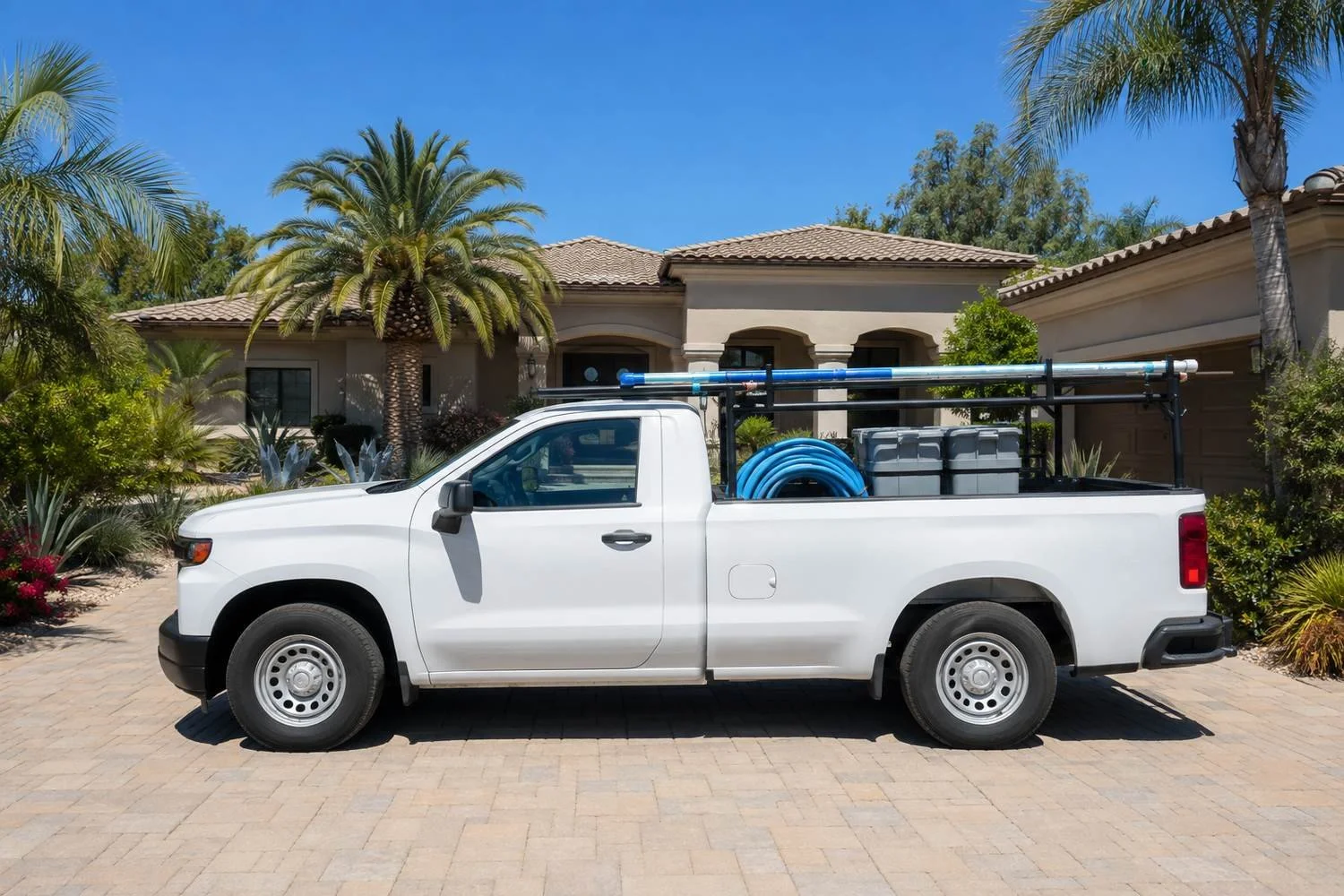
U.S. swimming pool cleaning services are about $8.8 billion in 2025, growing at a 4.2% compound rate over the prior five years. [S1] It is a market built almost entirely of small local route owners, and it clusters hard in the warm-climate states — Florida, Arizona, Southern California, Texas, and the Gulf Coast — where pools run year-round and the recurring revenue never pauses for winter.
The labor benchmark comes from grounds and building maintenance work. [S2] The wage to plan against varies more from one metro to the next than it does from one service category to another. Look yours up before you price a route. This is a hire-and-train business with a chemical-handling certification layered on top — no scarce credential gating entry, which is why the geography, not the skill, is the structural advantage. That wage is the price of replacing yourself — what a manager would have to be paid to do the work you would otherwise be doing. Every profit number later in this article has to survive it, and the real cost runs higher once payroll taxes and insurance go on top.
Why pool service made the list
Every category in the research had to clear four tests. Clear three and you usually have a self-employed job in disguise.
Does it pay after you replace yourself? It does where the geography supports year-round routes, which is what this category's one tag is about. Route density is what makes replacing the owner affordable, and density is a function of the map.
Does the revenue recur? About as reliably as recurring revenue gets. Pool service is weekly, billed monthly, and the customer who hands over a key to the gate does not go shopping every spring. It is subscription revenue in all but name.
Does it survive a recession? In the year-round markets, well. A pool is a large sunk asset that has to be maintained or it turns green and becomes a liability — and a household that owns a pool has already signaled the income to keep it serviced. Maintenance holds better than discretionary spend.
Will it still need humans in ten years? Someone has to test the water, balance the chemicals, clean the filter and look over the equipment, at a different pool every stop. Robotic cleaners handle part of the surface. The chemistry and the service call stay human.
Four for four, in the right market.
The research on this category separated on latitude rather than on the owner. Two versions of the same business turn up repeatedly. One runs in a year-round market with an average customer of seven years, bills monthly whether the visit happened this week or not, and holds churn near zero because nobody fires the person who already has the gate code and keeps the pool from turning green. The other runs the identical service in a four-season state — same revenue per customer, same skill — with four months of season and eight months of scrambling. From the lending side of the desk those are completely different files, and the difference is visible before either business has traded a day. It is not effort or execution. It is the map, and the encouraging part is that it is knowable before a dollar is committed.
What it takes to make this one work
A note on the tags. Every category in the fifty cleared the same four tests; far more never made it through. The tags do not grade a business — they tell you what has to line up for it to work in your hands. Pool service carries one: Right geography. That is the instruction manual.
The condition: pool service compounds where pools run year-round — Florida, Arizona, Southern California, Texas, the Gulf Coast. In those markets the concentration is the entire advantage. In a four-month northern season the arithmetic is different: you earn for a third of the year and carry costs the rest.
The move that meets it: match the approach to the map, and the map is free to check before you commit anything.
In a year-round market, concentrate. Build route density in a tight geographic cluster, because density is what collapses drive time and is where the money in this category actually comes from.
In a seasonal market, pair pool service with a winter service so the same customers and crew stay productive through the cold months — pool closing and winterizing first, then snow removal or holiday light installation. That turns four months of revenue into twelve. If a winter pairing is not practical where you are, the guide's other forty-nine categories are there; that is what having a list is for. What does not work is running a four-month business as though it were a year-round one.
The upside: in a year-round market the revenue behaves like an annuity rather than like a sale you have to make again. Weekly service, monthly billing, and a customer who does not shop around for the person who already has a key to the gate.
Route density means a technician services dozens of pools a week within a few miles, every one of them recurring and predictable. Retention runs high, what you spent to win a customer is repaid for years, and a dense, long-tenured route is exactly the asset a buyer pays a strong multiple for. Where the map cooperates, the cash is about as predictable as service revenue gets: the same stops, the same week, billed whether or not anyone had to be persuaded.
What it costs to get in — the three paths

| Path | Typical cost range | Best for |
|---|---|---|
| Startup | $10,000 – $25,000 | Truck + equipment + chemical certification |
| Acquisition | $137,500 – $271,000 | Established route density |
| Franchise | $88,000 – $213,000 | Routes + chemical sourcing |
Franchise brands are named as examples, not endorsements. Franchise examples: ASP, Pool Scouts. Franchise investment figures reflect a franchisor's most recent Franchise Disclosure Document (FDD) and change annually — verify each brand's current FDD (Item 7 for the initial-investment range; Item 19 for any financial-performance representation) before pursuing one. [S3]
Notice what the acquisition row actually buys: "established route density." That is the whole asset in pool service.
And notice where the franchise row sits relative to it. At the top end a franchise costs more than a built route does, and the two buy opposite things: the route comes with the customers and no brand, the franchise comes with the brand and no customers. In a category where density is the asset, that is a comparison worth making deliberately rather than by default.
A built route in a tight, year-round cluster — recurring billing and near-zero churn already in place — is worth far more than a truck and a test kit, because density takes years to build and is where the money comes from. Buying a good route in the right market is often the strongest entry available.
How people actually fund it
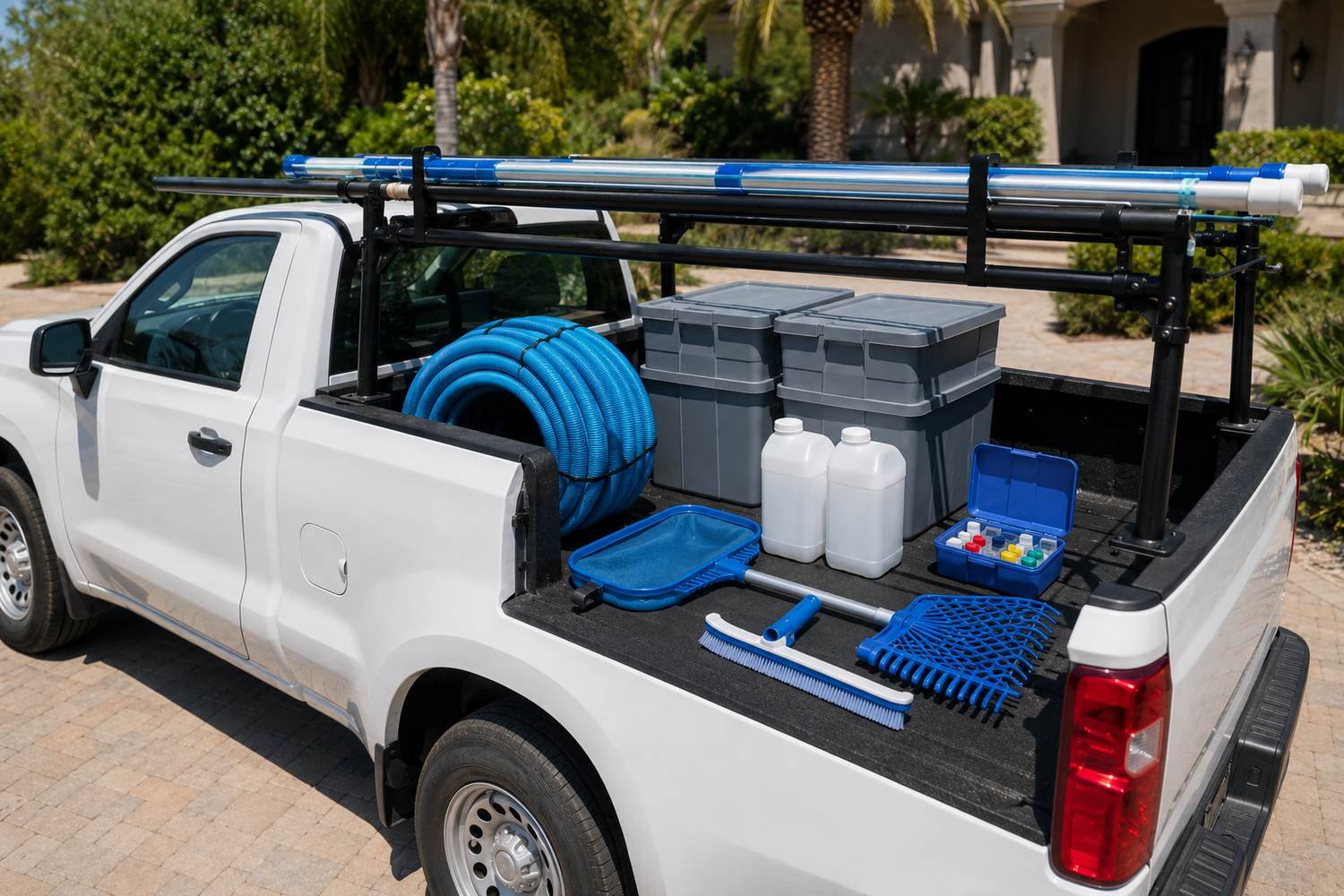
A $10,000–$25,000 startup comes from savings or a small loan — the entry tier where a business gets built alongside a paycheck.
A $137,500–$271,000 route acquisition is where a lender enters, and it sits in CDFI direct lending and SBA Community Advantage territory. That is the rung the book follows most closely for acquisitions, buying recurring, key-holding routes one at a time — which is very nearly a description of this category.
One pattern I watched from the lending chair: a qualified buyer walks into a national bank, gets declined, and concludes they cannot be funded. They never learn that a CDFI across town, or a Community Advantage lender, exists precisely for deals this size. Two free national directories will show you the ones near you — the Opportunity Finance Network CDFI locator and SBA Lender Match. [S4]
Finding the lender is the easy half. A pool route also has two specific strengths an underwriter looks for: account tenure and route density. A customer list where the average account has stayed seven years, clustered tightly enough that a technician services dozens a week within a few miles, behaves like an annuity — and a lender reading those two numbers prices the deal very differently from one reading only a customer count. Start recording the tenure and the density map before anyone asks.
The profit reality: owner-replacement cash flow

Here is the calculation that decides more of these deals than anything else in them. A pool business looks profitable because the owner is running the route, balancing the chemicals, billing, and doing the books — none of it priced. The honest test: after you pay the technicians, and after you pay someone a market wage to run the route the way you run it, is there enough left for you to own the thing?
Real numbers. Start with what a route technician costs in your area. [S2] But the technician is not the number that decides this test, because a technician replaces your hands, not your judgment. The number that decides it is the manager. Using the same grounds-services family as the closest published comparison, find what a first-line supervisor earns where you operate. Then put payroll taxes and insurance on top — the loaded cost is the one the routes have to carry. [S6] That is the person who runs the route the way you run it: schedules the stops, handles the chemistry questions, and takes the call when a pump fails on a Friday. Whatever the business reports as profit has to survive paying the technicians and that.
This is exactly where the geography tag becomes arithmetic. In a dense, year-round market a technician services enough pools per day that the truck and the wage are spread across many stops, and the cash left over holds. In a scattered or seasonal market the same wage is spread across fewer stops and fewer months, and it does not. The map is not a preference here. It is the denominator.
The category-level math is easy — you just did it. Running it on a specific route, where the seller's "profit" includes his own service hours and the true route density is buried in the stop list, is where people freeze. That is the job of the course, Microbusiness Millionaire: Operating System — the four tests turned into a repeatable screen you run on a real deal.
The benefits of owning a pool service business
Annuity-like recurring revenue. Weekly service, monthly billing, in a year-round market.
Near-zero churn. Nobody fires the person who has the gate code and keeps the pool clear.
Route density compounds. Dozens of stops within a few miles is where the money in this category comes from.
A large sunk asset behind every customer. Pool owners maintain, because a neglected pool becomes a liability fast.
A route is a sellable asset. Dense, long-tenured routes with a documented customer list command strong buyer multiples.
What separates the strong owners from the struggling ones
The map checked first. The defining decision in this category, and it costs nothing to make. Confirm whether your market runs year-round before anything else, and either concentrate or plan the winter pairing accordingly.
Density before reach. A pool twenty minutes out costs you the stops you could have made instead. Build a tight cluster, then widen it.
Chemistry done properly. Balancing is the skill that keeps customers and keeps you out of trouble. Get certified and get it right, and the retention this category is known for follows.
The stop priced at its true cost. Monthly billing has to cover chemicals, drive time and equipment wear. Price the real cost of the visit and the route still works at scale.
The equipment repair kept in-house. Pumps, filters and heaters fail, and the technician already standing there is the natural person to fix them. That work is worth having rather than handing to someone else.
Licenses, permits, and regulations
Pool service licensing varies by state and locality, and three of the requirements are worth separating because they can each catch you out differently.
The license. Some states require a pool or pool-servicing contractor license; others do not require one at all. Confirm which yours is before you quote a job.
The chemistry. Chemical handling and application commonly require a certification, and chemical storage and transport are regulated separately from the work itself. This is the part most new owners underestimate, because the certification is straightforward but the storage rules are not.
The repair work. Equipment or plumbing repair can cross into licensed-trade territory — which matters here, because equipment repair is one of the most profitable things a technician standing at the pool can do. Know where your line is before you take the work.
Some jurisdictions also have specific rules for commercial pool servicing at apartments, HOAs and hotels. Beyond all that: a registered entity, general liability, commercial auto, and workers' compensation once you hire. Start with your state and municipal offices and the free SBA "Apply for licenses and permits" tool. [S5] (General information, not legal advice — confirm your local requirements.)
Build a portfolio, not a job
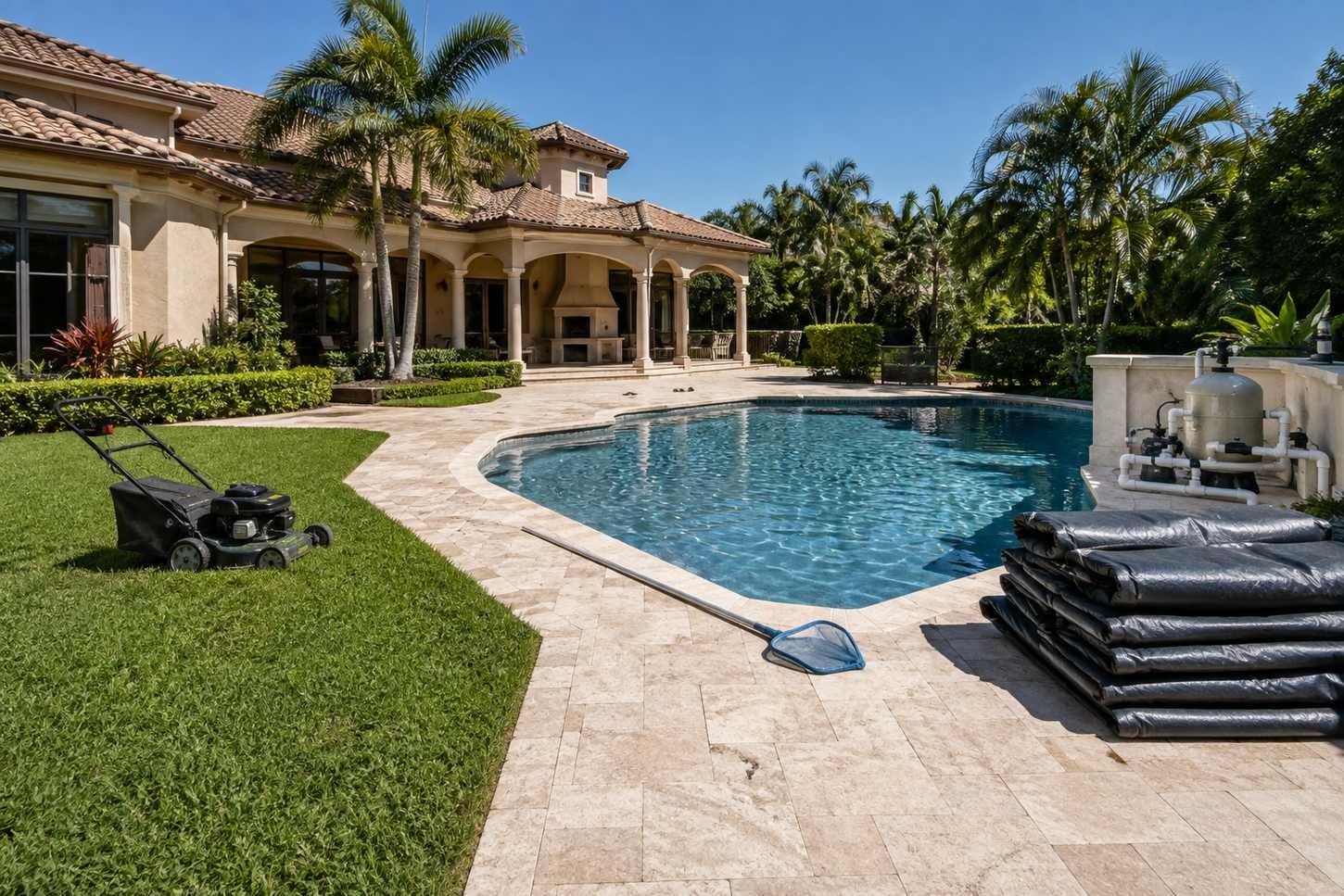
Pool service is a natural recurring-revenue anchor and a route business: it stacks along a territory, on backyards you are already visiting every week. In a seasonal market the pairing is not an optional refinement — it is the fix.
It pairs with pool closing and winterizing, the seasonal bookend to the summer route; with holiday light installation, the November-to-January revenue that fills a northern off-season; and with cleaning, another recurring, key-holding relationship with the same household. In a year-round market the pool route is strong enough to anchor a portfolio on its own. In a seasonal one it needs a winter partner to become a full-year business.
That is the difference between owning a route and owning a portfolio. You are not building a pool-cleaning operation. You are building the recurring-services vendor a few hundred households rely on, anchored by weekly work with a key to the gate. A portfolio like that, with a documented customer list and years of account tenure behind it, sells to a buyer as one asset — which is how it ends up worth over a million dollars at sale, instead of a truck and a net.
Frequently asked questions
Is a pool service business profitable? In a year-round market, yes — the revenue behaves like an annuity, with weekly service, monthly billing and near-zero churn. The honest test is whether it still produces cash after paying technicians and a manager, and route density in a warm-climate cluster is what makes that math work. In a four-month season the same business needs a winter service attached to it.
How much does it cost to start a pool service business? Roughly $10,000–$25,000 for a truck, equipment, and chemical certification. About $137,500–$271,000 to buy an established route — where you are really buying route density — or $60,000–$115,000 for a franchise.
Where is pool service most profitable? In year-round pool markets — Florida, Arizona, Southern California, Texas, and the Gulf Coast — where routes run all twelve months and density compounds. This is the category's single tag: the geography is the structural advantage.
What do I do if I am in a cold-weather state? Pair it. Combine the summer pool route with pool closing and winterizing, then a winter service such as snow removal or holiday lights, so the same customers and crew stay productive year-round. If that is not practical where you are, the guide's other categories are there — the thing that does not work is running a four-month business as though it were a twelve-month one.
Where to go from here
Download the free guide.50 Boring Businesses That Make Millionaires is the full result of the research: fifty categories run against the four tests, what each one costs to enter by all three paths, what has to line up for it to work, and how they pair into a portfolio. Free at microbusinessmillionaire.com.
Read the book.The Microbusiness Millionaire: How Ordinary People Build Extraordinary Wealth One Microbusiness at a Time follows four people who each reached a portfolio worth more than a million dollars by a different path. One keeps a hospital job and uses CDFI financing to acquire one stable service business, then another, then a third. One saves on a single income for three years, leaves a master plumber's wage, and stacks trade service lines starting with an SBA microloan. One uses an SBA Community Advantage loan to open a franchise, then opens three more. One starts with about $5,000 on the side and keeps a W-2 for years, building the slowest and most patient version of the same result. Four starting points, four amounts of money, four portfolios worth over a million dollars at sale. The book is coming soon — join the email list at microbusinessmillionaire.com to hear when it lands.
Join the next cohort — Microbusiness Millionaire: Operating System. The book gives you clear examples of how it's done. The course is the step-by-step system for doing it yourself: screening a real company against the four tests, running the owner-replacement cash-flow math on a seller's actual numbers, knowing when to walk, knowing which lenders fund deals this size, and installing the manager who runs the business without you. Eight weeks online, five seats a cohort, waitlist first — at microbusinessmillionaire.com.
About the author
Chris Scott has spent more than twenty-five years in the small-business arena. As the director of a Community Development Financial Institution (CDFI), he reviewed loan applications and made the approve-or-decline decisions. Later, at the U.S. Small Business Administration (SBA), he monitored lending programs. Across those two roles, thousands of business plans and loan applications crossed his desk. He still works at the SBA, now in its venture capital division. His research into which microbusinesses build wealth — and which quietly build a job — became The Microbusiness Millionaire and the free companion guide, 50 Boring Businesses That Make Millionaires.
Sources & references
[S1] IBISWorld, Swimming Pool Cleaning Services in the US (NAICS OD4832), 2025 — market size $8.8bn; 4.2% CAGR 2020–2025. ibisworld.com
[S2] U.S. Bureau of Labor Statistics, Occupational Outlook Handbook: Grounds Maintenance Workers — used as the closest available labor proxy for route service technicians. bls.gov/ooh
[S3] U.S. Federal Trade Commission, Franchise Rule / FDD Items 7 and 19. ftc.gov. Franchise range shown is anchored on the published Item 7 estimated initial investment for ASP — America's Swimming Pool Company (approximately $88,695–$213,171 per the franchisor's current FDD). Other brands in the category differ; verify each current FDD before relying on any figure.
[S4] Opportunity Finance Network CDFI Locator (ofn.org); SBA Lender Match (sba.gov).
[S5] U.S. Small Business Administration, Apply for licenses and permits (sba.gov); state pool-servicing licensing and chemical-handling certification requirements.
[S6] U.S. Bureau of Labor Statistics, Occupational Employment and Wage Statistics, First-Line Supervisors of Landscaping, Lawn Service, and Groundskeeping Workers (SOC 37-1012), used as the closest published comparison to a pool route supervisor and consistent with the grounds-services proxy at [S2]. bls.gov/oes
[Internal] 50 Boring Businesses That Make Millionaires — Pool Service entry (tag, three-path entry-cost table, portfolio pairings, framework note, "what it takes to make this one work"), drawn from the author's research and filtered through the underwriting criteria he applied as a CDFI lender.
This article is for general information only and is not legal, financial, tax, or investment advice. Category-level figures are reference points, not a specific-deal projection; individual businesses vary. Consult a CPA, attorney, business broker, franchise consultant, or CDFI loan officer before acting.
Last updated: 8/24/2026