

How to Start a Personal Training Business
People do not cancel the person who knows their knee, their history and their goals, which is why retention in this category behaves differently from a gym membership. Here is what a personal training business costs, what it pays after you replace yourself, and why one decision — whether you sign a lease or go to the client — settles almost everything else.
Chris Scott — former CDFI director and SBA management

As the director of a Community Development Financial Institution (CDFI), and as management at the U.S. Small Business Administration (SBA), I saw thousands of business plans and loan applications cross my desk. That work is where I learned what a durable business looks like on paper, and what a business that only looks durable looks like on paper.
It is not, however, where the list of fifty came from. That came from years of research, running category after category through the same four questions: Is it profitable? Does it have recurring revenue? Is it recession resistant? Is it AI resistant? Those four questions are the framework behind the book, The Microbusiness Millionaire, and they are what separated the categories that built real wealth from the ones that quietly built a job with a P&L attached. Fifty survived the screen. Far more never made it through.
Personal training is one of the fifty, and it is one you can start for the price of a certification and a set of equipment while keeping your paycheck. It is also a category where a single structural choice decides almost everything: whether you sign a lease or go to the client.
A word on how this differs from a mid-market fitness studio, since both are on the list and both sell fitness.
A studio sells a membership. It is a facility, billed monthly whether the member trains or not, and it lives or dies on churn and how many bodies the room holds. Personal training sells a person's time and attention. It is a route, priced per session or per package, and it lives on retention — the client who stays for years because you are their trainer.
A studio is built on occupancy. Training is built on relationships. They pair well and many operators end up running both, but the money behaves differently, and the mistake is starting one while pricing it like the other.
Get the lease-or-mobile choice right and this becomes a durable, high-cash-flow business with almost nothing on the balance sheet to weigh it down.
The industry: large, fragmented, and growing fast
The U.S. personal-training market runs about $11.9 billion in 2025 and has grown at roughly an 8.2% compound rate over the past five years. [S1] It is highly fragmented — no company holds even a 5% share — which is the structure that rewards an independent operator competing on results and relationship rather than scale.
The labor picture is strong. Fitness trainers and instructors hold 370,100 jobs, with employment projected to grow 12% from 2024 to 2034 against 3% across all occupations — four times the average rate. [S2]
What one of those trainers earns is worth holding on to, because it is not really a salary figure for your purposes. It is the price of your own replacement. Look up the trainer wage for your own market, then load payroll taxes and insurance on top. Every rate you set has to clear that number before a dollar of it is yours. Keep it in mind for the profit section below — it is the whole test. Every profit number later in this article has to survive it, and the real cost runs higher once payroll taxes and insurance go on top.
Demand is rising for two reasons worth separating: an aging population that wants to stay healthy longer, and specialization in areas like senior fitness and recovery, where the need is greatest and the pricing follows.
Why personal training made the list
Every category in the research had to clear four tests. Clear three and you usually have a self-employed job in disguise.
Does it pay after you replace yourself? It can, in the right model. Sessions and small-group training price high enough that once you have built a client list and the systems around it, you can bring on trainers, keep a coordinator, and still hold real cash flow — because clients are paying for outcomes and accountability rather than for the room.
Does the revenue recur? Personally and stubbornly. A good trainer keeps clients for years, and the relationship is hard to interrupt: people do not cancel the person who knows their knee, their history, and their goals. Reputation compounds — a visible transformation sends the next three clients.
Does it survive a recession? It holds up better than most discretionary services, especially in the personal, results-driven tier. Health spending on an ageing body is among the last things people give up entirely, and mobile/in-home models keep overhead low enough to ride out soft patches.
Will it still need humans in ten years? Coaching form, adjusting for an injury and holding a real person accountable in real time is exactly the work software cannot do. An app can count the reps. It cannot see the shoulder drop on the eighth one. Very low AI exposure.
Four for four, in a trade the Bureau of Labor Statistics expects to grow four times faster than the average occupation over the next decade.
The research on this category kept coming down to one decision, and it was never about programming. One operator signs a lease and builds out a studio — a good space, but rent comes due every month whether members show or not, and churn means constantly refilling a leaking bucket. The other runs the mobile model: goes to clients' homes, carries the equipment in a bag, and pays rent to nobody. The overhead is almost nothing, the numbers are clean, and the clients stay for years because she is their trainer rather than a membership they keep meaning to cancel. Same certification, same skill. From the lending side of the desk the difference is not subtle: one applicant is asking to finance a business that carries real-estate risk before it earns a dollar, and the other has designed that risk out of the model entirely. The second is a much shorter conversation.
What it takes to make this one work
A note on the tags. Every category in the fifty cleared the same four tests; far more never made it through. The tags do not grade a business — they tell you what has to line up for it to work in your hands. Personal training carries one: Solo first. That is the instruction manual.
The condition: a leased studio brings rent and member churn along with it. Real-estate dependency is the structural piece that can pull this category out of the framework's lane, because a monthly lease turns a clean, low-overhead service into a business that has to fill seats before it earns anything.
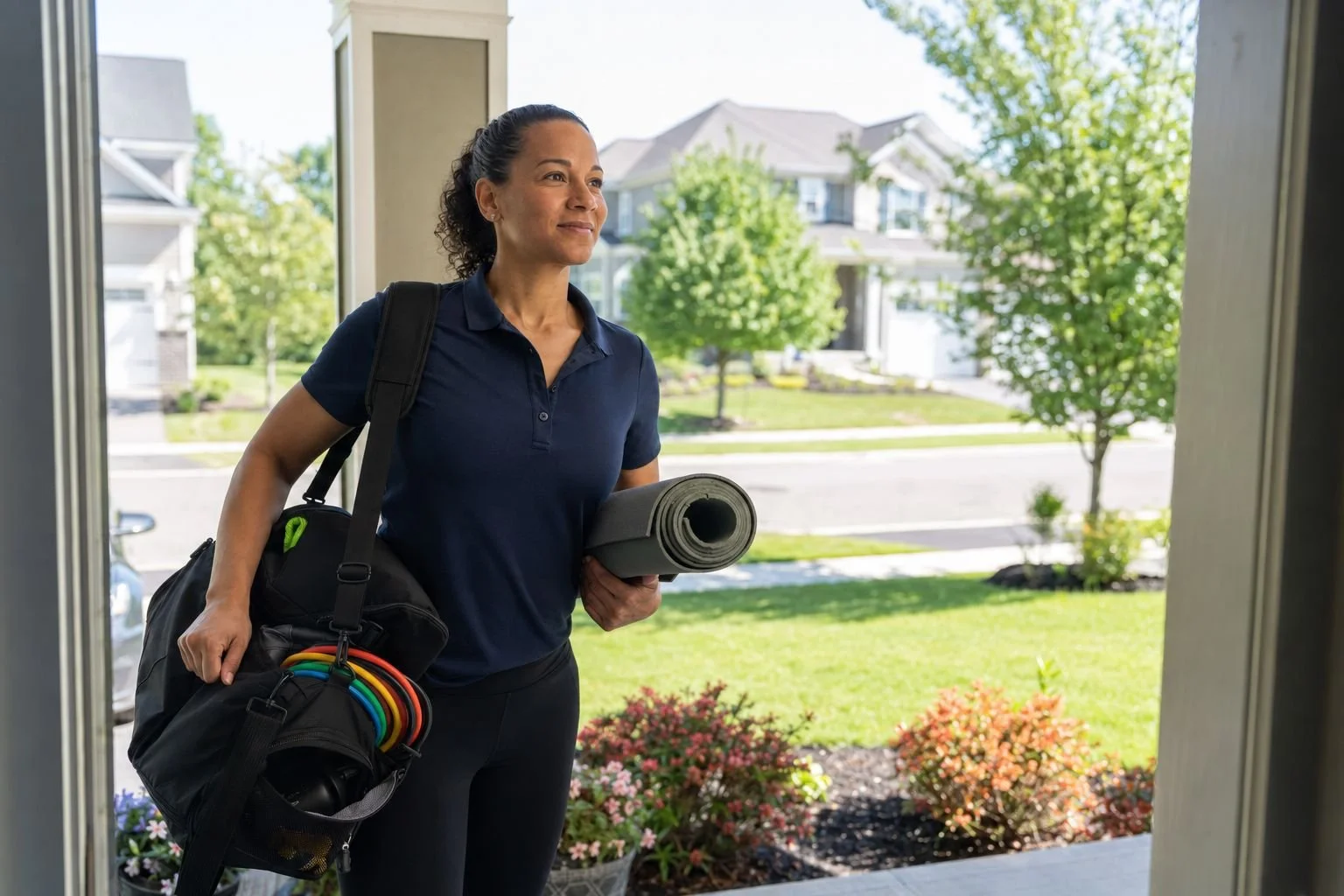
The move that meets it: run the mobile and in-home model, where you go to the client and carry no real estate at all. It is already proven at scale — GymGuyz has built a franchise system of well over a hundred locations on exactly this, with no storefront under any of them — and it starts for a fraction of a studio buildout.
It is worth seeing what the other road costs, because the fitness and rehab world has plenty of franchises built the opposite way. A clinic-based brand will walk you through site selection, lease negotiation and a build-out of roughly two thousand square feet before you treat a single client, and the investment runs to several hundred thousand dollars. That is a legitimate business. It is simply a different one, and it carries the rent risk this category is otherwise free of.
That single choice changes the risk profile of the whole business: no lease, no buildout, no churn arithmetic. Just you, the client, and a bag of equipment.
The upside: designed that way, there is almost nothing on the balance sheet to weigh the business down — no lease, no buildout, no equipment finance. Startup runs a couple of thousand dollars for certification and gear, there is no rent to cover before you earn anything, and demand is durable and personal — clients stay for years because the relationship is the product. You can start solo on the side and let the cash flow fund whatever you build next.
What it costs to get in — the three paths

| Path | Typical cost range | Best for |
|---|---|---|
| Startup (solo trainer) | $2,000 – $10,000 | Certification + equipment + initial marketing |
| Acquisition | ~$80,000 – $200,000 | Client list + equipment |
| Franchise (mobile) | $92,000 – $174,000 | Brand + no real estate (example: GymGuyz) |
Franchise brands are named as examples, not endorsements. Franchise investment figures reflect a franchisor's most recent Franchise Disclosure Document (FDD) and change annually — verify each brand's current FDD (Item 7 for the initial-investment range; Item 19 for any financial-performance representation) before pursuing one. [S3]
The solo startup is cheap because of what it does not require: no vehicle beyond the one you already drive, no premises, and no equipment you cannot carry in one bag. A certification, a set of portable gear, and enough marketing to land your first clients.
Notice that even the franchise path here is built to be mobile: the brands worth looking at let you skip the real estate rather than commit to it. And the acquisition path buys the thing that takes longest to build — an existing client list — which is worth considering if you would rather step into a full calendar than fill one.
How people actually fund it

Most people start this one out of pocket. A couple of thousand dollars is within reach without a loan, which is why it is such a strong side entry.
When you do want capital — to acquire a client list or open a small studio — an $80,000 to $200,000 deal sits in CDFI direct lending and SBA Community Advantage territory. That upper rung is where the book's franchise path runs, building in senior services, which is the world where fitness and care overlap.
One pattern I watched from the lending chair, across every industry that came through: a qualified buyer walks into a national bank, gets declined, and concludes they cannot be funded. They never learn that a CDFI across town, or a Community Advantage lender, exists precisely for deals this size. Two free national directories will show you the ones near you — the Opportunity Finance Network CDFI locator and SBA Lender Match. [S4]
Finding the lender is the easy half. A training business also has a specific tell an underwriter looks for: retained clients and prepaid packages rather than a churn of one-off sessions, and whether there is a lease sitting under the model at all. A retained, prepaying client list is far more bankable than a busy but leaky calendar, because one of those transfers to a new owner and the other largely leaves with you. Start recording both before anyone asks for them.
The profit reality: owner-replacement cash flow

Here is the calculation that decides more of these deals than anything else in them. A training business looks profitable because the owner is running every session, doing the scheduling, chasing the clients, and keeping the books — none of it priced separately. The honest test: after you pay your trainers, and after you pay a lead trainer a market wage to run sessions the way you run them, is there enough left for you to own the thing?
This is where the model choice becomes arithmetic. A studio operator carries rent before paying anyone, which consumes exactly the room a second trainer's wage has to come out of.
A mobile operator with retained, prepaying clients and no lease sets rates that cover a lead trainer and still leave real cash flow for the owner. Same certification, completely different ability to replace the owner — decided by whether real estate was taken on. With no rent in front of it, the mobile model gives the owner's replacement wage somewhere to come from — which is the whole reason the structural choice decides the profit question.
The category-level math is easy — you just did it. Running it on a specific company, where the seller's "profit" is really his own unpriced coaching hours and the lease-versus-mobile structure changes everything, is where people freeze. That is the job of the course, Microbusiness Millionaire: Operating System — the four tests turned into a repeatable screen you run on a real deal.
The benefits of owning a personal training business
A very low solo entry. A couple of thousand dollars for certification and equipment, with no premises and no vehicle to finance.
No real estate, done right. The mobile and in-home model carries no lease, which keeps the numbers clean and the risk low.
Client relationships that stick. People do not cancel the trainer who knows their body — retention is the asset.
A labor market growing four times faster than average. Growth of 12% projected against 3% across all occupations, driven by an aging, health-focused population.
Very low AI exposure. Real-time coaching and accountability need a person in the room.
What separates the strong operators from the struggling ones
Mobile before a lease. The defining decision in this category. Stay mobile until a studio is genuinely justified by the numbers, and the business carries no real-estate risk while it is still proving itself.
Outcomes packaged, not hours sold. Price for results and retention rather than billable sessions, and the client relationship becomes the asset instead of the calendar.
A client list built past your own two hands. A list a lead trainer can take over is what turns this from a job into something sellable. Start handing sessions over before you need to.
A specialization chosen. Senior fitness, recovery and post-rehab carry premium pricing and durable demand. Position where the need is greatest and the rate follows.
Licenses, permits, and regulations
Personal training is lightly regulated compared with the building trades, but a few things are worth confirming rather than assuming: three things are worth confirming rather than assuming.
A nationally recognized certification — NASM, ACE, NSCA, ACSM and similar — is the practical standard clients and facilities expect, even where no law demands one. Liability insurance is essential given the physical nature of the work, and you should have it before your first paid session rather than after. And a home-based or studio operation may trigger local zoning, occupancy or business-registration rules that a mobile operator working in clients' homes often avoids entirely.
Working with older or medical-history clients may call for additional credentials or physician clearance. Start with your certifying body and the free SBA "Apply for licenses and permits" tool. [S5] (General information, not legal advice — confirm your local requirements and carry appropriate liability coverage before you take paid clients.)
Build a portfolio, not a job

Personal training anchors a wellness cluster built around the same client, and in the mobile model it stacks the way route businesses do — along a territory, on households you are already driving to.
It pairs most naturally with nutrition coaching, the other half of nearly every fitness goal, sold to someone you are already training. It extends into recovery and massage services, and through the senior-fitness door into senior care and personal chef and meal prep, where an aging client's household needs training, care and specialized meals together. The operator who trains the client, guides their nutrition and connects into their broader care becomes the single wellness relationship a household keeps for years.
That is the difference between owning a job and owning a portfolio. You are not building a schedule around your own hours. You are building the wellness relationship a few hundred clients depend on, anchored by retained training work that carries no rent. A portfolio like that, with a documented client list and no real estate weighing it down, sells to a buyer as one asset — which is how it ends up worth over a million dollars at sale, instead of a calendar full of your own sessions.
Frequently asked questions
Is a personal training business profitable? In the mobile and in-home model, yes, and cleanly, because there is no lease to cover first. The honest test is whether it still produces cash after paying a lead trainer to replace your session hours, and retained, prepaying clients with low overhead are what make that math close.
How much does it cost to start a personal training business? As little as $2,000 to $10,000 to start solo with certification, equipment and initial marketing, because there are no premises and no vehicle to finance. About $80,000 to $200,000 to acquire an established client list, or $92,000 to $174,000 for a mobile franchise that skips the real estate.
Do I need a certification to start? A nationally recognized certification (NASM, ACE, NSCA, ACSM, or similar) is the practical standard, and liability insurance is essential. Confirm any local registration or zoning rules for a home or studio operation. [S5]
Should I open a studio or go mobile? The mobile/in-home model fits the framework better because it carries no real estate and no member-churn math. A leased studio can work, but only with the capital and retention plan to support the rent — start mobile unless a studio is clearly justified.
Where to go from here
Download the free guide.50 Boring Businesses That Make Millionaires is the full result of the research: fifty categories run against the four tests, what each one costs to enter by all three paths, what has to line up for it to work, and how they pair into a portfolio. Free at microbusinessmillionaire.com.
Read the book.The Microbusiness Millionaire: How Ordinary People Build Extraordinary Wealth One Microbusiness at a Time follows four people who each reached a portfolio worth more than a million dollars by a different path. One keeps a hospital job and uses CDFI financing to acquire one stable service business, then another, then a third. One saves on a single income for three years, leaves a master plumber's wage, and stacks trade service lines starting with an SBA microloan. One uses an SBA Community Advantage loan to open a franchise, then opens three more. One starts with about $5,000 on the side and keeps a W-2 for years, building the slowest and most patient version of the same result. Four starting points, four amounts of money, four portfolios worth over a million dollars at sale. The book is coming soon — join the email list at microbusinessmillionaire.com to hear when it lands.
Join the next cohort — Microbusiness Millionaire: Operating System. The book gives you clear examples of how it's done. The course is the step-by-step system for doing it yourself: screening a real company against the four tests, running the owner-replacement cash-flow math on a seller's actual numbers, knowing when to walk, knowing which lenders fund deals this size, and installing the operator who runs the business without you. Eight weeks online, five seats a cohort, waitlist first — at microbusinessmillionaire.com.
About the author
Chris Scott has spent more than twenty-five years in the small-business arena. As the director of a Community Development Financial Institution (CDFI) and as management at the U.S. Small Business Administration (SBA), he saw thousands of business plans and loan applications cross his desk. His research into which microbusinesses build wealth — and which quietly build a job — became The Microbusiness Millionaire and the free companion guide, 50 Boring Businesses That Make Millionaires.
Sources & references
[S1] IBISWorld, Personal Trainers in the US (NAICS OD4189), 2025 — market size ~$11.9bn; ~8.2% CAGR 2020–2025; highly fragmented (no company above 5% share). ibisworld.com
[S2] U.S. Bureau of Labor Statistics, Occupational Outlook Handbook: Fitness Trainers and Instructors (370,100 jobs; 12% projected growth 2024–34, much faster than average). bls.gov/ooh
[S3] U.S. Federal Trade Commission, Franchise Rule / FDD Items 7 and 19. ftc.gov
[S4] Opportunity Finance Network CDFI Locator (ofn.org); SBA Lender Match (sba.gov).
[S5] U.S. Small Business Administration, Apply for licenses and permits (sba.gov); recognized personal-training certifications (NASM, ACE, NSCA, ACSM); state and local registration, zoning, and liability-insurance requirements.
[Internal]50 Boring Businesses That Make Millionaires — Personal Training & Small-Studio Fitness entry (tag, three-path entry-cost table, portfolio pairings, framework note, "what it takes to make this one work"), drawn from the author's research and filtered through the underwriting criteria he applied as a CDFI lender.
This article is for general information only and is not legal, financial, tax, or investment advice. Category-level figures are reference points, not a specific-deal projection; individual businesses vary. Consult a CPA, attorney, business broker, franchise consultant, or CDFI loan officer before acting.
Last updated: 8/23/2026.